. 2010 Jan 22;469(2):268-72.
doi: 10.1016/j.neulet.2009.12.012. Epub 2009 Dec 17.

Human embryonic kidney (HEK293) cells express endogenous voltage-gated sodium currents and Na v 1.7 sodium channels

Affiliations

Human embryonic kidney (HEK293) cells express endogenous voltage-gated sodium currents and Na v 1.7 sodium channels

Bingjun He et al. Neurosci Lett. .

Abstract

Human embryonic kidney (HEK293) cells are widely used for the heterologous expression of voltage- and ligand-gated ion channels. Patch clamp analysis of HEK293 cells in the whole-cell configuration identified voltage-gated, rapidly inactivating inward currents. Peak current amplitudes ranged from less than 100 pA to more than 800 pA, with the majority (84 of 130 cells) in the 100-400 pA range. Transient inward currents were separated into three components on the basis of sensitivity to cadmium and tetrodotoxin (TTX). Application of cadmium (300 microM) reduced current amplitude to 65% of control, consistent with the existence of current carried by a cadmium-sensitive nonspecific cation channel previously identified in HEK293 cells. Application of TTX (500 nM) reduced current amplitude by 47%, consistent with the existence of current carried by a TTX-sensitive voltage-gated sodium channel. Joint application of cadmium and TTX was additive, reducing current amplitude to 28% of control. The residual cadmium- and TTX-resistant currents represent a third pharmacologically distinct component of the rapidly inactivating inward current that was not characterized further. The pyrethroid insecticide tefluthrin (10 microM) prolonged the inactivation of transient currents and induced slowly decaying tail currents, effects that are characteristic of sodium channel modification by pyrethroids. The use of sodium channel isoform-specific primers in polymerase chain reaction amplifications on HEK293 cell first-strand cDNA detected the consistent expression of the human Na(v)1.7 sodium channel isoform in cells that expressed the TTX-sensitive component of current. These results provide evidence for an endogenous TTX-sensitive sodium current in HEK293 cells that is associated primarily with the expression of the Na(v)1.7 sodium channel isoform.


Figures

Fig. 1
Fig. 1
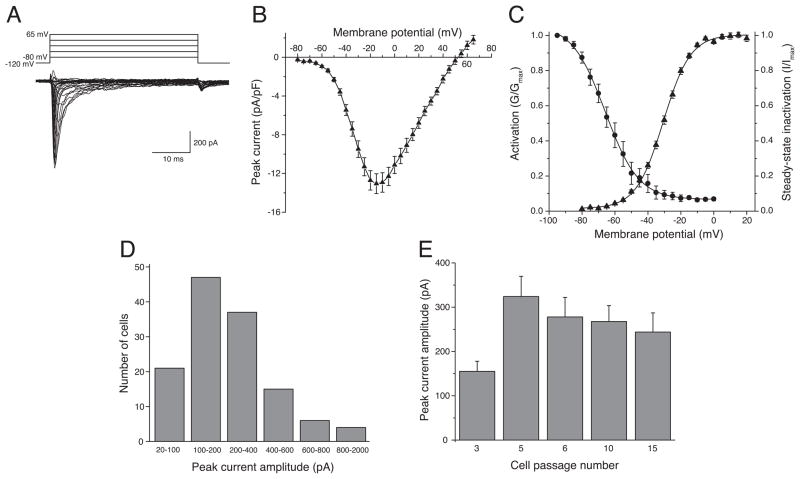
Properties of transient inward currents in HEK293 cells. (A) Representative current traces recorded during a 40-ms step depolarization from −120 mV to test potentials from −85 mV to 65 mV in 5-mV increments. (B) Current-voltage plot of multiple data sets such as those in panel A. Values are means ± SE of 67 separate determinations with different cells and are normalized to the capacitance (in pF) measured for each cell. (C) Voltage dependence of activation and steady-state inactivation. For activation, normalized conductance (G/Gmax) was derived from the current-voltage relationship (as in Fig. 1B) by dividing peak transient current (INa) by the driving force (VVrev) and normalizing to the maximum conductance observed in each cell. For inactivation, peak transient currents were measured during a test depolarization to −10 mV following a 200-ms conditioning prepulse to potentials from −95 mV to 0 mV in 5-mV increments and normalized to the maximal peak transient current in each experiment (I/Imax). Values for G/Gmax and I/Imax were plotted as a function of test (activation) or prepulse (inactivation) potential and curves were drawn by fitting mean values to the Boltzmann equation. Each data point is the mean ± SE of 67 (activation) or 16 (steady-state inactivation) determinations with different cells. (D) Amplitude distribution of transient inward currents measured upon depolarization from −120 mV to −10mV in 130 cells. (E) Plot of the mean amplitudes of transient inward currents as a function passage number for cells in continuous culture. Each value is the mean ± SE of 13–45 determinations with different cells.
Fig. 2
Fig. 2
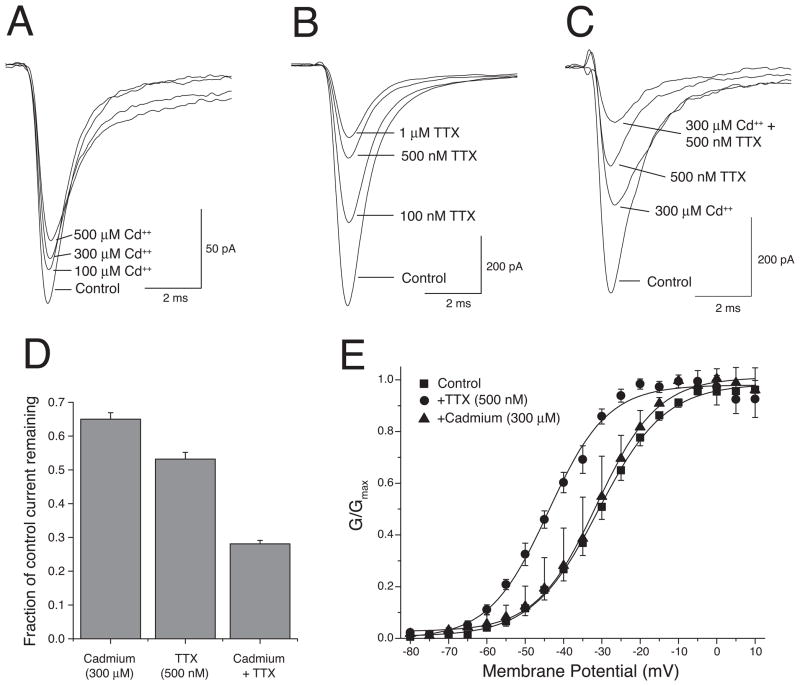
Effects of cadmium and TTX on transient inward currents. (A) Representative current traces elicited by depolarization from −120 mV to −10 mV before cadmium exposure and after exposure to three cadmium concentrations. (B) Representative current traces elicited by depolarization from −120 mV to −10 mV before TTX exposure and after exposure to three TTX concentrations. (C) Representative current traces elicited by depolarization from −120 mV to −10 mV before cadmium or TTX exposure and after exposure to cadmium alone, TTX alone, and cadmium plus TTX. (D) The fraction of transient inward current remaining following exposure to cadmium (300 μM), TTX (500 nM), or cadmium (300 μM) plus TTX (500 nM). Values are means ± SE of 22 (cadmium), 30 (TTX), or 19 (cadmium + TTX) determinations with different cells. (E) Plots of normalized peak conductance (G/Gmax) obtained from experiments performed in the absence (as in Fig. 1A) or presence of TTX (500 nM), or cadmium (300 μM) plotted as a function of test potential. Values are means ± SE of 12 (control), 7 (TTX), or 5 (cadmium) determinations; control values represent the pooled controls from separate experiments with TTX or cadmium. Curves were drawn by fitting mean values to the Boltzmann equation.
Fig. 3
Fig. 3
Effects of tefluthrin on transient inward currents. (A) Representative currents recorded before and after exposure of a cell to 10 μM tefluthrin. (B) Representative current traces recorded in the presence of 10 μM tefluthrin during a 40-ms step depolarization from −120 mV to test potentials from −85 mV to 65 mV in 5-mV increments. (C) Plots of normalized peak conductance (G/Gmax) obtained from experiments performed in the absence (as in Fig. 1A) or presence (as in Fig. 3B) of 10 μM tefluthrin plotted as a function of test potential. Values are means ± SE of 8 paired determinations. Curves were drawn by fitting mean values to the Boltzmann equation.
Fig. 4
Fig. 4
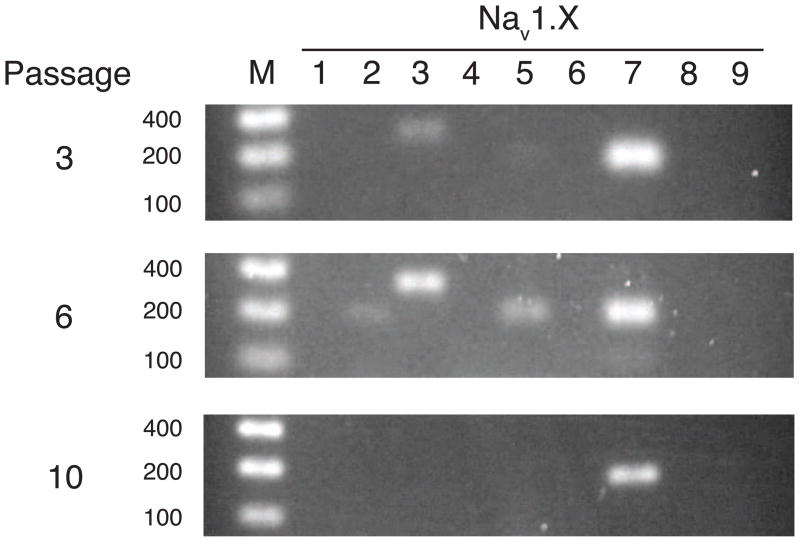
Detection of the expression of individual sodium channel α subunit isoforms in HEK293 cells after 3, 6, or 10 laboratory passages in continuous culture by RT-PCR and electrophoresis in 2% agarose gels. Lanes: M, markers (100, 200, and 400 bp); 1–9, isoform-specific PCR products for Nav1.1 – Nav1.9, respectively.

References

    1. Backx PH, Yue DT, Lawrence JH, Marban E, Tomaselli GF. Molecular localization of a ion-binding site within the pore of mammalian sodium channels. Science. 1992;257:248–251. - PubMed
    1. Berjulow S, Doring F, Froschmayr M, Grabner M, Glossmann H, Hering S. Endogenous calcium channels in human embryonic kidney (HEK293) cells. Br J Pharmacol. 1996;118:748–754. - PMC - PubMed
    1. Bezanilla F, Armstrong CM. Inactivation of the sodium channel. J Gen Physiol. 1977;70:549–566. - PMC - PubMed
    1. Cardenas L, Seda M, Noheda P, Buschmann H, Cintado CG, Martin JD, Pinto FM. Molecular diversity of voltage-gated α and β subunit mRNAs in human tissues. Eur J Pharmacol. 2006;541:9–16. - PubMed
    1. Graham FL, Smiley J, Russell WC, Nairn R. Characteristics of a human cell line transformed by DNA from human adenovirus type 5. J Gen Virol. 1977;36:59–77. - PubMed

Publication types

MeSH terms

Substances

LinkOut - more resources