


Poverty trap formed by the ecology of infectious diseases
- PMID: 20007179
- PMCID: PMC2842808
- DOI: 10.1098/rspb.2009.1778
Poverty trap formed by the ecology of infectious diseases
Abstract
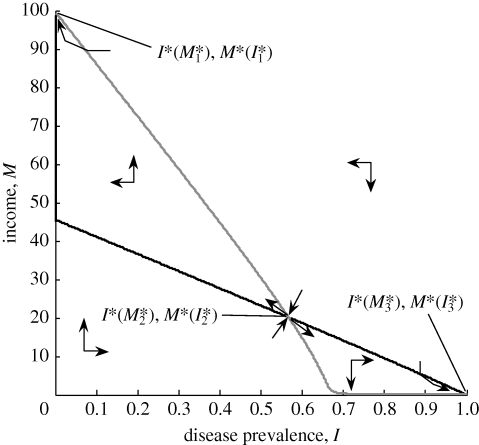
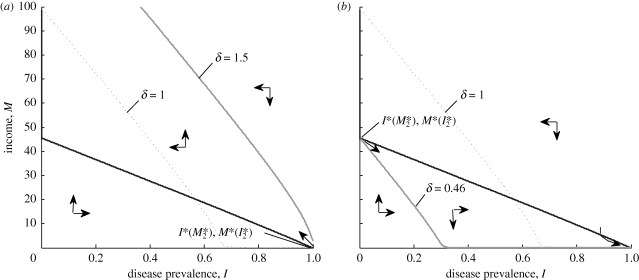
While most of the world has enjoyed exponential economic growth, more than one-sixth of the world is today roughly as poor as their ancestors were many generations ago. Widely accepted general explanations for the persistence of such poverty have been elusive and are needed by the international development community. Building on a well-established model of human infectious diseases, we show how formally integrating simple economic and disease ecology models can naturally give rise to poverty traps, where initial economic and epidemiological conditions determine the long-term trajectory of the health and economic development of a society. This poverty trap may therefore be broken by improving health conditions of the population. More generally, we demonstrate that simple human ecological models can help explain broad patterns of modern economic organization.
Figures
References
-
- Anderson R. M., May R. M.1992Infectious diseases of humans: dynamics and control. New York, NY: Oxford University Press
-
- Black F. L.1975Infectious diseases in primitive societies. Science 187, 515–518 (doi:10.1126/science.163483) - DOI - PubMed
-
- Bloom D. E., Canning D.2000The health and wealth of nations. Science 287, 1207–1209 (doi:10.1126/science.287.5456.1207) - DOI - PubMed
-
- Bloom D., Canning D., Sevilla J.2003Geography and poverty traps. J. Econ. Growth 8, 355–378 (doi:10.1023/A:1026294316581) - DOI
-
- Bonds M. H., Keenan D. C., Leidner A., Rohani P.2005Higher disease prevalence can induce greater sociality; a game-theoretic coevolutionary model. Evolution 59, 159–168 - PubMed
Publication types
MeSH terms
LinkOut - more resources
Full Text Sources
Medical
