Prevalence of atrial fibrillation and its predictors in nondialysis patients with chronic kidney disease
- PMID: 20007681
- PMCID: PMC2827597
- DOI: 10.2215/CJN.03170509
Prevalence of atrial fibrillation and its predictors in nondialysis patients with chronic kidney disease
Abstract
Background and objectives: Chronic kidney disease (CKD) increases systemic inflammation, which is implicated in development and maintenance of atrial fibrillation (AF); therefore, we hypothesized that the prevalence of AF would be increased among nondialysis patients with CKD. This study also reports independent predictors of the presence of AF in this population.
Design, setting, participants, & measurements: A retrospective, cross-sectional analysis of 1010 consecutive nondialysis patients with CKD from two community-based hospitals was conducted. Estimated GFRs (eGFRs) were calculated using the Modification of Diet in Renal Disease (MDRD) equation. Multivariate logistic regression was used to determine independent predictors.
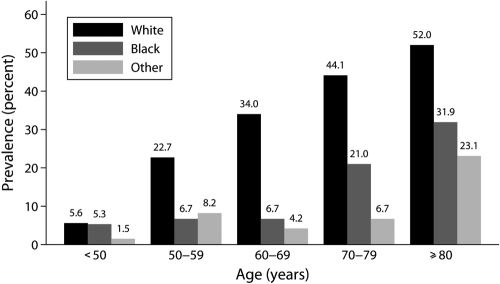
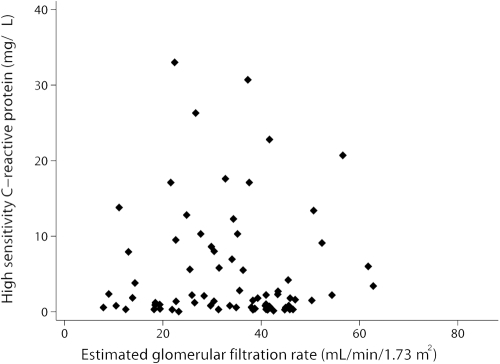
Results: Of 1010 nondialysis patients with CKD, 214 (21.2%) had AF. Patients with AF were older than patients without AF (76 +/- 11 versus 63 +/- 15 yr). The prevalence of AF among white patients (42.7%) was higher than among black patients (12.7%) or other races (5.7%). In multivariate analyses, age, white race, increasing left atrial diameter, lower systolic BP, and congestive heart failure were identified as independent predictors of the presence of AF. Although serum high-sensitivity C-reactive protein levels were elevated in our population (5.2 +/- 7.4 mg/L), levels did not correlate with the presence of AF or with eGFR. Finally, eGFR did not correlate with the presence of AF in our population.
Conclusions: The prevalence of AF was increased in our population, and independent predictors were age, white race, increasing left atrial diameter, lower systolic BP, and congestive heart failure.
Figures
References
-
- Go AS, Hylek EM, Phillips KA, Chang Y, Henault LE, Selby JV, Singer DE: Prevalence of diagnosed atrial fibrillation in adults: national implications for rhythm management and stroke prevention: The AnTicoagulation and Risk Factors in Atrial Fibrillation (ATRIA) Study. JAMA 285: 2370–2375, 2001 - PubMed
-
- Carson PE, Johnson GR, Dunkman WB, Fletcher RD, Farrell L, Cohn JN: The influence of atrial fibrillation on prognosis in mild to moderate heart failure: The V-HeFT Studies. The V-HeFT VA Cooperative Studies Group Circulation 87: VI102–VI110, 1993 - PubMed
-
- Dries DL, Exner DV, Gersh BJ, Domanski MJ, Waclawiw MA, Stevenson LW: Atrial fibrillation is associated with an increased risk for mortality and heart failure progression in patients with asymptomatic and symptomatic left ventricular systolic dysfunction: A retrospective analysis of the SOLVD trials. Studies of Left Ventricular Dysfunction. J Am Coll Cardiol 32: 695–703, 1998 - PubMed
-
- Maisel WH, Rawn JD, Stevenson WG: Atrial fibrillation after cardiac surgery. Ann Intern Med 135: 1061–1073, 2001 - PubMed
-
- Rathore SS, Berger AK, Weinfurt KP, Schulman KA, Oetgen WJ, Gersh BJ, Solomon AJ: Acute myocardial infarction complicated by atrial fibrillation in the elderly: Prevalence and outcomes. Circulation 101: 969–974, 2000 - PubMed
Publication types
MeSH terms
LinkOut - more resources
Full Text Sources
Medical
Research Materials
Miscellaneous