. 2010 Feb 19;285(8):5392-404.
doi: 10.1074/jbc.M109.064659. Epub 2009 Dec 11.

Liver X receptor agonists augment human islet function through activation of anaplerotic pathways and glycerolipid/free fatty acid cycling

Affiliations

Liver X receptor agonists augment human islet function through activation of anaplerotic pathways and glycerolipid/free fatty acid cycling

Takeshi Ogihara et al. J Biol Chem. .

Abstract

Recent studies in rodent models suggest that liver X receptors (LXRs) may play an important role in the maintenance of glucose homeostasis and islet function. To date, however, no studies have comprehensively examined the role of LXRs in human islet biology. Human islets were isolated from non-diabetic donors and incubated in the presence or absence of two synthetic LXR agonists, TO-901317 and GW3965, under conditions of low and high glucose. LXR agonist treatment enhanced both basal and stimulated insulin secretion, which corresponded to an increase in the expression of genes involved in anaplerosis and reverse cholesterol transport. Furthermore, enzyme activity of pyruvate carboxylase, a key regulator of pyruvate cycling and anaplerotic flux, was also increased. Whereas LXR agonist treatment up-regulated known downstream targets involved in lipogenesis, we observed no increase in the accumulation of intra-islet triglyceride at the dose of agonist used in our study. Moreover, LXR activation increased expression of the genes encoding hormone-sensitive lipase and adipose triglyceride lipase, two enzymes involved in lipolysis and glycerolipid/free fatty acid cycling. Chronically, insulin gene expression was increased after treatment with TO-901317, and this was accompanied by increased Pdx-1 nuclear protein levels and enhanced Pdx-1 binding to the insulin promoter. In conclusion, our data suggest that LXR agonists have a direct effect on the islet to augment insulin secretion and expression, actions that should be considered either as therapeutic or unintended side effects, as these agents are developed for clinical use.


Figures
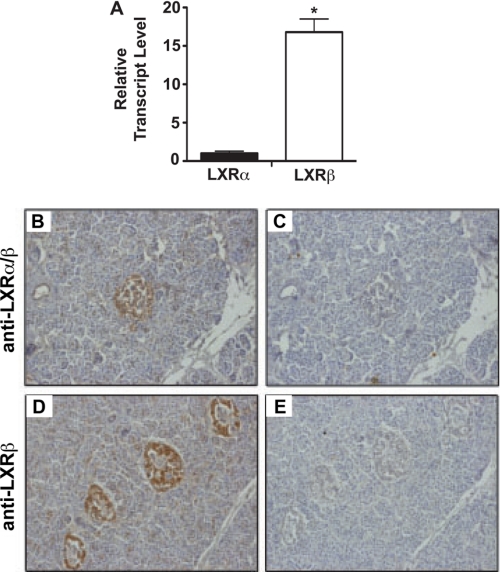
FIGURE 1.
FIGURE 1.
Distribution of LXRs in human islets. A, qRT-PCR was performed using total mRNA isolated from primary human islets maintained in 11 mm glucose. LXR mRNA levels were normalized to β-actin mRNA levels. All data are shown as the mean ± S.E. (n = 3). *, data indicate statistical difference (p < 0.05) compared with LXRα mRNA level. Panels B–E, human pancreas sections were immunostained with anti-LXRα/β antibody (B) or anti-LXRα/β antibody plus blocking peptide for LXRα/β (C). Human pancreas sections were immunostained with anti-LXRβ antibody (D) or anti-LXRβ antibody plus blocking peptide for LXRβ (E). Antibody binding was revealed using peroxidase-conjugated secondary IgG and diaminobenzidine tetrahydrochloride substrate to yield a brown signal.
FIGURE 2.
FIGURE 2.
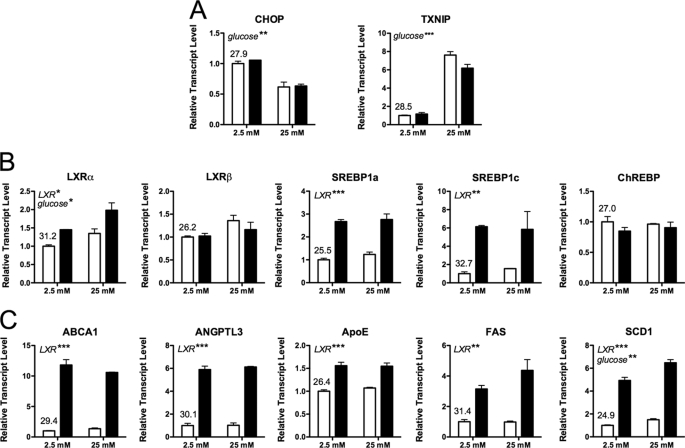
Gene expression changes following islet exposure to LXR agonist. Human islets (∼100/well) were preincubated for 2 h in 2.5 mm glucose, then switched to either low glucose (2.5 mm) or high glucose (25 mm) in the presence or absence of 1 μm TO-901317 for 24 h. RNA was measured by qRT-PCR using an ABI Prism system and SYBR chemistry (primers are provided in supplemental Table 1). A, the efficacy of glucose exposure was revealed by changes in CHOP and TXNIP mRNA levels. B, shown is expression of relevant transcription factors. C, shown is expression of LXR target genes involved in lipid metabolism. mRNA levels were normalized to β-actin, and the results represent the mean ± S.E. of duplicate biologic samples. The qRT-PCR cycle number at the threshold for each gene is provided for the vehicle-treated, low-glucose group. Two-way ANOVA was performed, and significant effects of glucose and LXR agonist are indicated in italics (*p < 0.05; **p < 0.01; ***p < 0.001); no significant interaction of glucose and ligand was observed for these RNA species. Similar results were obtained with a second independent experiment and were observed with an alternate LXR agonist, GW3965 (Fig. 3).
FIGURE 3.
FIGURE 3.
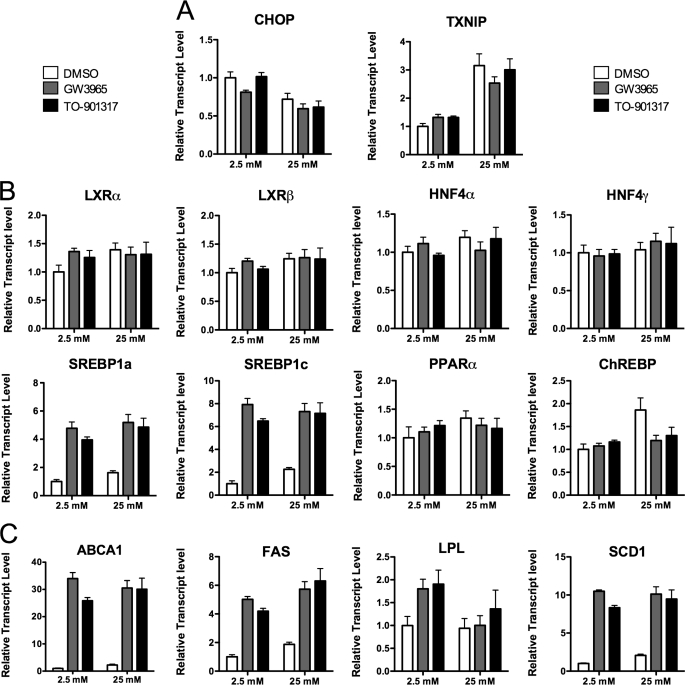
Similar gene expression changes are observed with two different LXR agonists. Human islets (∼100/well) were preincubated for 2 h in 2.5 mm glucose, then switched to either low glucose (2.5 mm) or high glucose (25 mm) with 1 μm GW3965 (gray bars), 1 μm TO-901317 (black bars), or vehicle (DMSO, white bars). RNA was measured by qRT-PCR using an ABI Prism system and SYBR chemistry (primers are provided in supplemental Table 1). RNA levels are depicted relative to the housekeeping gene β-actin and depict the average of triplicate analyses of a single RNA sample from ∼100-pooled human islets. A, the efficacy of glucose exposure was revealed by changes in CHOP and TXNIP RNA levels. B, shown is expression of relevant transcription factors. C, shown is expression of LXR target genes involved in lipid metabolism. PPAR, peroxisome proliferator-activated receptor.
FIGURE 4.
FIGURE 4.
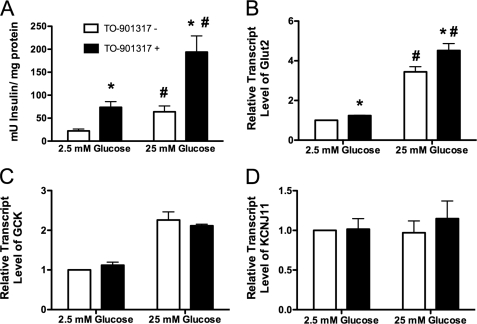
LXR activation enhances insulin secretion in human islets. A, 50 human islets were exposed to 2.5 or 25 mm glucose for 1 h after 16 h of preincubation with or without 1 μm TO-901317. Insulin secretion was measured by enzyme-linked immunosorbent assay and normalized to total protein content. All data are shown as the mean ± S.E. (n = 3). Groups were compared by two-way ANOVA. *, data indicate statistical difference (p < 0.05) compared with islets incubated in the absence of TO-901317. #, data indicate statistical difference (p < 0.05) compared with islets incubated in 2.5 mm glucose. Panels B–D, human islets (∼100/well) were preincubated for 2 h in 2.5 mm glucose and then switched to either low glucose (2.5 mm) or high glucose (25 mm) in the presence or absence of 1 μm TO-901317 for 24 h. RNA was measured by qRT-PCR using TaqMan primer/probe combinations (primers are provided in supplemental Table 1). All data are shown as the mean ± S.E. (n = at least 3) and are displayed as relative expression compared with islets incubated in 2.5 mm glucose in the absence of agonist. Groups were compared using two-way ANOVA. *, data indicate statistical difference (p < 0.05) versus human islets incubated without TO-901317. #, data indicate statistical difference (p < 0.0001) compared with islets incubated in 2.5 mm glucose. GCK, glucokinase; KCNJ11, potassium channel 11.
FIGURE 5.
FIGURE 5.
Treatment with LXR agonist increases pyruvate carboxylase enzyme activity in human islets. A and C, human islets (∼100/well) were preincubated for 2 h in 2.5 mm glucose and then switched to either low glucose (2.5 mm) or high glucose (25 mm) in the presence or absence of 1 μm TO-901317 for 24 h. RNA was measured by qRT-PCR using TaqMan primer/probe combinations (primers provided in supplemental Table 1). All data are shown as the mean ± S.E. (n = at least 3) and are displayed as relative expression compared with islets incubated in 2.5 mm glucose in the absence of agonist. Groups were compared using two-way ANOVA. *, data indicate statistical difference (p < 0.05) versus human islets incubated without TO-901317. B, total protein was isolated from ∼100 human islets incubated in 25 mm glucose in the presence or absence of 1 μm TO-901317 for 24 h. IDH1 protein levels on immunoblot were normalized to actin protein levels. All data are shown as the mean ± S.E. (n = 4). Groups were compared using a t test. *, data indicate statistical difference (p < 0.05) versus human islets incubated without TO-901317. D, human islets (∼300/well) were incubated in 25 mm glucose in the presence or absence of 1 μm TO-901317 for 24 h. Pyruvate carboxylase (PC) enzyme activity was measured in total cell lysate and normalized to total protein content. All data are shown as the mean ± S.E. (n = 4). Groups were compared using a t test. *, data indicate statistical difference (p < 0.05) versus human islets incubated without TO-901317.
FIGURE 6.
FIGURE 6.
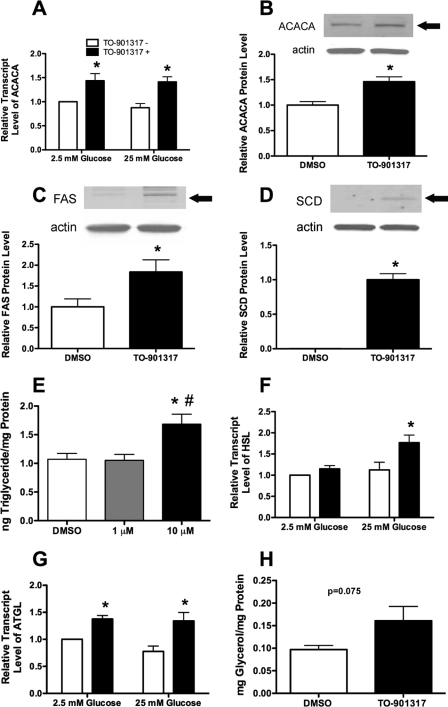
Treatment with 1 μm TO-901317 stimulates lipogenesis and lipolysis and does not lead to increased triglyceride accumulation in human islets. A, F, and G, human islets (∼100/well) were preincubated for 2 h in 2.5 mm glucose and then switched to either low glucose (2.5 mm) or high glucose (25 mm) in the presence or absence of 1 μm TO-901317 for 24 h. mRNA levels were measured by qRT-PCR using TaqMan primer/probe combinations (primers are provided in supplemental Table 1). All data are shown as the mean ± S.E. (n = at least 3) and are displayed as relative expression compared with islets incubated in 2.5 mm glucose in the absence of agonist. Groups were compared using two-way ANOVA. *, data indicate statistical difference (p < 0.05) versus human islets incubated without TO-901317. HSL, hormone-sensitive lipase. B–D, total protein was isolated from ∼100 human islets incubated in 25 mm glucose in the presence or absence of 1 μm TO-901317 for 24 h. ACACA, FAS, and SCD protein levels on immunoblot were normalized to actin protein levels. All data are shown as the mean ± S.E. (n = 4). Groups were compared using a t test. *, data indicate statistical difference (p < 0.05) versus human islets incubated without TO-901317. E, human islets (∼100/well) were incubated with DMSO and 1 μm or 10 μm TO-901317 for 72 h in media containing 5.5 mm glucose. Triglyceride concentration was measured and normalized to total protein content. Data shown are the mean ± S.E. (n = 4). Groups were compared using one-way ANOVA. *, data indicate statistical difference (p < 0.05) versus human islets incubated without TO-901317. #, data indicate statistical difference (p < 0.05) versus human islets incubated with 1 μm TO-901317. H, human islets (∼100/well) were incubated with DMSO or 1 μm TO-901317 for 72 h in media containing 25 mm glucose. Glycerol release into the supernatant was measured and normalized to total protein content. Data shown are the mean ± S.E. (n = 4), and results were compared using a t test (p = 0.075 for the comparison).
FIGURE 7.
FIGURE 7.
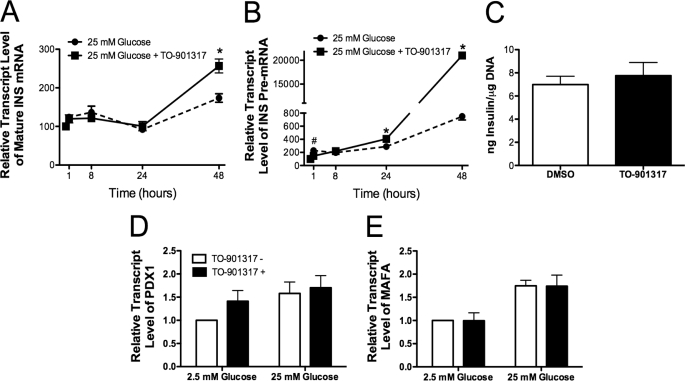
LXR activation induces insulin transcription. Approximately 100 human islets were incubated with 25 mm glucose in the presence (indicated by a solid line) or absence (indicated by a dashed line) of 1 μm TO-901317 for 1, 8, and 24 h (panels A and B). mRNA levels of insulin (mature RNA, panel A; pre-mRNA, panel B) were determined by qRT-PCR and normalized to β-actin mRNA levels. All data are shown as the mean ± S.E. (n = at least 3) and are displayed as relative expression compared with islets incubated in 2.5 mm glucose in the absence of agonist. Groups were compared using one-way ANOVA. #, data indicate statistical difference (p < 0.05) versus human islets treated with TO-901317. *, data indicate statistical difference (p < 0.05) versus human islets incubated without TO-901317. Panel C, human islets (∼100/well) were incubated for 48 h in 25 mm glucose in the presence or absence of 1 μm TO-901317. Total islet insulin content was measured and normalized to DNA content. Panels D and E, human islets (∼100/well) were preincubated for 2 h in 2.5 mm glucose, then switched to either low glucose (2.5 mm) or high glucose (25 mm) in the presence or absence of 1 μm TO-901317 for 24 h. mRNA levels were measured by qRT-PCR using TaqMan primer/probe combinations or Syber chemistry (primers are provided in supplemental Table 1). All data are shown as the mean ± S.E. (n = at least 3) and are displayed as relative expression compared with islets incubated in 2.5 mm glucose in the absence of agonist. Groups were compared using two-way ANOVA.
FIGURE 8.
FIGURE 8.
LXR activation increases Pdx-1 protein content in the nucleus of human islets. Nuclear (A) or total protein (B) was isolated from ∼1000 human islets incubated in media containing 25 mm glucose in the presence or absence of 1 μm TO-901317 for 18 h. Pdx-1 protein levels on immunoblot were normalized to actin protein levels. All data are shown as the mean ± S.E. (n = 4). Groups were compared using a t test. *, data indicate statistical difference (p < 0.05) versus human islets incubated without TO-901317. C, 2 μg of human islet nuclear extract was used for each EMSA reaction with or without 5 μl of preimmune serum or anti-Pdx-1 antiserum and separated by 5% polyacrylamide gel. EMSA was performed using the A3 element of the human INS promoter containing the sequence CTG GTT AAG ACT CTA ATG ACC CGC TGG TCC TG. For competition experiments, an unlabeled probe of the same sequence was added at 100 or 200 times the concentration of labeled probe. Data shown are representative of three independent experiments.
FIGURE 9.
FIGURE 9.
LXR activation increases Pdx-1 nuclear translocation and Pdx-1 binding to the insulin promoter in INS-1 cells. Nuclear fraction (A), cytosolic fraction (B), and total cell lysate (C) were isolated from INS-1 cells cultured in the presence or absence of 1 μm TO-901317 for 16 h in media containing 2.5 mm or 25 mm glucose and immunoblotted with anti-Pdx-1 antibody or anti-actin antibody. Pdx-1 protein levels were normalized to actin protein levels. All data are shown as the mean ± S.E. (n = 4). Groups were compared using two-way ANOVA. *, data indicate statistical difference (p < 0.05) versus INS-1 cells treated without TO-901317. #, data indicate statistical difference (p < 0.05) versus INS-1 cells treated with 2.5 mm glucose. D, 1 μg of INS-1 nuclear extract was used for each EMSA reaction with or without 5 μl of preimmune serum or anti-Pdx-1 antiserum and separated by 5% polyacrylamide gel. EMSA was performed using the A3 element of the human insulin promoter. Data shown are representative of three independent experiments. E, INS-1 cells were harvested and subjected to chromatin immunoprecipitation analysis as detailed under supplemental “Experimental Procedures.” Quantitative PCR was used to measure recovery of the proximal insulin promoter using antibody to Pdx-1 or normal rabbit serum (NRS). Results are expressed as percent recovery of the gene fragment relative to input chromatin. Results represent the mean ± S.E. for three independent experiments and were analyzed using two-way ANOVA (A–C) or one-way ANOVA (E). *, data indicate statistical difference (p < 0.005) compared with INS-1 cells incubated without TO-901317.
FIGURE 10.
FIGURE 10.
Summary model; LXR activation has multiple effects in human islets. Treatment of human islets with the LXR agonist, TO-901317, increases insulin secretion through a mechanism that involves increased pyruvate carboxylase enzyme activity and increased expression of several genes known to influence islet function including those involved in reverse cholesterol transport and glycerolipid/free fatty acid cycling (GL/FFA). After chronic exposure to LXR agonist, insulin transcription is also increased and corresponds to increased Pdx-1 binding to the proximal INS promoter. HSL, hormone-sensitive lipase; ATGL, adipose triglyceride lipase. * denotes genes known to be direct transcriptional targets of LXRs.

References

    1. Edwards P. A., Kennedy M. A., Mak P. A. (2002) Vascul. Pharmacol. 38, 249–256 - PubMed
    1. Varga G., Su C. (2007) BioDrugs 21, 117–124 - PubMed
    1. Zelcer N., Tontonoz P. (2006) J. Clin. Invest. 116, 607–614 - PMC - PubMed
    1. Joseph S. B., Castrillo A., Laffitte B. A., Mangelsdorf D. J., Tontonoz P. (2003) Nat. Med. 9, 213–219 - PubMed
    1. Scholz H., Lund T., Dahle M. K., Collins J. L., Korsgren O., Wang J. E., Foss A. (2009) Diabetologia 52, 1352–1362 - PubMed

Publication types

MeSH terms

LinkOut - more resources