. 2009 Dec 15;15(24):7462-7468.
doi: 10.1158/1078-0432.CCR-09-0479.

Hyaluronan-CD44 Interactions in Cancer: Paradoxes and Possibilities

Affiliations

Hyaluronan-CD44 Interactions in Cancer: Paradoxes and Possibilities

Bryan P Toole. Clin Cancer Res. .

Abstract

Hyaluronan is a prominent component of the micro-environment in most malignant tumors and can be prognostic for tumor progression. Extensive experimental evidence in animal models implicates hyaluronan interactions in tumor growth and metastasis, but it is also evident that a balance of synthesis and turnover by hyaluronidases is critical. CD44, a major hyaluronan receptor, is commonly but not uniformly associated with malignancy, and is frequently used as a marker for cancer stem cells in human carcinomas. Multivalent interactions of hyaluronan with CD44 collaborate in driving numerous tumor-promoting signaling pathways and transporter activities. It is widely accepted that hyaluronan-CD44 interactions are crucial in both malignancy and resistance to therapy, but major challenges for future research in the field are the mechanism of activation of hyaluronan-CD44 signaling in cancer cells, the relative importance of variant forms of CD44 and other hyaluronan receptors, e.g., Rhamm, in different tumor contexts, and the role of stromal versus tumor cell production and turnover of hyaluronan. Despite these caveats, it is clear that hyaluronan-CD44 interactions are an important target for translation into the clinic. Among the approaches that show promise are antibodies and vaccines to specific variants of CD44 that are uniquely expressed at critical stages of progression of a particular cancer, hyaluronidase-mediated reduction of barriers to drug access, and small hyaluronan oligosaccharides that attenuate constitutive hyaluronan-receptor signaling and enhance chemosensitivity. In addition, hyaluronan is being used to tag drugs and delivery vehicles for targeting of anticancer agents to CD44-expressing tumor cells. (Clin Cancer Res 2009;15(24):7462-8).


Conflict of interest statement

Disclosure of Potential Conflicts of Interest: The author is an inventor on a patent related to some of the contents of this article.

Figures

Figure 1
Figure 1. Regulation of signaling cascades by hyaluronan-CD44 interaction
Hyaluronan synthases produce and extrude hyaluronan, which may be retained by the synthase or released into the pericellular milieu. The extruded hyaluronan interacts multivalently with CD44 to induce and/or stabilize signaling domains within the plasma membrane. These signaling domains contain receptor tyrosine kinases (ErbB2 and EGFR), other signaling receptors (TGFβR1) and non-receptor kinases (Src family) that drive oncogenic pathways, e.g. the MAP kinase and PI3 kinase/Akt cell proliferation and survival pathways, as well as various transporters that participate in drug resistance and malignant cell properties (15, 34). Various adaptor proteins such as Vav2, Grb2 and Gab-1 mediate interaction of CD44 with upstream effectors, e.g. RhoA, Rac1 and Ras, that drive these pathways (11, 34). In other cases carbohydrate side groups on variant regions of CD44, e.g. heparan sulfate chains, bind regulatory factors and co-activate receptor tyrosine kinases, e.g. the c-Met receptor (31). Hyaluronan-CD44 interactions also induce cytoskeletal changes that promote cell motility and invasion. In this case actin filaments are joined to the cytoplasmic tail of CD44 via members of the ezrin-radixin-moiesin (ERM) family or ankyrin (11, 31). Proteoglycans and associated factors attached to pericellular hyaluronan may also influence these activities (13, 23). This diagram emphasizes cell autonomous activities influenced by hyaluronan produced by tumor cells. Hyaluronan produced by stromal cells may have overlapping or different activities but the relative contributions of stromal and tumor-derived hyaluronan are not yet clear (6).
Figure 2
Figure 2. Antagonists of hyaluronan-receptor interactions
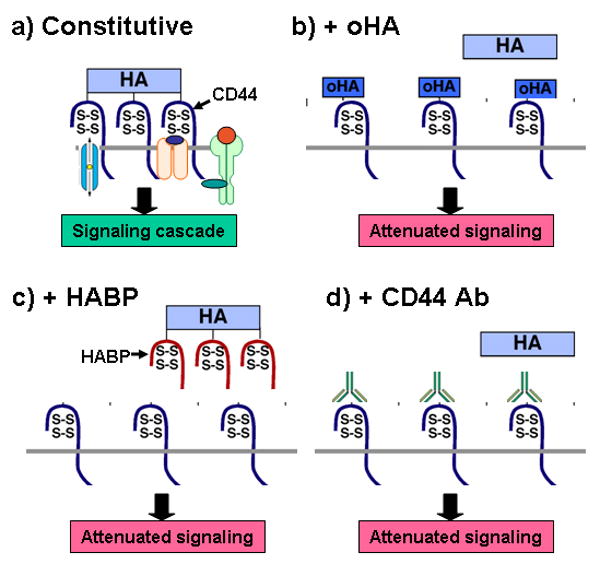
Antagonists of hyaluronan synthesis or hyaluronan-CD44 interaction de-stabilize the signaling domains illustrated in Figure 1, resulting in inhibition of oncogenic pathways and sensitization to drug treatment. Various approaches have been used to interfere with hyaluronan-CD44 interactions in vivo and in vitro (14, 21). Depicted here are: a) a constitutive signaling domain, as illustrated in Figure 1; b) exchange of endogenous, multivalent hyaluronan (HA) with small, monovalent hyaluronan oligomers (oHA); c) displacement of endogenous hyaluronan by a soluble hyaluronan-binding protein (HABP); d) inhibition of hyaluronan-CD44 interaction with blocking antibody. Other approaches such as antisense RNA or siRNA against hyaluronan synthases or CD44 have also been used.

References

    1. Nelson CM, Bissell MJ. Of extracellular matrix, scaffolds, and signaling: tissue architecture regulates development, homeostasis, and cancer. Annu Rev Cell Dev Biol. 2006;22:287–309. - PMC - PubMed
    1. Polyak K, Haviv I, Campbell IG. Co-evolution of tumor cells and their microenvironment. Trends Genet. 2009;25:30–8. - PubMed
    1. Joyce JA, Pollard JW. Microenvironmental regulation of metastasis. Nat Rev Cancer. 2009;9:239–52. - PMC - PubMed
    1. Kalluri R, Weinberg RA. The basics of epithelial-mesenchymal transition. J Clin Invest. 2009;119:1420–8. - PMC - PubMed
    1. Knudson W, Biswas C, Li XQ, Nemec RE, Toole BP. The role and regulation of tumour-associated hyaluronan. Ciba Found Symp. 1989;143:150–9. - PubMed