. 2009 Dec 15;23(24):2861-75.
doi: 10.1101/gad.1862709.

Fusion of nearby inverted repeats by a replication-based mechanism leads to formation of dicentric and acentric chromosomes that cause genome instability in budding yeast

Affiliations

Fusion of nearby inverted repeats by a replication-based mechanism leads to formation of dicentric and acentric chromosomes that cause genome instability in budding yeast

Andrew L Paek et al. Genes Dev. .

Abstract

Large-scale changes (gross chromosomal rearrangements [GCRs]) are common in genomes, and are often associated with pathological disorders. We report here that a specific pair of nearby inverted repeats in budding yeast fuse to form a dicentric chromosome intermediate, which then rearranges to form a translocation and other GCRs. We next show that fusion of nearby inverted repeats is general; we found that many nearby inverted repeats that are present in the yeast genome also fuse, as does a pair of synthetically constructed inverted repeats. Fusion occurs between inverted repeats that are separated by several kilobases of DNA and share >20 base pairs of homology. Finally, we show that fusion of inverted repeats, surprisingly, does not require genes involved in double-strand break (DSB) repair or genes involved in other repeat recombination events. We therefore propose that fusion may occur by a DSB-independent, DNA replication-based mechanism (which we term "faulty template switching"). Fusion of nearby inverted repeats to form dicentrics may be a major cause of instability in yeast and in other organisms.


Figures
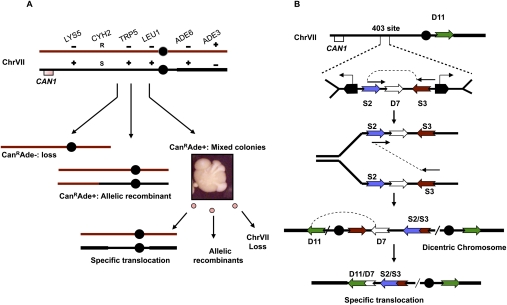
Figure 1.
Figure 1.
Chromosome system to detect instability. (A) Two homologs of ChrVII and mutant alleles on each allow for genetic detection of chromosome changes. The CAN1 gene has been removed from ChrV and inserted into one copy of ChrVII. Selection for the loss of the CAN1 gene allows growth of cells with any of three types of chromosome changes, including simple loss, allelic recombinants, and mixed colonies. Mixed colonies contain cells of multiple genotypes, including a specific translocation. See the Materials and Methods for details. (B) Configuration of elements in the ChrVII403 site and the geometry and order of how fusion may occur. Two tRNA genes (pentagons) transcribe toward the oncoming fork and slow replication. Fusion between the two LTR σ repeats (S2 and S3), shown diagrammatically, forms a dicentric, followed by recombination between the two LTR δ sequences (D7 and D11) to form the specific translocation.
Figure 2.
Figure 2.
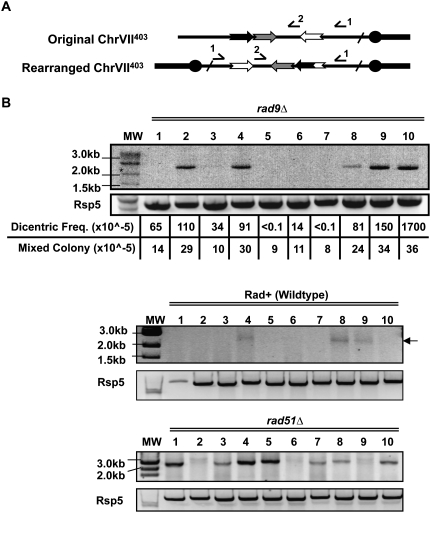
Inverted repeat fusion generates dicentrics that cause further chromosome instability. (A) Shown are the structures of normal ChrVII and the putative dicentric with the positions of PCR primers 1 and 2 used to detect the presence of the dicentric. (B) Genomic DNA from unselected cultures of Rad+, rad9, and rad51 were subjected to PCR amplification using primers 1 and 2. Gels show qualitative PCR results. The rad9 cultures were also analyzed for their frequencies of mixed colonies and quantitative PCR to determine the amount of dicentric. Spearman correlation test was performed to correlate instability and dicentrics. Spearman rank correlation coefficient (ρ) is 0.973; P-value, <0.0001. (Lanes 4,8,9) Three of the Rad+ cultures are faintly positive for the dicentric fragment. Primers to RSP5 were used as PCR controls.
Figure 3.
Figure 3.
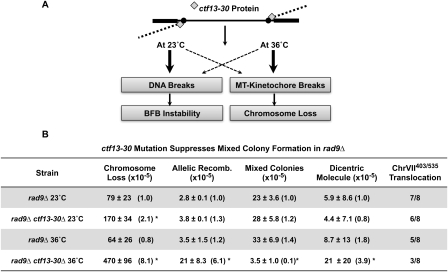
Instability is affected by the Ctf13 protein, suggesting that dicentrics are intermediates in instability. (A) Model of how Ctf13 function may affect the fate of a dicentric chromosome. See the text for discussion. (B) rad9 and rad9 ctf13-30 strains were grown at permissive (23°C) or restrictive (36°C) temperatures, then analyzed for instability events, translocations, and frequency of dicentrics by quantitative PCR as described in the Materials and Methods.
Figure 4.
Figure 4.
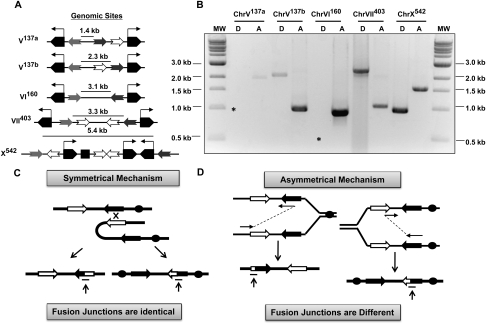
Inverted repeats at five sites in the yeast genome fuse to form dicentrics and/or acentrics. (A) The sites screened for fusion contain tRNA genes (pentagons), repeat sequences (gray and brown arrows are involved in the fusion reaction, whereas clear ones are not), and, in one case, an origin (square). Inverted repeat fusion forms either dicentric or acentric fragments using primers in schemes shown in C. (B) DNA fragments are detected at all five sites tested, using appropriate primers specific for each site. Primer sequences are in Supplemental Figure S9. Analysis of three sites yielded both acentric and dicentric fragments. Asterisks indicate where DNA fragments should have appeared, if they formed. The DNA sequence of all of the DNA fragments has been confirmed (Supplemental Fig. S5). (C) If the fusion junctions for acentric and dicentric chromosomes are identical, then they could have arisen by a symmetrical mechanism. This mechanism can conceptually be viewed as a crossover depicted here; one event generates both acentrics and dicentrics. (Not shown here are stalled forks as intermediates; this diagram is meant to convey the idea of a symmetrical event only.) (D) On the other hand, if the fusion junctions for acentric and dicentric chromosomes are not identical, then we infer that acentrics and dicentrics must be formed by separate events. In this case, the DNA polymerase is “jumping” between different sequences to form acentrics than it does to form dicentrics. Note that symmetric joints can also be formed by an asymmetrical mechanism, if the DNA polymerases for the acentric and dicentric “jump” between identical sequences.
Figure 5.
Figure 5.
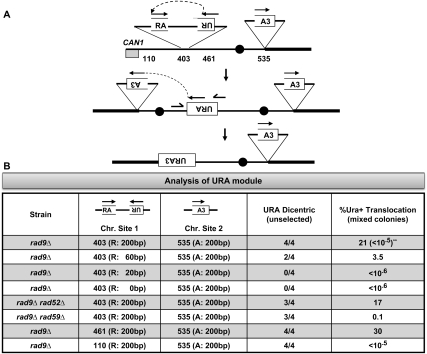
Synthetic inverted repeats fuse to form dicentrics, and then recombine to form translocations. (A) Three segments of the URA3 gene were cloned into two modules (see Supplemental Fig. S6 for details of module construction and chromosome insertion). The two modules were then inserted into the specific sites in ChrVII as indicated. Inverted repeat recombination joins UR to RA modules via recombination of shared “R” sequences to form a dicentric. A second recombination event joins “A” to “A3” to form an intact URA3 gene, rendering the cells Ura+. (B) Each rad9 strain contains a UR or RA module in one of three sites on the left arm of ChrVII, and all strains contain the A3 module at one site on the right arm. The UR modules differ in the amount of sequence homology shared with the RA module (size of “R” is 200, 60, 20, or 0 bp of homology, as indicated). Each modified rad9 strain was analyzed for the presence of the specific PCR fragment diagnostic of a dicentric chromosome, in four independent cultures, using dicentric URA primers (Supplemental Fig. S9). CanR mixed colonies were generated from each rad9 strain, and the frequency of Ura+ cells in cells from mixed colonies was determined (see the Materials and Methods). (**) The frequency of Ura+ colonies in Cans cells is shown in Supplemental Figure S8.
Figure 6.
Figure 6.
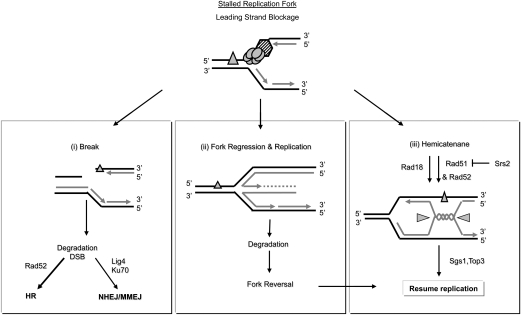
A model of the pathways that may act on stalled replication forks. DNA polymerase stalls at a lesion (triangle). The stalled fork may undergo a DSB (i), or sister strand annealing, template switch events forming a regressed fork (ii) or hemicatenane (iii). DSBs may undergo DNA rejoining by NHEJ, MMEJ, HR, SSA, or telomere addition (not shown). Some genes tested in this study that may regulate each pathway are shown.
Figure 7.
Figure 7.
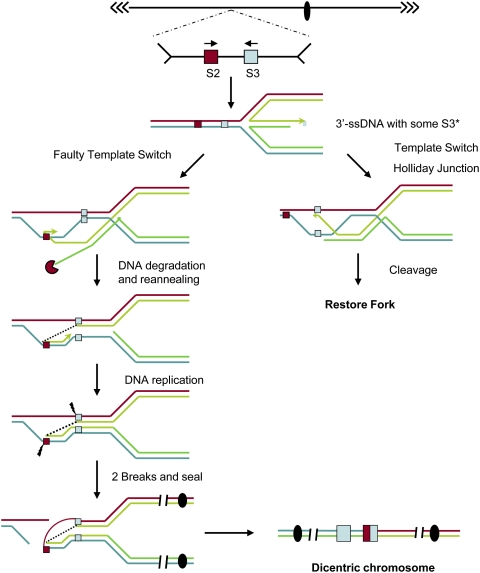
DNA replication-based mechanism of inverted repeat fusion. The top shows a chromosome region that contains inverted repeat sequences (red box, S2; blue box, S3), separated by several kilobases of DNA. The right fork stalls (not shown), then regresses to form the “chicken foot” structure with some S3 sequence at the 3′ end of the regressed strand. On the right, the regressed fork normally reinvades at the appropriate S3 sequence, and forms a Holliday structure that then is cleaved and resolved to restore a fork (after Atkinson and McGlynn 2009). On the left, the regressed fork reinvades at the wrong S2 sequence. Then, the unpaired regressed strand (dark green) is degraded (pacman), and the invaded strand begins to replicate using the blue strand as a template (displacing the blue strand from the red strand and allowing annealing of light green to red, forming the S2–S3 joint; dotted line). Upon completion of replication, ssDNA breaks must separate the left red and blue strands and the gap is filled (thin red arc, details not shown), forming the dicentric with hybrid S2–S3 repeat and one intact S2 repeat. The dicentric may then undergo further instability.

Comment in

  • Leaping forks at inverted repeats.
    Branzei D, Foiani M. Branzei D, et al. Genes Dev. 2010 Jan 1;24(1):5-9. doi: 10.1101/gad.1884810. Genes Dev. 2010. PMID: 20047996 Free PMC article.

References

    1. Admire A, Shanks L, Danzl N, Wang M, Weier U, Stevens W, Hunt E, Weinert T. Cycles of chromosome instability are associated with a fragile site and are increased by defects in DNA replication and checkpoint controls in yeast. Genes & Dev. 2006;20:159–173. - PMC - PubMed
    1. Ahmed A, Podemski L. Observations on template switching during DNA replication through long inverted repeats. Gene. 1998;223:187–194. - PubMed
    1. Albrecht EB, Hunyady AB, Stark GR, Patterson TE. Mechanisms of sod2 gene amplification in Schizosaccharomyces pombe. Mol Biol Cell. 2000;11:873–886. - PMC - PubMed
    1. Atkinson J, McGlynn P. Replication fork reversal and the maintenance of genome stability. Nucleic Acids Res. 2009;37:3475–3492. - PMC - PubMed
    1. Bai Y, Symington LS. A Rad52 homolog is required for RAD51-independent mitotic recombination in Saccharomyces cerevisiae. Genes & Dev. 1996;10:2025–2037. - PubMed

Publication types

MeSH terms

Substances

LinkOut - more resources