. 2009 Dec;21(12):3767-80.
doi: 10.1105/tpc.109.070441. Epub 2009 Dec 15.

Antagonistic HLH/bHLH transcription factors mediate brassinosteroid regulation of cell elongation and plant development in rice and Arabidopsis

Affiliations

Antagonistic HLH/bHLH transcription factors mediate brassinosteroid regulation of cell elongation and plant development in rice and Arabidopsis

Li-Ying Zhang et al. Plant Cell. 2009 Dec.

Abstract

In rice (Oryza sativa), brassinosteroids (BRs) induce cell elongation at the adaxial side of the lamina joint to promote leaf bending. We identified a rice mutant (ili1-D) showing an increased lamina inclination phenotype similar to that caused by BR treatment. The ili1-D mutant overexpresses an HLH protein homologous to Arabidopsis thaliana Paclobutrazol Resistance1 (PRE1) and the human Inhibitor of DNA binding proteins. Overexpression and RNA interference suppression of ILI1 increase and reduce, respectively, rice laminar inclination, confirming a positive role of ILI1 in leaf bending. ILI1 and PRE1 interact with basic helix-loop-helix (bHLH) protein IBH1 (ILI1 binding bHLH), whose overexpression causes erect leaf in rice and dwarfism in Arabidopsis. Overexpression of ILI1 or PRE1 increases cell elongation and suppresses dwarf phenotypes caused by overexpression of IBH1 in Arabidopsis. Thus, ILI1 and PRE1 may inactivate inhibitory bHLH transcription factors through heterodimerization. BR increases the RNA levels of ILI1 and PRE1 but represses IBH1 through the transcription factor BZR1. The spatial and temporal expression patterns support roles of ILI1 in laminar joint bending and PRE1/At IBH1 in the transition from growth of young organs to growth arrest. These results demonstrate a conserved mechanism of BR regulation of plant development through a pair of antagonizing HLH/bHLH transcription factors that act downstream of BZR1 in Arabidopsis and rice.


Figures

Figure 1.
Figure 1.
The ili1-D Mutant Shows Increased Lamina Joint Inclination and BR Sensitivity. (A) Seven-day-old rice seedlings of wild type, wild type treated with 10 ng/μL eBL for 2 d (WT+BL), and the ili1-D mutant. Arrows point to the lamina joints. (B) Tillering-stage wild type and the ili1-D mutant plants grown in soil. (C) Scanning electron microscopy images of the adaxial surface of the lamina joint of wild type, wild type treated with 10 ng/μL eBL, and the ili1-D mutant. Bars = 300 μm. (D) Lamina inclination angles of the wild type and ili1-D grown on medium containing various concentration of eBL. Bars indicate sd (n = 12). (E) Coleoptile lengths of the wild type and ili1-D grown in medium containing indicated concentration of eBL. Bars indicate sd (n = 15). [See online article for color version of this figure.]
Figure 2.
Figure 2.
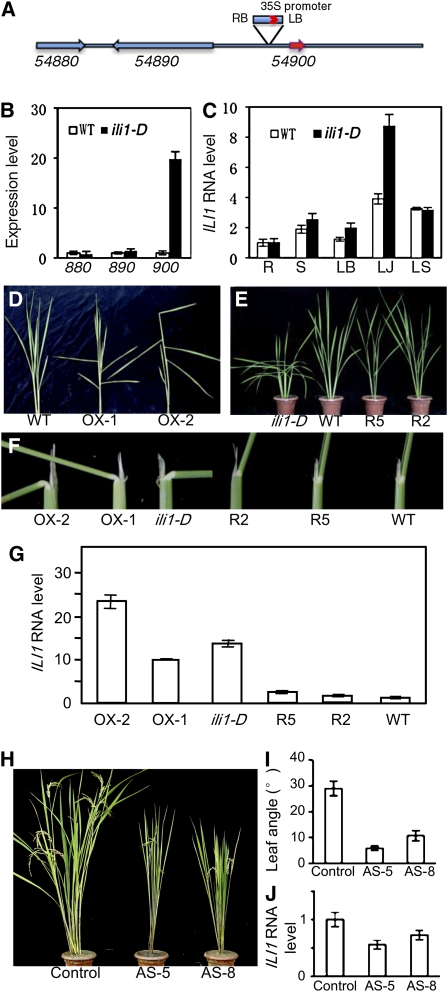
The Enlarged Leaf Angle of ili1-D Is Caused by Overexpression of a HLH Transcription Factor. (A) A diagram of the genomic region flanking the T-DNA insertion site in ili1-D. (B) Quantitative RT-PCR analysis of the expression of the genes surrounding the T-DNA insertion. Tubulin was used as a control. (C) Tissue-specific expression of ILI1 RNA in the wild type and ili1-D rice analyzed by quantitative RT-PCR in seedlings at trefoil stage. R, root; S, stem; LB, leaf blade; LJ, lamina joint; LS, leaf sheath. (D) Overexpression of ILI1 in transgenic rice (two independent lines: OX-1 and OX-2) recapitulates the increased laminar inclination phenotype of ili1-D. (E) Suppressing ILI1 expression using RNAi in the ili1-D mutant background (two independent lines: R2 and R5) rescues the lamina inclination phenotype. (F) Close-up view of individual lamina joint of ILI1-OX and ili1-D/ILI1-RNAi transgenic plants shown in (C) and (D). (G) Quantitative RT-PCR analysis of the expression levels of ILI1 in the control, ILI1-OX, and ILI1-RNAi transgenic plants. (H) to (J) Antisense suppression of ILI1 expression in wild-type rice causes erect leaves. (H) ILI1-AS transgenic plants (AS5 and AS8) at the heading stage. (I) Quantitation of the lamina joint angles of the flag leaves. (J) Quantitative RT-PCR analysis of the expression levels of ILI1 in the control and ILI1-AS plants. The negative transgenic plant was used as control. Error bars indicate sd.
Figure 3.
Figure 3.
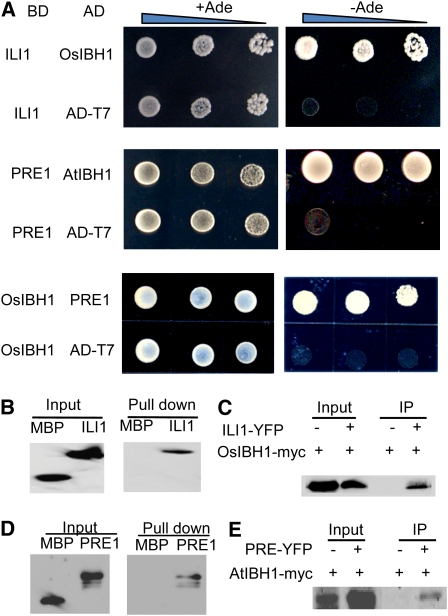
ILI1 and Its Arabidopsis Homolog PRE1 Interact with Rice and Arabidopsis IBH1. (A) A yeast two-hybrid screen identified Os IBH1 as an ILI1-interacting protein, and the interaction is conserved between their Arabidopsis homologs PRE1 and At IBH1. Three clones of yeast containing each combination of bait (BD) and prey (AD) vectors were grown on medium with Ade or without Ade. AD-T7, pGAD-T7 empty vector was used as a negative control. (B) ILI1 interacts with Os IBH1 in vitro. Glutathione agarose beads containing GST-Os IBH1 were incubated with equal amounts of MBP or MBP-ILI1. Proteins bound to GST-OsIBH1 were detected by immunoblotting using anti-MBP antibody. (C) Co-IP assay showing ILI1 interaction with Os IBH1. Tobacco leaves coexpressing 35S:ILI1-YFP and 35S:OsIBH1-myc or only 35S:OsIBH1-myc were used to immunoprecipitate with anti-GFP antibody, and the immunoblot was probed with anti-myc antibody. (D) and (E) PRE1 interacts with At IBH1 in vitro and in vivo. (D) In vitro pull-down assay, performed as in (C), of the interaction between GST-AtIBH1 and MBP-PRE1. (E) Arabidopsis plants expressing At IBH1-myc only or coexpressing At IBH1-myc and PRE1-YFP were used to immunoprecipitate with anti-GFP antibody, and the immunoblot was probed with anti-myc antibody. [See online article for color version of this figure.]
Figure 4.
Figure 4.
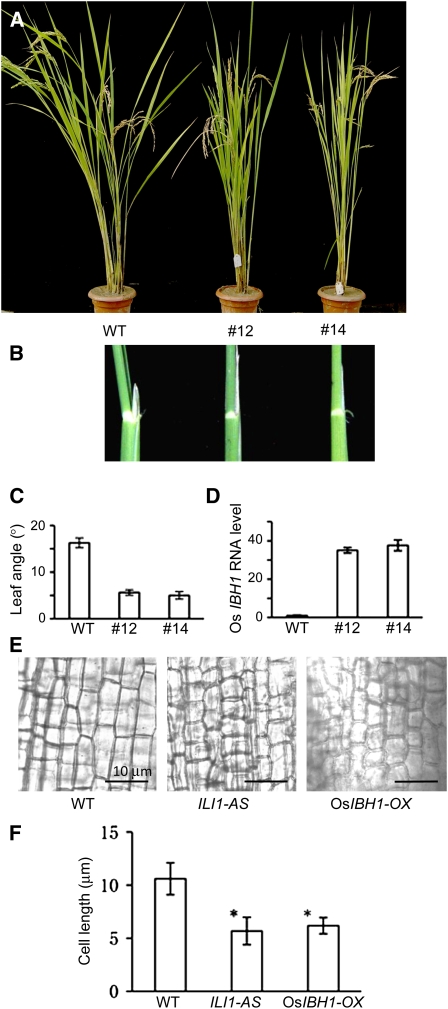
Overexpression of IBH1 in Rice Causes an Erect Leaf Phenotype. (A) The wild-type control plant and 35S:OsIBH1-GFP transgenic rice plants (lines 12 and 14) at heading stage. (B) The lamina joints of the wild-type and 35S:OsIBH1-GFP transgenic rice plants. (C) Quantitation of leaf angle of the control and 35S:OsIBH1-GFP transgenic plants. Data from 12 to 15 leaves of each plant. Bars indicate sd. (D) Os IBH1 RNA expression levels in the wild-type and 35S:OsIBH1-GFP transgenic rice plants. Bars indicate sd. (E) Cells of lamina joint of wild-type control, ILI1-AS, and OsIBH1-OX plants. (F) Measurement of the lengths of cells shown in (E). Bars are means ± sd. Asterisks indicate significant difference from the wild type (P < 0.05, Student's t test). [See online article for color version of this figure.]
Figure 5.
Figure 5.
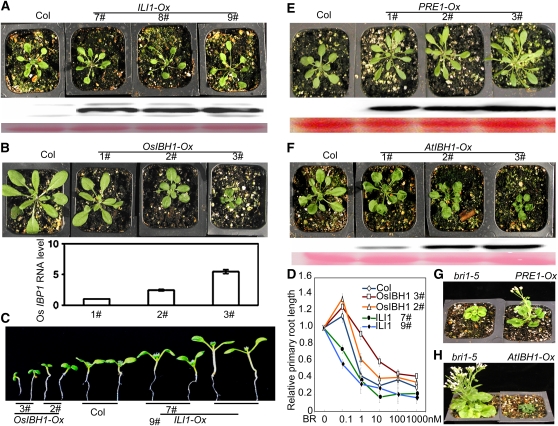
ILI1/PRE1 and IBH1 Function Antagonistically in Regulating Plant Growth. (A) Overexpression of ILI1 in Arabidopsis increases petiole elongation. Panels from top to bottom are pictures of wild-type (Columbia) and 35S:ILI1-YFP plants (ILI1-Ox) grown in soil for 3 weeks, immunoblot probed using GFP antibody, and the gel blot stained for protein with Ponceau S. (B) Overexpression of Os IBH1 in Arabidopsis inhibits petiole elongation. The 35S:OsIBH1-GFP plants (OsIBH1-Ox) were grown in soil for 3 weeks. The bottom panels show RT-PCR analysis of the expression levels of Os IBH1 in the plants with UBQ5 as a loading control. (C) Seedling of OsIBH1-Ox and ILI1-Ox transgenic lines grown on half-strength Murashige and Skoog (MS) medium in constant light for 7 d. (D) The ILI1-Ox and OsIBH1-Ox transgenic plants show increased and decreased sensitivity to BR, respectively. Seedlings were grown on medium containing different concentrations of BL for 7 d under constant light. Relative root lengths were average of 30 plants and normalized to the untreated plants. Error bars represent sd. (E) Overexpression PRE1-YFP (PRE1-Ox) causes longer petioles. The plants were grown in soil for 3 weeks. Bottom panels show immunoblot probed with anti-GFP antibodies and Ponceau S staining for loading control. (F) The 35S:AtIBH1-Myc (AtIBH1-Ox) transgenic plants show shorter petioles. The plants were grown in soil for 3 weeks. Bottom panels show immunoblot probed with anti-myc antibodies and Ponceau S staining for loading control. (G) Overexpression of PRE1-YFP partly suppresses the bri1-5 phenotype. (H) Overexpression of At IBH1-Myc enhances the bri1-5 dwarf phenotype.
Figure 6.
Figure 6.
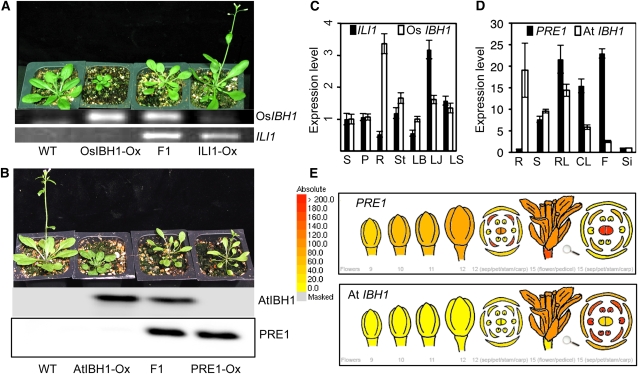
ILI1 and PRE1 Suppress the Activity of IBH1 in Vivo. (A) Four-week-old plants of ILI1-Ox, OsIBH1-Ox, and their cross progeny (F1). The bottom panels show the PCR genotyping of the transgenes. (B) Four-week-old PRE1-Ox and AtIBH1-Ox plants and their cross progeny (F1). The bottom panels show immunoblots probed with anti-myc or anti-GFP antibodies. (C) Quantitative RT-PCR analysis of ILI1 and Os IBH1 in various tissues of rice. S, stem; P, panicle; R, root; LB, leaf blade; LJ, lamina joint; LS, leaf sheath. Error bars indicate sd. (D) Quantitative RT-PCR analysis of PRE1 and At IBH1 in various tissues of Arabidopsis. R, root; S, seedling; RL, rosette leaf; CL, cauline leaf; F, unopen floral buds; Si, silique. Error bars indicate sd. (E) Relative expression levels of PRE1 and At IBH1 in floral buds (left) and the open flower (right) based on microarray data displayed in the eFP browser (http://www.bar.utoronto.ca/efp/cgi-bin/efpWeb.cgi). Color scale shows microarray signal level.
Figure 7.
Figure 7.
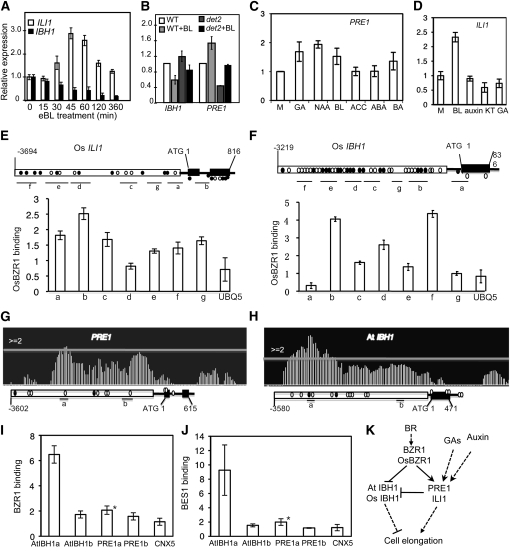
BR Increases the Transcript Levels of ILI1 and PRE1, but Represses Os IBH1 and At IBH1 Directly through OsBZR1 and BZR1 in Rice and Arabidopsis. (A) Quantitative RT-PCR analysis of the transcripts of ILI1 and Os IBH1 in wild-type rice treated with 1 μM 24-eBL for different times. (B) Quantitative RT-PCR analysis of the transcripts of PRE1 and At IBH1 in wild-type Arabidopsis and det2 treated with 100 nM eBL or mock solution for 2 h. (C) and (D) Quantitative RT-PCR analysis of the effects of different plant hormones on the expression of PRE1 (C) and ILI1 (D). (C) Seven-day-old Arabidopsis seedling were treated for 1 h with mock solution (M), 50 μM gibberellic acid (GA), 1 μM naphthalenacetic acid (NAA), 100 nM bassinolide (BL), 2 μM 1-aminocyclopropane-1-carboxylic acid (ACC), 100 μM abscisic acid (ABA), or 100 nM 6-benzyl aminopurine (6-BA). (D) Rice seedlings were soaked in water containing no hormone (M), 10 μM eBL, 10 μM 2,4-D, 100 μM kinetin (KT), or 100 μM GA for 3 h. (E) to (L) ChIP assays of binding of Os BZR1 ([E] and [F]), BZR1 ([G] to [I]), and BES1 (J) to the promoters of ILI1 (E), Os IBH1 (F), PRE1, and At IBH1 ([G] to [J]). For gene structure diagrams for ILI1 (E), Os IBH1 (F), PRE1 (G), and At IBH1 (H), open boxes show promoter regions, black lines show untranslated regions and introns, black boxes show coding sequences, black circles show BR response element motifs, and white circles show putative E-box motifs. Regions analyzed by quantitative PCR are shown by short lines marked with letters (a to g), and the quantity of binding by Os BZR1, BZR1, or BES1 is shown in the bar graph of (E), (F), (I), and (J) as fold of enrichment over the control sample. Asterisks indicate significant differences (P < 0.05) from UBQ5 and CNX5, which are control genes in rice and Arabidopsis. Error bars indicate sd. (G) and (H) The BZR1 ChIP-microarray data displayed by Integrated Genome Browser software at selected chromosomal regions marked by the gene structure of PRE1 and At IBH1. The horizontal lines indicate the cutoff of twofold enrichment. (K) A model for the functions of PRE1/ILI1 and IBH1 in BR response in Arabidopsis and rice. IBH1 negatively regulates cell elongation. BR signaling directly represses the transcription of IBH1 and activates PRE1/ILI1 through BZR1 binding to their promoters. PRE1/ILI1 inhibits IBH1 at the protein level by heterodimerization. Such double repression of IBH1 at the transcriptional and protein levels effectively releases its inhibition of cell elongation, leading to robust growth responses, such as the BR-induced lamina inclination. PRE1/ILI1 or their homologs might also be targets for other signals that regulate cell elongation, such as GA and auxin.

References

    1. Bai, M.Y., Zhang, L.Y., Gampala, S.S., Zhu, S.W., Song, W.Y., Chong, K., and Wang, Z.Y. (2007). Functions of OsBZR1 and 14-3-3 proteins in brassinosteroid signaling in rice. Proc. Natl. Acad. Sci. USA 104 13839–13844. - PMC - PubMed
    1. Bernhardt, C., Zhao, M., Gonzalez, A., Lloyd, A., and Schiefelbein, J. (2005). The bHLH genes GL3 and EGL3 participate in an intercellular regulatory circuit that controls cell patterning in the Arabidopsis root epidermis. Development 132 291–298. - PubMed
    1. Bishop, G.J., and Koncz, C. (2002). Brassinosteroids and plant steroid hormone signaling. Plant Cell 14(Suppl): S97–S110. - PMC - PubMed
    1. Chen, K.Y., Cong, B., Wing, R., Vrebalov, J., and Tanksley, S.D. (2007). Changes in regulation of a transcription factor lead to autogamy in cultivated tomatoes. Science 318 643–645. - PubMed
    1. Chory, J., Nagpal, P., and Peto, C.A. (1991). Phenotypic and genetic analysis of det2, a new mutant that affects light-regulated seedling development in Arabidopsis. Plant Cell 3 445–459. - PMC - PubMed

Publication types

MeSH terms