


Burns, inflammation, and intestinal injury: protective effects of an anti-inflammatory resuscitation strategy
- PMID: 20009662
- PMCID: PMC4251580
- DOI: 10.1097/TA.0b013e3181ba3577
Burns, inflammation, and intestinal injury: protective effects of an anti-inflammatory resuscitation strategy
Abstract
Background: Intestinal barrier breakdown after severe burn can lead to intestinal inflammation, which may act as the source of the systemic inflammatory response. In vitro intestinal cell studies have shown that mitogen-activated protein kinase (MAPK) signaling is an important modulator of intestinal inflammation. We have previously observed that pentoxifylline (PTX) attenuates burn-induced intestinal permeability and tight junction breakdown. We hypothesized that PTX would limit intestinal barrier breakdown and attenuate inflammatory signaling via the MAPK pathway.
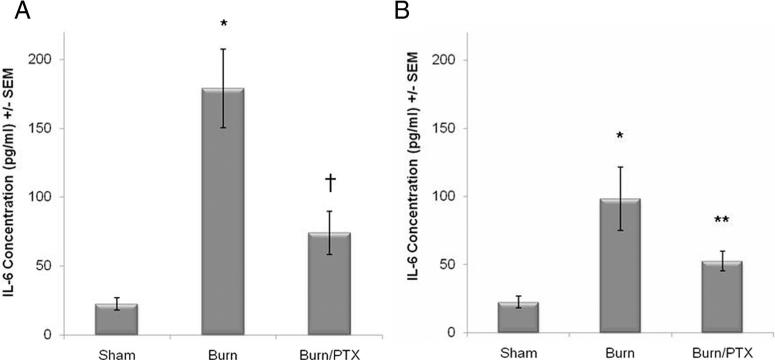
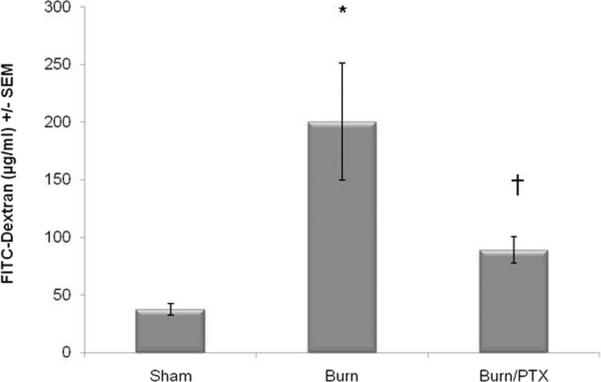
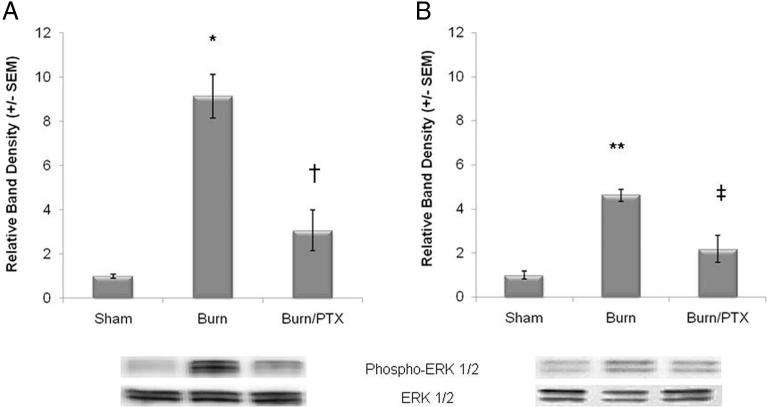
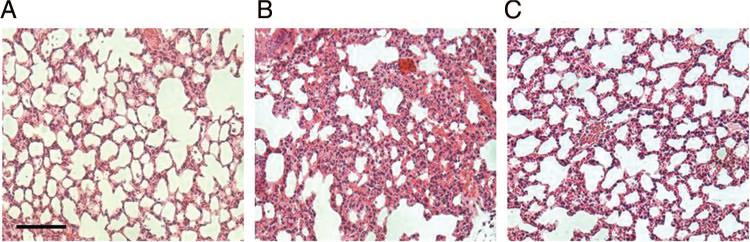
Methods: Male balb/c mice underwent 30% total body surface area full-thickness steam burn. Immediately after burn, animals received an intraperitoneal injection of PTX (12.5 mg/kg) in normal saline or normal saline alone. In vivo intestinal permeability to 4 kDa fluorescein isothiocyanate-dextran was measured. Intestinal extracts were obtained to measure interleukin-6 by enzyme-linked immunosorbent assay, and phosphorylated p38 MAPK, p38 MAPK, phosphorylated extracellular signal-related kinase (1/2) (ERK (1/2)), and ERK (1/2) by immunoblotting. Acute lung injury was assessed by histology at 24 hours after burn.
Results: Administration of PTX immediately after injury attenuated burn-induced intestinal permeability. PTX also decreased the burn-induced phosphorylation of p38 MAPK and decreased phosphorylation of ERK (1/2) at 2 hours and 24 hours after injury. Animals given PTX had decreased intestinal interleukin-6 levels. A single dose of PTX also decreased histologic lung injury at 24 hours after burn.
Conclusion: PTX attenuates burn-induced intestinal permeability and subsequent intestinal inflammation. Use of PTX after burn was also associated with decreased acute lung injury. Because of its compelling anti-inflammatory effects, PTX may be an ideal candidate for use as an immunomodulatory adjunct to resuscitation fluid.
Figures

References
-
- Magnotti LJ, Xu DZ, Lu Q, Deitch EA. Gut-derived mesenteric lymph: a link between burn and lung injury. Arch Surg. 1999;134:1333–1340. discussion 1340–1341. - PubMed
-
- Deitch EA, Xu D, Kaise VL. Role of the gut in the development of injury- and shock induced SIRS and MODS: the gut-lymph hypothesis, a review. Front Biosci. 2006;11:520–528. - PubMed
-
- Caruso JM, Feketeova E, Dayal SD, Hauser CJ, Deitch EA. Factors in intestinal lymph after shock increase neutrophil adhesion molecule expression and pulmonary leukosequestration. J Trauma. 2003;55:727–733. - PubMed
-
- Masuno T, Moore EE, Cheng AM, Sarin EL, Banerjee A. Bioactivity of postshock mesenteric lymph depends on the depth and duration of hemorrhagic shock. Shock. 2006;26:285–289. - PubMed
MeSH terms
Substances
Grants and funding
LinkOut - more resources
Full Text Sources
Other Literature Sources
Medical
Miscellaneous
