


Review
doi: 10.1097/QAD.0b013e32833424c8.
Targeting Trojan Horse leukocytes for HIV prevention
Affiliations
- PMID: 20010071
- PMCID: PMC4097178
- DOI: 10.1097/QAD.0b013e32833424c8
Item in Clipboard
Review
Targeting Trojan Horse leukocytes for HIV prevention
AIDS.
.
No abstract available
Figures
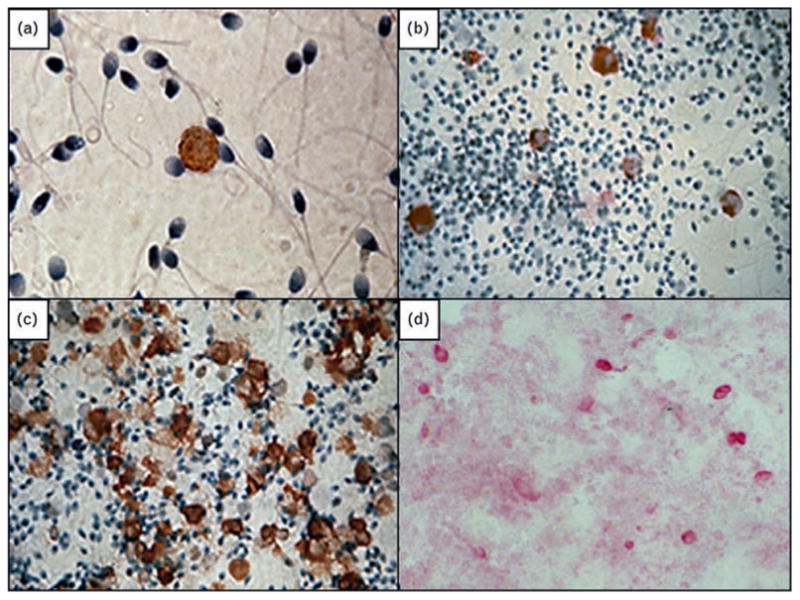
(a) CD4+ T cell in semen. (b) CD68+ macrophages in semen. (c) CD45+ leukocytes in semen from a man with leukocytospermia. (d) CD68+ macrophages in cervicovaginal secretions. Magnification × 400.
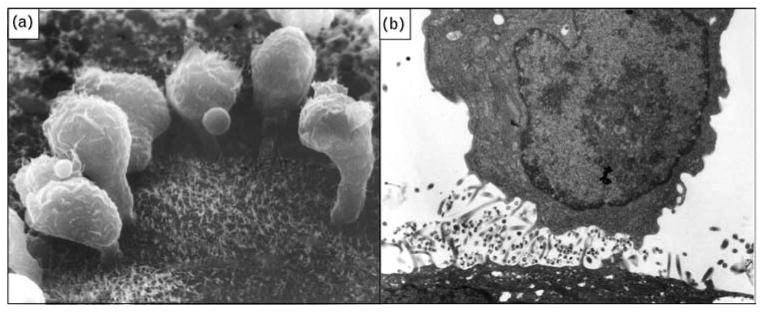
(a) Scanning electron micrograph showing HIV-infected lymphocytes adhering to the surface of an epithelial cell (magnification × 10000). (b) Transmission electron micrograph of HIV-infected macrophage from semen releasing virus after contact with a genital tract epithelial cell (magnification × 15 000). Original photographs provided by David M. Phillips with permission from the Population Council, New York. Part (a) reproduced from [4].
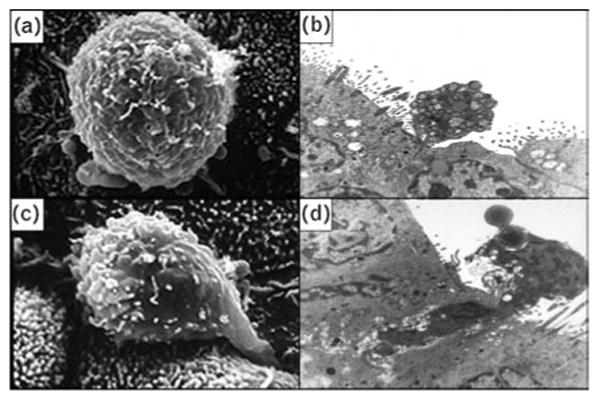
Scanning electron micrograph (a) and transmission electron micrograph (b) of human peripheral blood monocyte attached to epithelial intracellular junction. Scanning electron micrograph (c) and transmission electron micrograph (d) of human peripheral blood monocyte apparently infiltrating between two epithelial cells. Magnification: scanning electron micrograph, × 10000; transmission electron micrograph, × 15000.
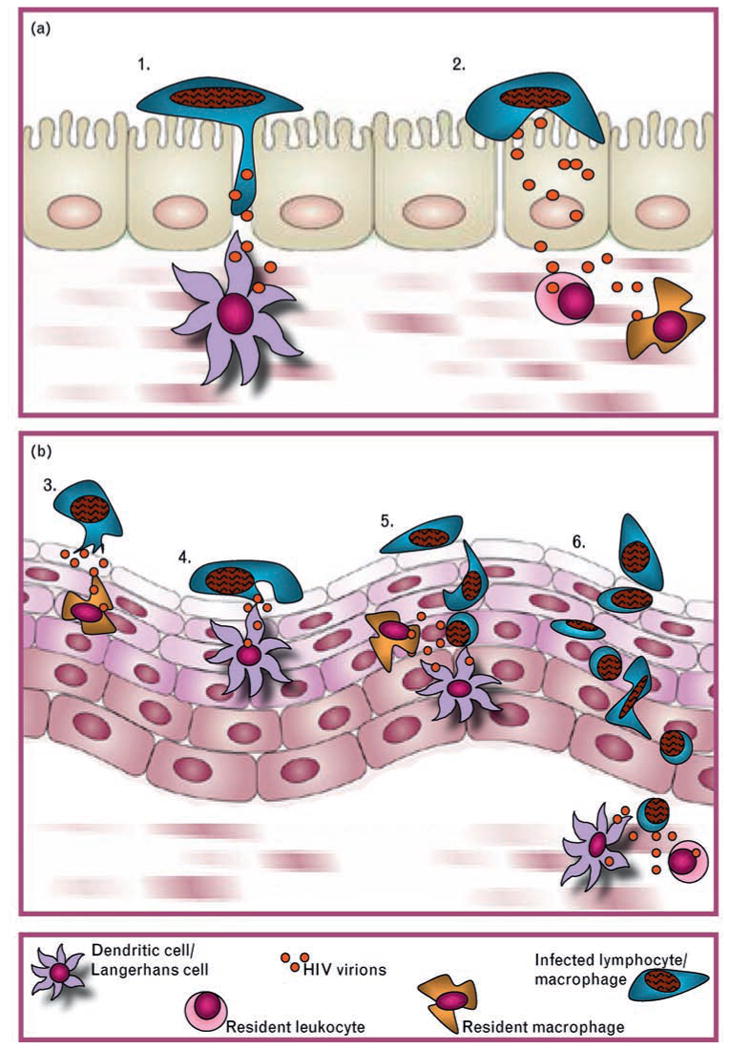
(a) Columnar epithelium: (1) Infected cell migrates between epithelial cells to infect susceptible host cells in the lamina propria or draining lymph nodes. (2) HIV trancytosis through epithelial cells to infect susceptible target cells in lamina propria. (b) Stratified squamous epithelium: (3) Transfer of HIV from infected leukocyte to epithelial cell, which transfers virus to intraepithelial or subepithelial target cells through (a) transcytosis or (b) attraction via release of chemokines. (4) Direct cell-to-cell transfer of HIV from infected leukocyte to intraepithelial target cell via viral synapses. (5) Transepithelial migration of infected leukocyte to infect intraepithelial target cells within the epithelium. (6) Transepithelial migration of infected cell to infect target cells in the subepithelium or draining lymph nodes.
References
-
- UNAIDS. AIDS epidemic update. Geneva: UNAIDS and WHO; 2007.
-
- Shattock RJ, Moore JP. Inhibiting sexual transmission of HIV-1 infection. Nat Rev Microbiol. 2003;1:25–34. - PubMed
-
- Anderson DJ, Yunis EJ. ‘Trojan Horse’ leukocytes in AIDS. N Engl J Med. 1983;309:984–985. - PubMed
-
- Phillips DM. The role of cell-to-cell transmission in HIV infection. AIDS. 1994;8:719–731. - PubMed
-
- Levy JA. The transmission of AIDS: the case of the infected cell. JAMA. 1988;259:3037–3038. - PubMed
Publication types
MeSH terms
Grants and funding
LinkOut - more resources
Full Text Sources
Other Literature Sources
Medical
