


Bone T-scores and functional status: a cross-sectional study on German elderly
- PMID: 20011039
- PMCID: PMC2784940
- DOI: 10.1371/journal.pone.0008216
Bone T-scores and functional status: a cross-sectional study on German elderly
Abstract
Background: We explore the association between bone T-scores, used in osteoporosis diagnosis, and functional status since we hypothesized that bone health can impact elderly functional status and indirectly independence.
Methods: In a cross-sectional study (2005-2006) on community dwelling elderly (> = 75 years) from Herne, Germany we measured bone T-scores with Dual-energy X-ray Absorptiometry, and functional status indexed by five geriatric tests: activities of daily living, instrumental activities of daily living, test of dementia, geriatric depression score and the timed-up-and-go test, and two pooled indexes: raw and standardized. Generalized linear regression was used to determine the relationship between T-scores and functional status.
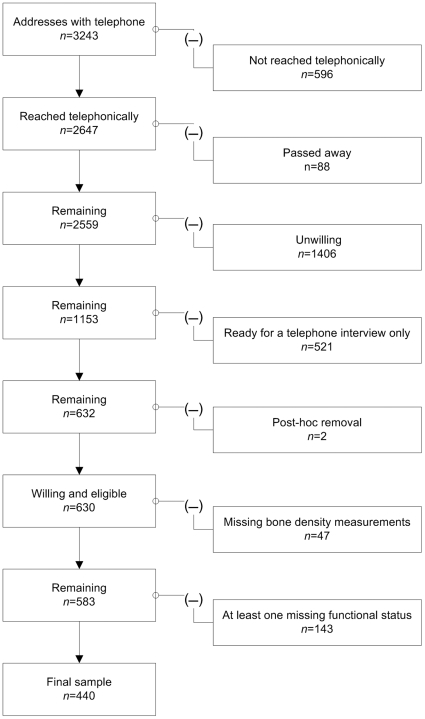
Results: From 3243 addresses, only 632 (19%) completed a clinical visit, of which only 440 (male:female, 243:197) could be included in analysis. T-scores (-0.99, 95% confidence interval [CI], -1.1-0.9) predicted activities of daily living (95.3 CI, 94.5-96.2), instrumental activities of daily living (7.3 CI, 94.5-96.2), and timed-up-and-go test (10.7 CI, 10.0-11.3) (P < = 0.05). Pooled data showed that a unit improvement in T-score improved standardized pooled functional status (15 CI, 14.7-15.3) by 0.41 and the raw (99.4 CI, 97.8-101.0) by 2.27 units. These results were limited due to pooling of different scoring directions, selection bias, and a need to follow-up with evidence testing.
Conclusions: T-scores associated with lower functional status in community-dwelling elderly. Regular screening of osteoporosis as a preventive strategy might help maintain life quality with aging.
Conflict of interest statement
Figures
References
-
- Frassetto LA, Berkemeyer S. Osteoporosis: The scientific basis of the alkaline diet. In: Kohlstadt I,, editor. Food and Nutrients in Disease Management. CRC Press Inc; 2009. pp. 503–520.
-
- Looker AC, Orwoll ES, Johnston CCJ, Lindsay RL, Wahner HW, et al. Prevalence of low femoral bone denstiy in older U.S. adults from NHANES III. J Bone Miner Res. 1997;12:1761–8. - PubMed
-
- National Institute of Health. Osteoporosis: The diagnosis. 2005. http://www.niams.nih.gov/Health_Info/Bone/Osteoporosis/diagnosis.asp. Accessed December 02, 2008.
-
- Karagas MR, Lu-Yao GL, Barrett JA, Beach ML, Baron JA. Heterogenity of hip fracture: age, race, sex, and geographic patterns of femoral neck and trochanteric fractures among the US elderly. Am J Epidemiol. 1996;143:677–682. - PubMed
-
- Naessen T, Parker R, Persson I, Zack M, Adami HO. Time trends in incidence rates of first hip fracture in the Uppsala Helath Care Region, Sweden, 1965–1983. Am J Epidemiol. 1989;130:289–299. - PubMed
Publication types
MeSH terms
LinkOut - more resources
Full Text Sources
