


Toll-like receptor mRNA expression is selectively increased in the colonic mucosa of two animal models relevant to irritable bowel syndrome
- PMID: 20011045
- PMCID: PMC2785428
- DOI: 10.1371/journal.pone.0008226
Toll-like receptor mRNA expression is selectively increased in the colonic mucosa of two animal models relevant to irritable bowel syndrome
Abstract
Background: Irritable bowel syndrome (IBS) is largely viewed as a stress-related disorder caused by aberrant brain-gut-immune communication and altered gastrointestinal (GI) homeostasis. Accumulating evidence demonstrates that stress modulates innate immune responses; however, very little is known on the immunological effects of stress on the GI tract. Toll-like receptors (TLRs) are critical pattern recognition molecules of the innate immune system. Activation of TLRs by bacterial and viral molecules leads to activation of NF-kB and an increase in inflammatory cytokine expression. It was our hypothesis that innate immune receptor expression may be changed in the gastrointestinal tract of animals with stress-induced IBS-like symptoms.
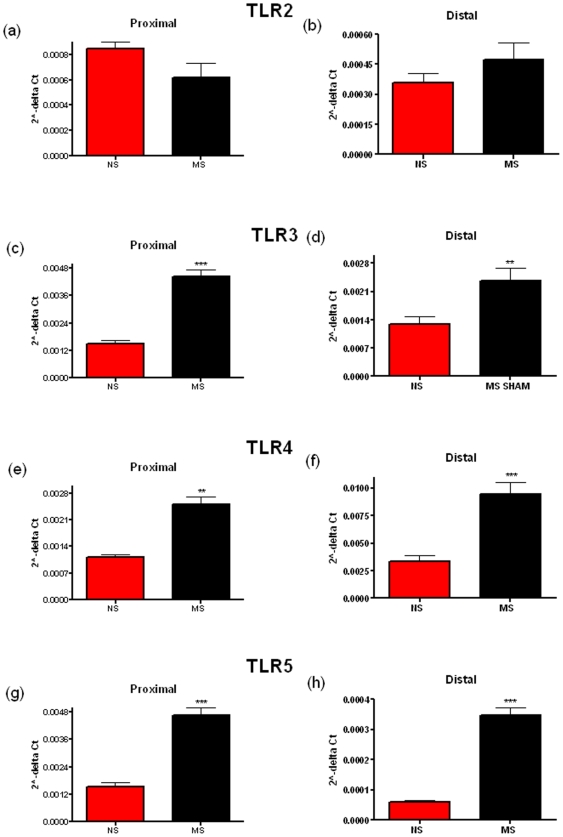
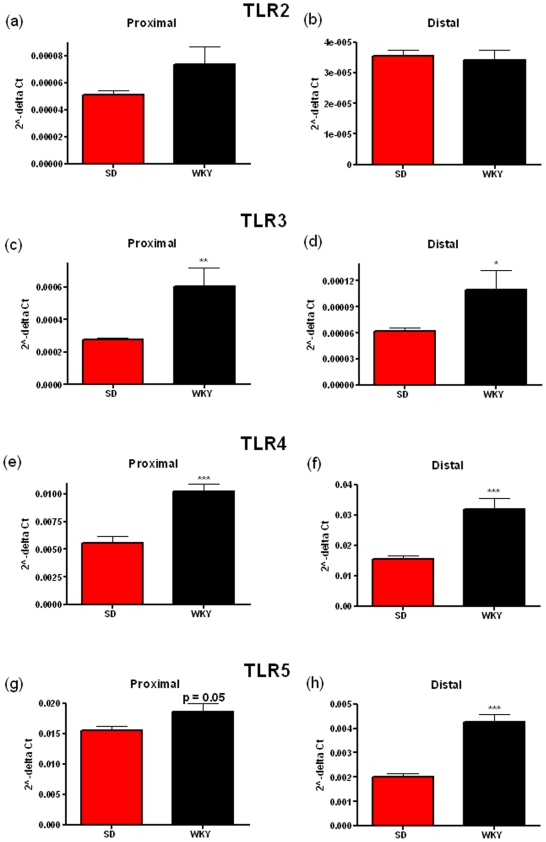
Methodology/principal findings: In this study, our objective was to evaluate the TLR expression profile in the colonic mucosa of two rat strains that display colonic visceral hypersensitivity; the stress-sensitive Wistar-Kyoto (WKY) rat and the maternally separated (MS) rat. Quantitative PCR of TLR2-10 mRNA in both the proximal and distal colonic mucosae was carried out in adulthood. Significant increases are seen in the mRNA levels of TLR3, 4 & 5 in both the distal and proximal colonic mucosa of MS rats compared with controls. No significant differences were noted for TLR 2, 7, 9 & 10 while TLR 6 could not be detected in any samples in both rat strains. The WKY strain have increased levels of mRNA expression of TLR3, 4, 5, 7, 8, 9 & 10 in both the distal and proximal colonic mucosa compared to the control Sprague-Dawley strain. No significant differences in expression were found for TLR2 while as before TLR6 could not be detected in all samples in both strains.
Conclusions: These data suggest that both early life stress (MS) and a genetic predisposition (WKY) to stress affect the expression of key sentinels of the innate immune system which may have direct relevance for the molecular pathophysiology of IBS.
Conflict of interest statement
Figures


References
-
- Drossman DA, Camilleri M, Mayer EA, Whitehead WE. AGA technical review on irritable bowel syndrome. Gastroenterology. 2002;123:2108–2131. - PubMed
-
- Quigley EM. Current concepts of the irritable bowel syndrome. Scand J Gastroenterol. 2003;(Suppl):1–8. - PubMed
-
- Mayer EA, Collins SM. Evolving pathophysiologic models of functional gastrointestinal disorders. Gastroenterology. 2002;122:2032–2048. - PubMed
-
- Mayer EA, Naliboff BD, Craig AD. Neuroimaging of the brain-gut axis: from basic understanding to treatment of functional GI disorders. Gastroenterology. 2006;131:1925–1942. - PubMed
Publication types
MeSH terms
Substances
LinkOut - more resources
Full Text Sources
Other Literature Sources
