Embryogenesis of bladder exstrophy: A new hypothesis
- PMID: 20011468
- PMCID: PMC2788445
- DOI: 10.4103/0971-9261.43017
Embryogenesis of bladder exstrophy: A new hypothesis
Abstract
Aims and objective: To postulate a hypothesis to explain the embryogenesis of exstrophy bladder based on our clinical observations.
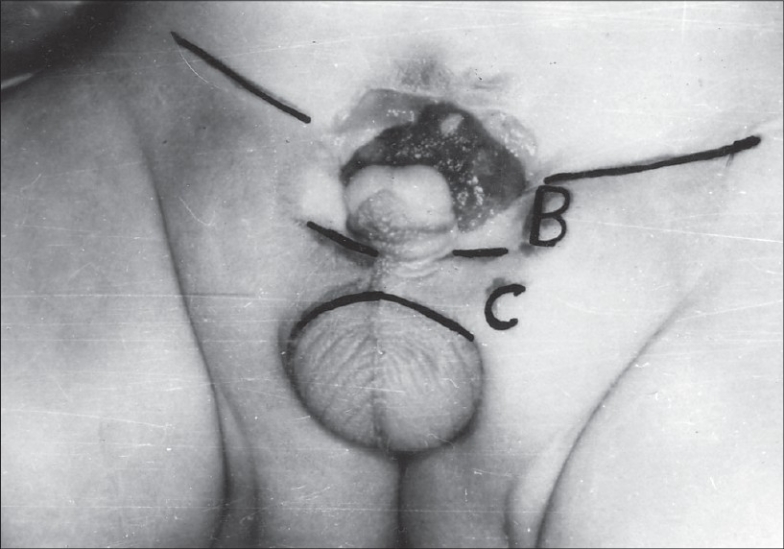
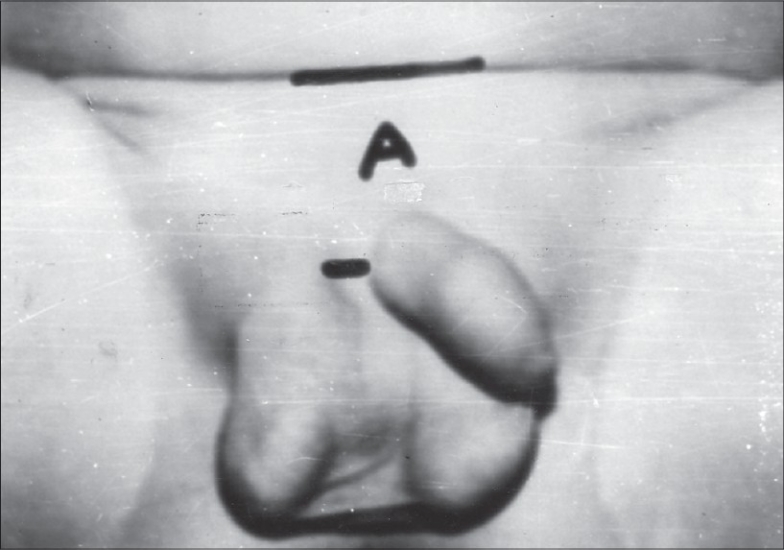
Materials and methods: In 27 cases of exstrophy, we measured the distance between the lowermost inguinal skin crease to the root of the penis (clitoris) (B) and the distance between the penis (clitoris) and the scrotum (labia majora) (C). These were compared with age, height and XP distance (distance between xiphisternum and symphysis pubis) matched control group of normal children. The distance between the lowermost inguinal skin crease and the penis (clitoris) (A) was measured in control group.
Results: The observation was A = B + C. This implies that in exstrophy bladder, the position of the penis (clitoris) has moved cephalad from the lower border of A to the junction of B and C.
Conclusion: Based on the observations, we postulate that abnormal origin of genital tubercle may be the cause of exstrophy bladder. The abnormal origin of primordia of the genital tubercle in more cephalad direction than normal causes wedge effect, which will interfere with the medial migration of the mesoderm as well as the midline approximation of mesodermal structures in the lower abdominal wall, thereby resulting in the exstrophy of bladder.
Keywords: Bladder exstrophy; embryology of cloaca; genital tubercle.
Conflict of interest statement
Figures
References
-
- Arey LB. Developmental anatomy. 6th ed. Philadelphia: W.B. Saunders Co; 1954. pp. 200–1.pp. 306–8.
-
- Jordan HE, Kindred JE. A text book of embryology. New York: Applleton and Co; 1932. pp. 116–8.
-
- Patten BM. Varying developmental mechanism in teratology. Paediatric. 1957;1:734–48. - PubMed
-
- Stockard CR. Developmental rate and structural expression and experimental study of twins double monsters and single deformities and the interaction among embryonic organs during their origin and development. Am J Anat. 1921;28:112–277.
-
- Porter RM. Bladder outside the belly. Nashville J Med And Surg. 1855;8:381.