. 2009 Dec 14;4(12):e8210.
doi: 10.1371/journal.pone.0008210.

RNA editing genes associated with extreme old age in humans and with lifespan in C. elegans

Affiliations

RNA editing genes associated with extreme old age in humans and with lifespan in C. elegans

Paola Sebastiani et al. PLoS One. .

Erratum in

Abstract

Background: The strong familiality of living to extreme ages suggests that human longevity is genetically regulated. The majority of genes found thus far to be associated with longevity primarily function in lipoprotein metabolism and insulin/IGF-1 signaling. There are likely many more genetic modifiers of human longevity that remain to be discovered.

Methodology/principal findings: Here, we first show that 18 single nucleotide polymorphisms (SNPs) in the RNA editing genes ADARB1 and ADARB2 are associated with extreme old age in a U.S. based study of centenarians, the New England Centenarian Study. We describe replications of these findings in three independently conducted centenarian studies with different genetic backgrounds (Italian, Ashkenazi Jewish and Japanese) that collectively support an association of ADARB1 and ADARB2 with longevity. Some SNPs in ADARB2 replicate consistently in the four populations and suggest a strong effect that is independent of the different genetic backgrounds and environments. To evaluate the functional association of these genes with lifespan, we demonstrate that inactivation of their orthologues adr-1 and adr-2 in C. elegans reduces median survival by 50%. We further demonstrate that inactivation of the argonaute gene, rde-1, a critical regulator of RNA interference, completely restores lifespan to normal levels in the context of adr-1 and adr-2 loss of function.

Conclusions/significance: Our results suggest that RNA editors may be an important regulator of aging in humans and that, when evaluated in C. elegans, this pathway may interact with the RNA interference machinery to regulate lifespan.


Conflict of interest statement

Competing Interests: The authors have declared that no competing interests exist.

Figures

Figure 1
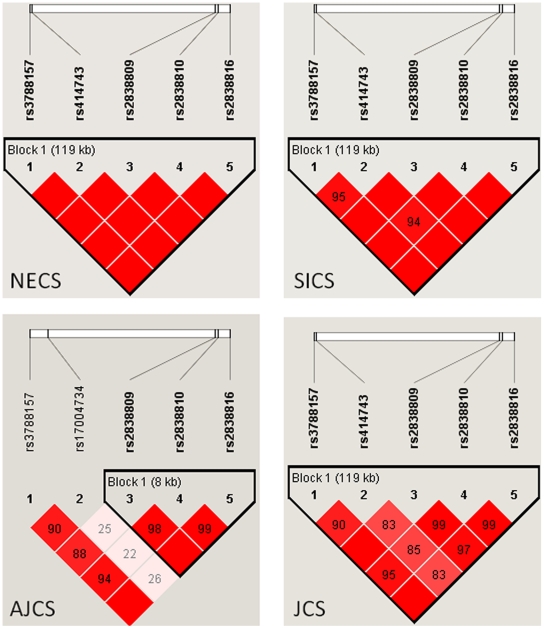
Figure 1. Pattern of LD among the SNP in ADARB1 (chromosome 21) that are associated with exceptional longevity.
The four plots display the pattern of LD captured by the SNPs associated with exceptional longevity in ADARB1 (chromosome 21) using data from the NECS, SICS, AJCS and JCS. The intensity of red represents the strength of LD measured by D′.
Figure 2
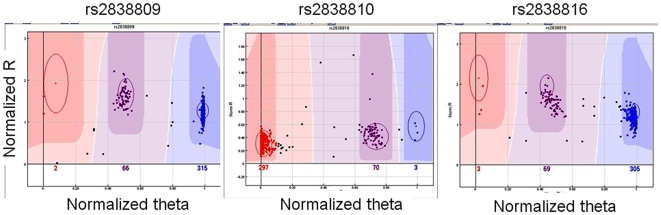
Figure 2. Result of genotype cluster algorithm from BeadStudio.
The three plots show the normalized intensities in polar coordinate and the cluster definition from BeadStudio for NECS subjects. The clear separation suggests that the genotype calls are robust.
Figure 3
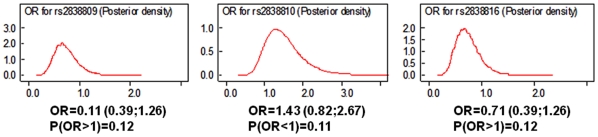
Figure 3. Posterior densities of ORs.
Posterior densities of the ORs for the 3 SNPs in ADARB1 with rare alleles and moderate effects in the data aggregated from NECS, SICS and JCS. Significant associations would results in posterior densities not overlapping 1 and definite evidence of either an OR<1 or an OR>1, while all of the three densities have heavy tails and do not provide definite evidence against the null hypothesis of no association.
Figure 4
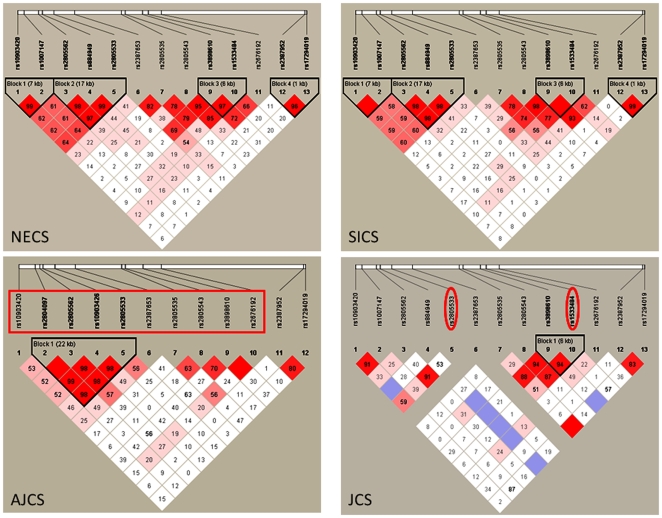
Figure 4. Pattern of LD among the SNP in ADARB2 (chromosome 10) that are associated with exceptional longevity.
The four plots display the pattern of LD captured by the SNPs associated with exceptional longevity in ADARB2 (chromosome 10) in the NECS, SICS, AJCS and JCS data. The intensity of red cells represents the strength of LD measured by D′. The LD pattern in the NECS, SICS and AJCS subjects are very similar but differ substantially from the pattern of LD in the JCS subjects in which two SNPs become almost monomorphic (rs884949 and rs2387653). Highlighted in red are the SNPs that replicate the results in the AJCS and JCS subjects.
Figure 5
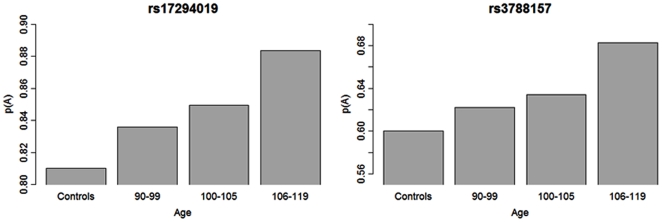
Figure 5. Age related trend of allele frequencies.
The two barplots show the age related trend of allele frequencies of SNPs rs17294019 (ADARB2, SNP # 98 in Table 1) and rs3788157 (ADARB1, SNP # 135 in Table 1) in the NECS (n = 1,023). The frequencies of the common allele for both SNPs were stratified in the age groups 90–99; 100–105, 106 and higher. Trends of allele frequencies for increasing age groups are consistent with a strong correlation between genotype and phenotype that results in substantial enrichment of protective alleles in older subjects.
Figure 6
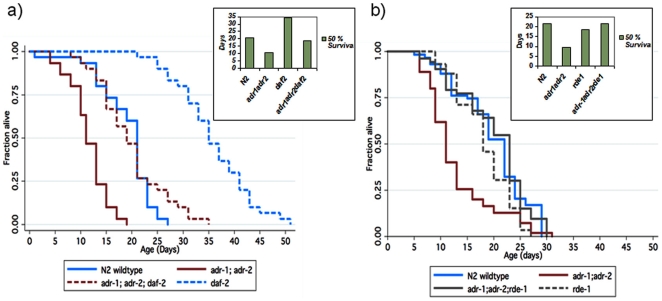
Figure 6. ADAR mediated decline in lifespan, daf-2 influence, and rde-1 rescue.
a) Lifespan using mutant strains for adr-1;adr-2 in the context of dsRNA mediated gene inactivation of daf-2. Synchronized worms at the larval stage 4 (L4) were sterilized with FudR and allowed to feed on bacterial lawns that contained dsRNA for daf-2. Note: adr-1; adr-2 double mutant (red solid), adr-1; adr-2 double mutant with dsRNA for daf-2 (red hatched), N2 wild type (blue solid), N2 with dsRNA for daf-2 (blue hatched). Note decline in lifespan due to adr-1; adr-2 compared with N2 wildtype. Also note increases in lifespan of both N2 and adr-1; adr-2 in the presence of dsRNA for daf-2. The 50% survival time in the adr-1; adr-2 mutant animals was 10 days (95% limits 9 and 12 days) compared with 20 days (95% limits 18 and 20 days) for N2 wild-type control worms. RNAi to daf-2 increases lifespan to 34 days (95% limits 32 and 40 days), compared with 20 days for the wild type (N2 worms fed empty vector (RNAi)). daf-2 gene inactivation, in the background of the adr-1 and adr-2 null mutations also restored lifespan to 18 days (95% limits 16 and 20 days), compared with 10 days for the adr-1;adr-2 double mutant strain. b) Lifespan using mutant strains for adr-1;adr-2 (solid red), N2 wildtype (solid blue), rde-1 (grey hatched), adr-1; adr-2; rde-1 (grey solid) demonstrate declines in lifespan using mutant strains and full rescue of lifespan in an RNAi defective (rde-1) background. The adr-1; adr-2 mutant was again about half as long lived as wild-type (median survival time 9 days for adr-1;adr-2 strain (95% limits 9 and 11 days), and median survival time 21 days (95% limits 18 and 21 days), for N2 wild-type worms. The survival distribution of the triple mutant adr-1;adr-2; rde-1 is median lifespan 21 days (95% limits 18 and 21 days), which is significantly different from adr-1;adr-2, with a median lifespan of 9 days (95% limits 9 and 11 days). The lifespan of rde-1 was modestly reduced compared with the wild-type N2, as was reported previously29. Inset boxes displays 50% survival (days) for each condition and demonstrates that daf-2 gene inactivation increases lifespan, in both wild type and in adr-1;adr-2 mutant strains (a) and that RNAi knockout (rde-1) restores lifespan.

References

    1. Christensen K, Johnson TE, Vaupel JW. The quest for genetic determinants of human longevity: challenges and insights. Nat Rev Genet. 2006;7:436–448. - PMC - PubMed
    1. Gudmundsson H, Gudbjartsson DF, Frigge M, Gulcher JR, Stefansson K. Inheritance of human longevity in Iceland. Eur J Hum Genet. 2000;8:743–749. - PubMed
    1. Hjelmborg JV, Iachine I, Skytthe A, Vaupel JW, McGue M, et al. Genetic influence on human lifespan and longevity. Hum Genet. 2006;119:312–321. - PubMed
    1. Kerber RA, O'Brien E, Smith KR, Cawthon RM. Familial excess longevity in Utah genealogies. J Gerontol A Biol Sci Med Sci. 2001;56:B130–139. - PubMed
    1. Perls T, Shea-Drinkwater M, Bowen-Flynn J, Ridge SB, Kang S, et al. Exceptional familial clustering for extreme longevity in humans. J Am Geriatr Soc. 2000;48:1483–1485. - PubMed

Publication types

MeSH terms