


doi: 10.1007/s10488-009-0257-4.
Staff turnover in statewide implementation of ACT: relationship with ACT fidelity and other team characteristics
Affiliations
- PMID: 20012481
- PMCID: PMC2888664
- DOI: 10.1007/s10488-009-0257-4
Item in Clipboard
Staff turnover in statewide implementation of ACT: relationship with ACT fidelity and other team characteristics
Adm Policy Ment Health.
2010 Sep.
Abstract
Staff turnover on assertive community treatment (ACT) teams is a poorly understood phenomenon. This study examined annual turnover and fidelity data collected in a statewide implementation of ACT over a 5-year period. Mean annual staff turnover across all observations was 30.0%. Turnover was negatively correlated with overall fidelity at Year 1 and 3. The team approach fidelity item was negatively correlated with staff turnover at Year 3. For 13 teams with 3 years of follow-up data, turnover rates did not change over time. Most ACT staff turnover rates were comparable or better than other turnover rates reported in the mental health and substance abuse literature.
Figures
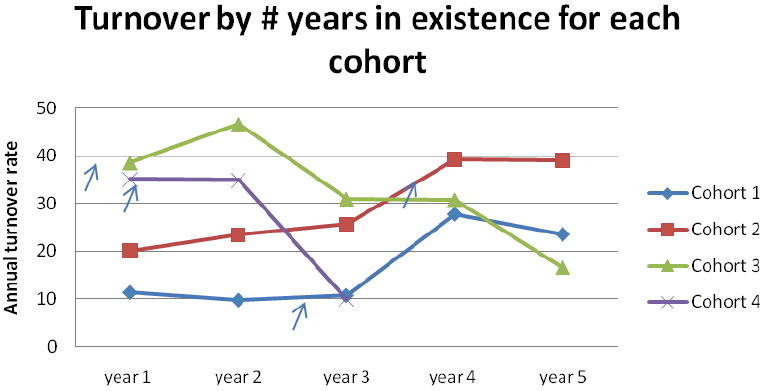
Cohort is defined by when the baseline assessment was completed. Cohort 1: early 2002; Cohort 2: Fall 2002; Cohort 3: late 2003 and early 2004; Cohort 4: late 2004 and 2005. Note: The arrows show the approximate time that Medicaid per diem began for each cohort. The change in admission criteria happened approximately one year later.
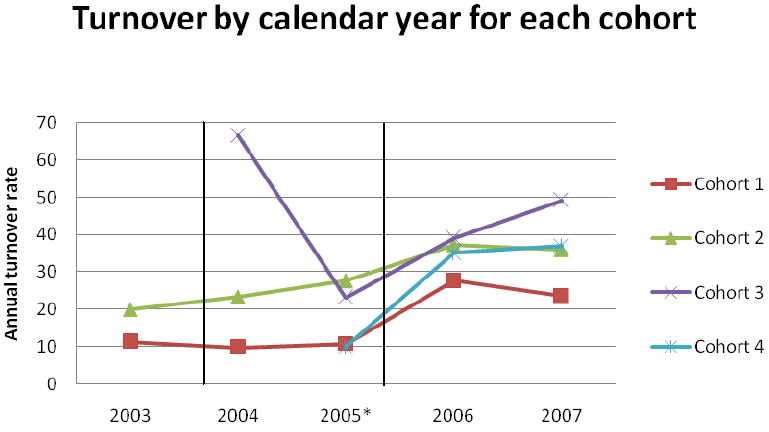
Cohort is defined by when the baseline assessment was completed. Cohort 1: early 2002; Cohort 2: Fall 2002; Cohort 3: late 2003 and early 2004; Cohort 4: late 2004 and 2005. The first vertical line indicates the start of special Medicaid per diem funding for ACT (October 2004) and the second indicates a policy change of more stringent admission criteria (October, 2005).
References
-
- Allness DJ, Knoedler WH. The PACT model of community-based treatment for persons with severe and persistent mental illness: A manual for PACT start-up. Arlington, VA: NAMI; 2003.
-
- Allred CA, Burns BJ, Phillips SD. The assertive community treatment team as a complex dynamic system of care. Administration and Policy in Mental Health. 2005;32(3):211–220. - PubMed
-
- Ben-Dror R. Employee turnover in community mental health organization: A developmental stages study. Community Mental Health Journal. 1994;30(3):243–257. - PubMed
-
- Blankertz LE, Robinson SE. Turnover intentions of community mental health workers in psychosocial rehabilitation services. Community Mental Health Journal. 1997;33(6):517–529. - PubMed
-
- Bond GR. Variations in an assertive outreach model. New Directions for Mental Health Services. 1991;52:65–80. - PubMed
Publication types
MeSH terms
Grants and funding
LinkOut - more resources
Full Text Sources
