. 2010 Mar;112(5):1295-304.
doi: 10.1111/j.1471-4159.2009.06543.x. Epub 2009 Dec 14.

A novel choline cotransporter sequestration compartment in cholinergic neurons revealed by selective endosomal ablation

Affiliations

A novel choline cotransporter sequestration compartment in cholinergic neurons revealed by selective endosomal ablation

Michael T Ivy et al. J Neurochem. 2010 Mar.

Erratum in

  • J Neurochem.2010 Apr;113(1):285

Abstract

The sodium-dependent, high affinity choline transporter - choline cotransporter - (ChCoT, aka: cho-1, CHT1, CHT) undergoes constitutive and regulated trafficking between the plasma membrane and cytoplasmic compartments. The pathways and regulatory mechanisms of this trafficking are not well understood. We report herein studies involving selective endosomal ablation to further our understanding of the trafficking of the ChCoT. Selective ablation of early sorting and recycling endosomes resulted in a decrease of approximately 75% of [3H]choline uptake and approximately 70% of [3H]hemicholinium-3 binding. Western blot analysis showed that ablation produced a similar decrease in ChCoTs in the plasma membrane subcellular fraction. The time frame for this loss was approximately 2 h which has been shown to be the constitutive cycling time for ChCoTs in this tissue. Ablation appears to be dependent on the intracellular cycling of transferrin-conjugated horseradish peroxidase and the selective deposition of transferrin-conjugated horseradish peroxidase in early endosomes, both sorting and recycling. Ablated brain slices retained their capacity to recruit via regulated trafficking ChCoTs to the plasma membrane. This recruitment of ChCoTs suggests that the recruitable compartment is distinct from the early endosomes. It will be necessary to do further studies to identify the novel sequestration compartment supportive of the ChCoT regulated trafficking.


Figures
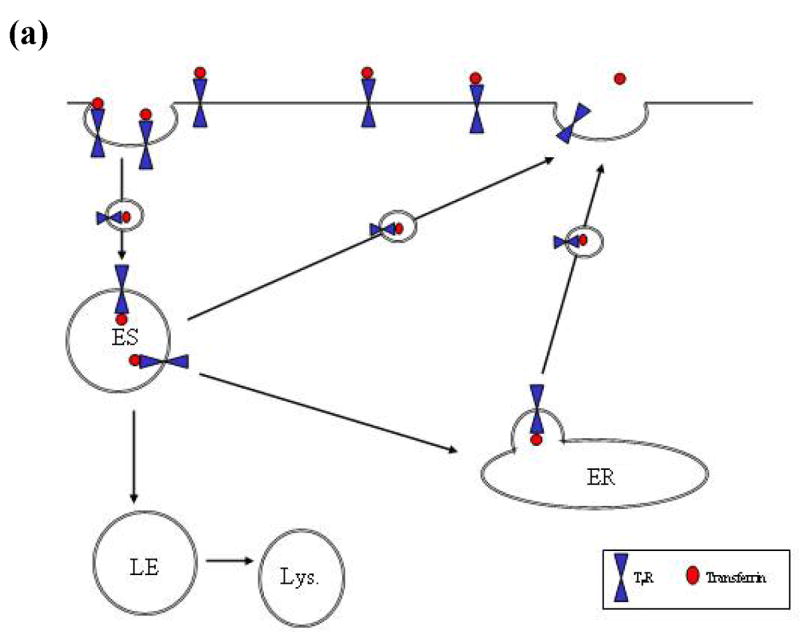
Figure 1
Figure 1
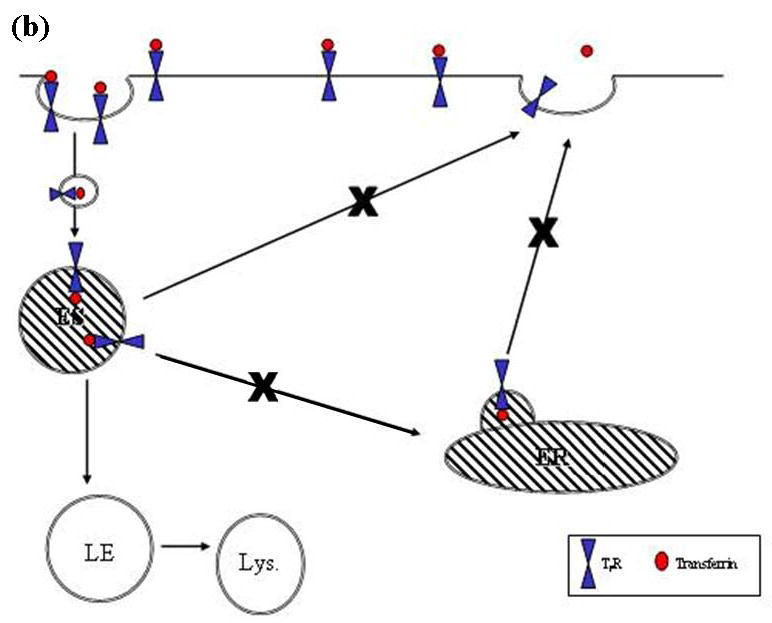
Intracellular trafficking model for the Transferrin receptor. (a) The Transferrin receptor (TfR) with bound Transferrin (Tf) cycles via the early sorting (ES) endosome and the early recycling (ER) endosome back to the surface membrane. Additional endosomes are the late endosome (LE) and lysosome (Lys.). (b) Early endosomes are presumed saturated with the Transferrin-Horseradish Peroxidase (Tf-HRP) complex bound to the TfR. Treatment with diaminobenzedine (DAB) plus hydrogen peroxide (H2O2) results in a chemical cross-linking rendering both endosomes nonfunctional (cross-hatching). Blockage of these endosomes is indicated by (X).
Figure 1
Figure 1
Intracellular trafficking model for the Transferrin receptor. (a) The Transferrin receptor (TfR) with bound Transferrin (Tf) cycles via the early sorting (ES) endosome and the early recycling (ER) endosome back to the surface membrane. Additional endosomes are the late endosome (LE) and lysosome (Lys.). (b) Early endosomes are presumed saturated with the Transferrin-Horseradish Peroxidase (Tf-HRP) complex bound to the TfR. Treatment with diaminobenzedine (DAB) plus hydrogen peroxide (H2O2) results in a chemical cross-linking rendering both endosomes nonfunctional (cross-hatching). Blockage of these endosomes is indicated by (X).
Figure 2
Figure 2
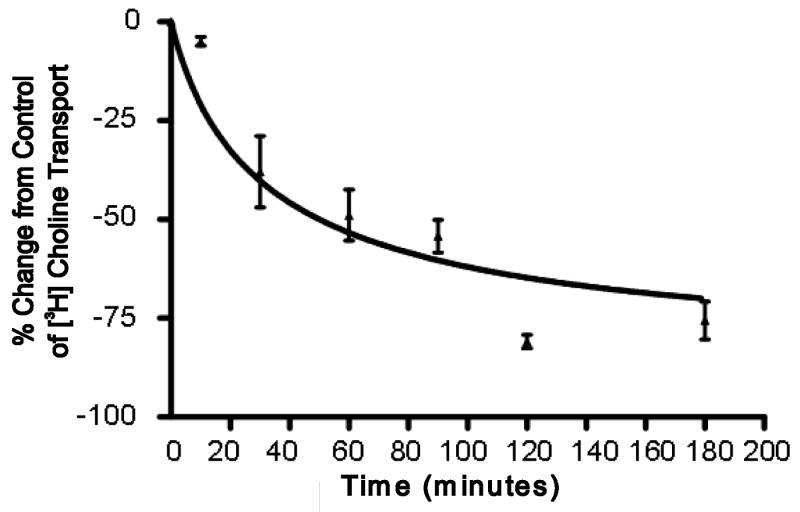
Time course for loss of plasma membrane choline cotransporters after ablation. Brain hemi-slices were pretreated with either Tf-HRP conjugate or normal Chao's solution (control) for 30 min at 37°C, after which hemi-slices were treated with DAB for 1 h at 4°C. Following treatment, hemi-slices were washed in normal Chao's for varying times from 0-180 min at RT and subsequently, slices were incubated in 1μM [3H]choline Chao's for 30 min at RT. Data are plotted as the difference between the ablated and control, and represent the mean ± SEM for at least 3 determinations.
Figure 3
Figure 3
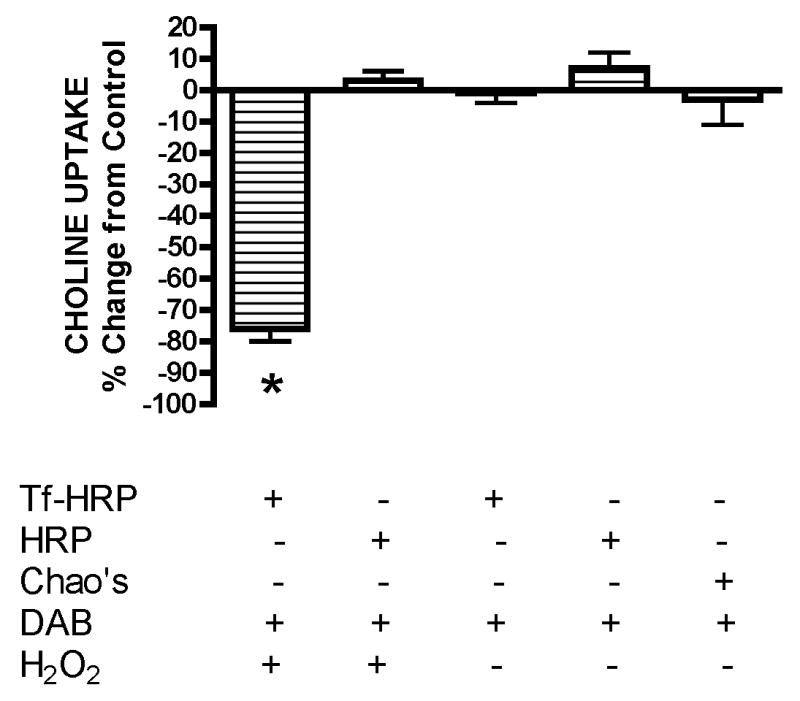
The effects of HRP conjugated Transferrin on high affinity choline transport. Brain hemi-slices were pretreated with either Tf-HRP conjugate, unconjugated HRP, or normal Chao's solution (control) for 30 min at 37°C. After quenching and washing, hemi-slices were subjected separately to either DAB + H2O2, DAB, or H2O2 for 1 h at 4°C. All slices were washed in normal Chao's for 120 min at RT, and subsequently, were incubated in 1μM [3H]choline Chao's for 30 min at RT. The data values are expressed as percentages of the control uptake shown as 0 on the Y axis. Data are the mean ± SEM for at least 3 determinations. The asterisk (*) indicates p < 0.05 versus control values (Student's t-test).
Figure 4
Figure 4
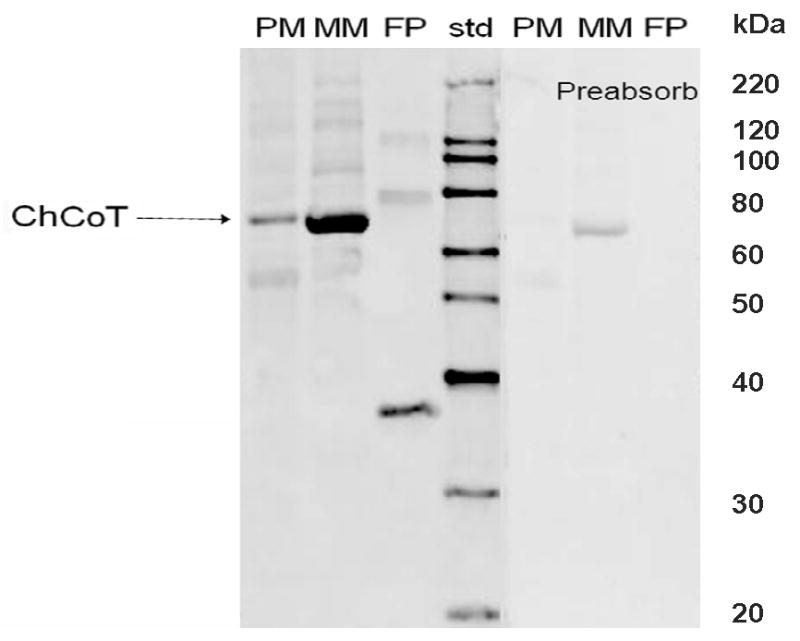
Specificity of custom choline cotransporter antibody. Western blot analysis of choline cotransporter (ChCoT) expression in Limulus brain hemi-slice extracts of plasma membrane (PM) and microsomal membrane (MM) fractions were performed using a polyclonal ChCoT custom synthesized antibody. Immunoblotting of subcellular fraction protein extracts, and samples of a fusion peptide (FP; positive control) was carried out. The ChCoT antibody identified a ∼70kDa band from both the PM and MM fractions, and showed a single band (∼35kDa) from the FP. The preabsorbed control failed to identify the FP and ∼70kDa PM band; the ∼70kDa MM band was greatly reduced. Representative images from independent experiments (n = 3) are shown.
Figure 5
Figure 5
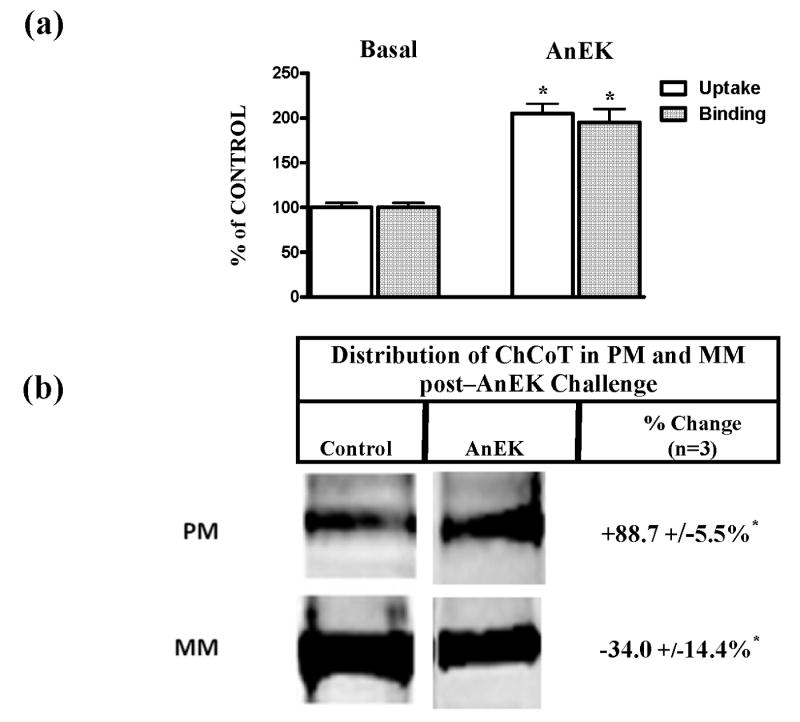
The effects of antecedent elevated potassium on high affinity choline transport and hemicholinium-3 specific binding. Brain hemi-slices were subjected to separate 15 min pretreatments in either normal Chao's (basal/control conditions) or 120mM potassium (K+) Chao's (antecedent elevated, AnEK) solution at RT, and subsequently slices were used for (a) [3H]choline uptake and [3H]HC-3 binding measurements, or (b) ChCoT antibody Western blot analysis. For uptake and binding (a), hemi-slices were incubated either in 1μM [3H]choline or 10 nM [3H]HC-3 Chao's solution for 30 min at RT. Average control values for choline uptake 1.93 ± 0.71 pmol/mg tissue, and for HC-3 specific binding 6.43 ± 1.42 fmol/mg tissue. AnEK treatment caused a doubling of both choline uptake and HC-3 specific binding. Data are the mean ± SEM for at least 3 determinations. The asterisk (*) indicates p < 0.05 versus control values (Student's t-test). In Western blots (b), the PM and MM extracts showed a shift of ChCoTs to the PM, with a decrease from MM stores. Densities of PM and MM bands were measured and compared in calculating % changes. Data are the mean ± SEM with (n = 3) for each value; representative blots from separate experiments are shown.
Figure 6
Figure 6
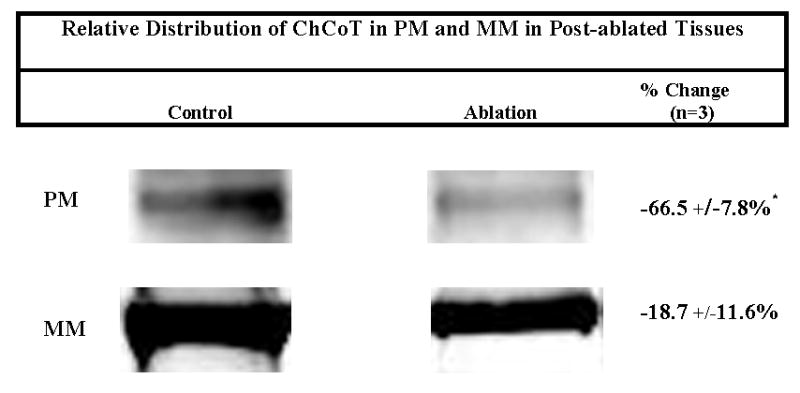
The effect of ablation on the choline cotransporter subcellular distribution. Western blots shown for brain slices following either the control (no ablation) or ablation protocol in which tissues were treated with only DAB or DAB + H2O2 for 1 h at 4°C, respectively. Subsequently, slices were homogenized and subcellular fractionated into PM and MM samples. PM and MM extracts were used in SDS-PAGE. Densities of PM and MM bands of several experiments (n = 3) were used in determining the relative intensities before and after ablation. Results show a loss of ChCoTs from the PM following ablation. The asterisk (*) indicates p < 0.05 versus control values (Student's t-test).
Figure 7
Figure 7
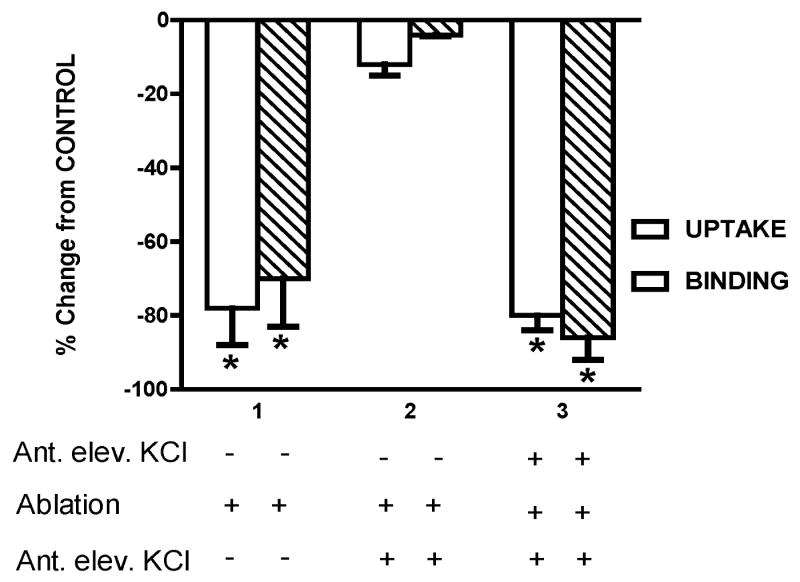
The effect of antecedent elevated potassium challenge on choline cotransport and hemicholinium-3 specific binding in ablated Limulus brain hemi-slices. First, brain hemi-slices were incubated with the Tf-HRP for 30 min at 37°C followed by DAB cytochemistry for 1 h at 4°C. Subsequent to ablation and normal Chao's washes for 120 min at RT, slices were incubated in Chao's containing either 1 μM [3H]choline or 10 nM [3H]HC-3 for 30 min at RT and results are shown in lane 1. The 0 across the top of the graph represents control values for both uptake and binding determinations. Second, brain tissues were subjected to ablation, normal Chao's washes and antecedent elevated KCl treatment prior to being incubated with either 1 μM [3H]choline or 10 nM [3H]HC-3 for 30 min with the findings shown (lane 2). Third, hemi-slices were initially exposed to antecedent elevated KCl, ablated, and then treated with a second antecedent elevated KCl challenge after which [3H]choline uptake or [3H]HC-3 binding were measured. Results are shown in lane 3, and are the means ± SEM with n = 3-5 for each value. The asterisk (*) indicates results significantly differ from normal Chao's treatment p < 0.05, (Student's t-test).
Figure 8
Figure 8
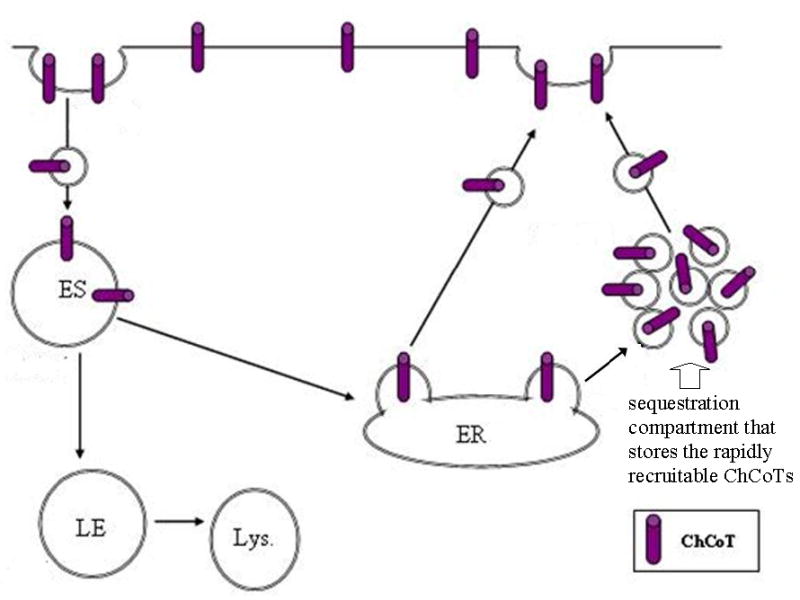
Model for the dual (constitutive and regulated) trafficking of the choline cotransporter. The model depicts pathways through which the ChCoT may traffic from and back to the cell surface. In the basal state, endocytosis of ChCoT vesicles fuse with early endosomes in close proximity to the PM, thus removing transporters from the cell surface. The continuous constitutive trafficking of the ChCoTs appears to be from the PM to early endosomes, then back to the PM. High neuronal activity (simulated by antecedent exposure to depolarizing concentrations of KCl) triggers a rapid increase in the rate of exocytotic insertion of ChCoTs into the PM. A special sequestration compartment, distinct from early endosomes, appears to be the primary storage site of ChCoTs that are rapidly recruited to the PM (i.e. regulated trafficking). This specialized compartment, separate from early endosomes, does appear to require functioning endosomes for its replenishment. The results summarized herein, can be explained by the model in this figure.

Similar articles

Cited by

References

    1. Apparsundaram S, Ferguson SM, George AL, Jr, Blakely RD. Molecular cloning of a human hemicholinium-3-sensitive choline transporter. Biochem Biophys Res Commun. 2000;276(3):862–867. - PubMed
    1. Birks R, MacIntosh FC. Acetylcholine metabolism of a sympathetic ganglion. J Biochem Physiol. 1961;39:787–827.
    1. Bogan JS, Hendon N, McKee AE, Tsao T, Lodish HF. Functional cloning of TUG as a regulator of GLUT4 glucose transporter trafficking. Nature. 2003;425:727–733. - PubMed
    1. Chao I. Action of electrolytes on the dorsal median nerve cord of the Limulus heart. Biol Bull Mar Biol Lab Woods Hole. 1933;64:358–381.
    1. Deken SL, Wang D, Quick MW. Plasma membrane GABA transporters reside on distinct vesicles and undergo rapid regulated recycling. J Neurosci. 2003;23:1563–1568. - PMC - PubMed

Publication types

MeSH terms