


NIPAL4/ichthyin is expressed in the granular layer of human epidermis and mutated in two Pakistani families with autosomal recessive ichthyosis
- PMID: 20016120
- PMCID: PMC2855276
- DOI: 10.1159/000265757
NIPAL4/ichthyin is expressed in the granular layer of human epidermis and mutated in two Pakistani families with autosomal recessive ichthyosis
Abstract
Background: Autosomal recessive congenital ichthyosis (ARCI) can be divided into 3 types including lamellar ichthyosis (OMIM 242304), nonbullous congenital ichthyosiform erythroderma (OMIM 242100) and harlequin ichthyosis (OMIM 242500). The last type is uncommon since newborns with harlequin ichthyosis usually die shortly after birth. Several genes have been linked to ARCI, but these represent only 60% of the known genetic causes of this condition.
Methods: After having performed a linkage analysis, we analyzed the DNA of 2 consanguineous Pakistani families with ARCI for NIPAL4 mutations and performed in situ hybridization (ISH) for NIPAL4 mRNA in the epidermis.
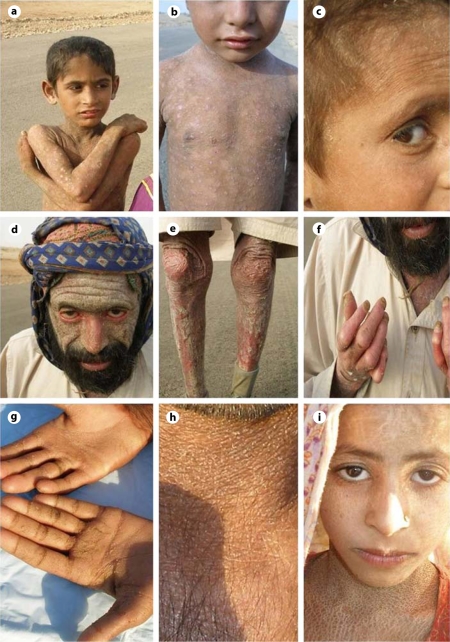
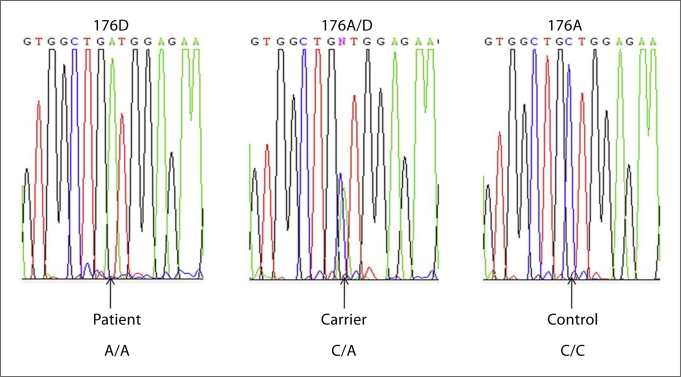
Results: The haplotype analysis revealed a linkage to chromosome 5, and we identified a recurrent missense mutation, p.A176D, in affected individuals from both families. We also determined by ISH that NIPAL4 mRNA is highly expressed in the granular cell layer of the epidermis, consistent with the ARCI phenotype.
Conclusion: Our results expand the spectrum of the clinical manifestations of the NIPAL4 gene and further extend our understanding of its molecular function.
Copyright 2009 S. Karger AG, Basel.
Figures


References
-
- Lefèvre C, Bouadjar B, Karaduman A, Jobard F, Saker S, Özguc M, et al. Mutations in ichthyin a new gene on chromosome 5q33 in a new form of autosomal recessive congenital ichthyosis. Hum Mol Genet. 2004;13:2473–2482. - PubMed
-
- Griffiths WAD, Judge MR, Leigh IM. Disorders of keratinization. In: Champion RH, Burton JL, Burns DA, Breathnach SM, editors. Textbook of Dematology. ed 6. Oxford: Blackwell Science; 1998. pp. 1483–1530.
-
- Eckl KM, de Juanes S, Kurtenbach J, Nätebus M, Lugassy J, Oji V, et al. Molecular analysis of 250 patients with autosomal recessive congenital ichthyosis: evidence for mutation hotspots in ALOXE3 and allelic heterogeneity in ALOX12B. J Invest Dermatol. 2009;129:1421–1428. - PubMed
-
- Lugassy J, Hennies HC, Indelman M, Khamaysi Z, Bergman R, Sprecher E. Rapid detection of homozygous mutations in congenital recessive ichthyosis. Arch Dermatol Res. 2008;300:81–85. - PubMed
Publication types
MeSH terms
Substances
Grants and funding
LinkOut - more resources
Full Text Sources
Other Literature Sources
Molecular Biology Databases
