


Relative dose intensity delivered to patients with early breast cancer: Canadian experience
- PMID: 20016741
- PMCID: PMC2794674
- DOI: 10.3747/co.v16i6.311
Relative dose intensity delivered to patients with early breast cancer: Canadian experience
Abstract
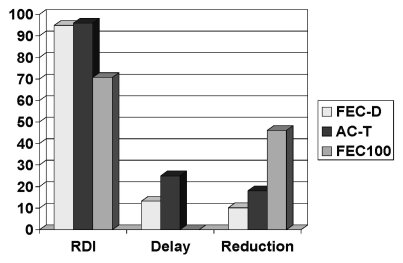
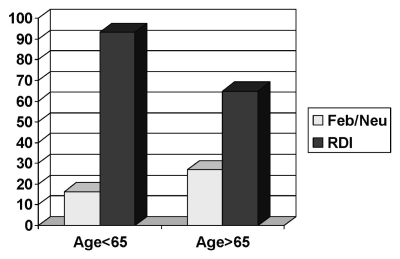
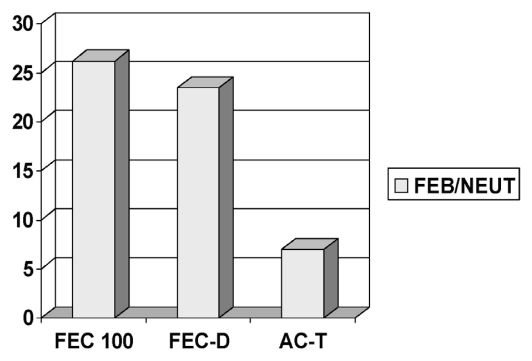
Adjuvant chemotherapy for early breast cancer improves disease-free and overall survival in pre- and postmenopausal women. The importance of maintaining relative dose intensity (RDI) is well-known; however, little information is available from routine clinical practice regarding how well dose intensity is maintained with modern chemotherapy regimens.In a retrospective review of patients undergoing chemotherapy for early breast cancer at a single institution in Canada from January 2006 to November 2007, a total of 263 patients received one of the following regimens:AC-T [doxorubicin (Adriamycin: Pharmacia, Kalamazoo, MI, U.S.A.)-cyclophosphamide, paclitaxel (Taxol: Bristol-Myers Squibb, Princeton, NJ, U.S.A.)]FEC-100 (5-fluorouracil-epirubicin-cyclophosphamide)FEC-D (5-fluorouracil-epirubicin-cyclophosphamide, docetaxel)Overall, only 14.4% of patients had a RDI less than 85%. Dose delay or reduction (or both) occurred in 46%, 37%, and 20% of patients receiving fec-100, ac-t, and fec-d respectively. Optimal RDI was delivered to 96%, 95%, and 70.7% of patients for ac-t, fec-d and fec-100 regimens respectively. Patients over 65 years of age accounted for 14% of the total cohort and were more likely to receive a suboptimal RDI than were patients younger than 65 years of age (35% vs. 6.6%).Optimal chemotherapy RDI (>85%) for early breast cancer can be achieved at an academic cancer centre. This goal is less often accomplished in elderly patients, and thus a proactive approach is required for managing toxicity in that population.
Keywords: Early breast cancer; adjuvant chemotherapy; relative dose intensity.
Figures
References
-
- Canadian Cancer Society and the National Cancer Institute of Canada. Canadian Cancer Statistics 2006. Toronto: Canadian Cancer Society; 2006.
-
- Early Breast Cancer Trialists’ Collaborative Group (ebctcg) Effects of chemotherapy and hormonal therapy for early breast cancer on recurrence and 15-year survival: an overview of the randomized trials. Lancet. 2005;365:1687–717. - PubMed
-
- Bonadonna G, Valagussa P, Moliterni A, Zambetti M, Brambilla C. Adjuvant cyclophosphamide, methotrexate, and fluorouracil in node-positive breast cancer: the results of 20 years of follow-up. N Engl J Med. 1995;332:901–6. - PubMed
-
- Kwak LW, Halpern J, Olshen RA, Horning SJ. Prognostic significance of actual dose intensity in diffuse large-cell lymphoma: results of a tree-structured survival analysis. J Clin Oncol. 1990;8:963–77. - PubMed
-
- Lepage E, Gisselbrecht C, Haioun C, et al. Prognostic significance of received relative dose intensity in non-Hodgkin’s lymphoma patients: application to lnh-87 protocol. The gela (Groupe d’Etude des Lymphomes de l’Adulte) Ann Oncol. 1993;4:651–6. - PubMed
LinkOut - more resources
Full Text Sources
