. 2010 Feb;152(2):1073-83.
doi: 10.1104/pp.109.147637. Epub 2009 Dec 16.

Apyrase (nucleoside triphosphate-diphosphohydrolase) and extracellular nucleotides regulate cotton fiber elongation in cultured ovules

Affiliations

Apyrase (nucleoside triphosphate-diphosphohydrolase) and extracellular nucleotides regulate cotton fiber elongation in cultured ovules

Greg Clark et al. Plant Physiol. 2010 Feb.

Abstract

Ectoapyrase enzymes remove the terminal phosphate from extracellular nucleoside tri- and diphosphates. In Arabidopsis (Arabidopsis thaliana), two ectoapyrases, AtAPY1 and AtAPY2, have been implicated as key modulators of growth. In fibers of cotton (Gossypium hirsutum), transcript levels for GhAPY1 and GhAPY2, two closely related ectoapyrases that have high sequence similarity to AtAPY1 and AtAPY2, are up-regulated when fibers enter their rapid growth phase. In an ovule culture system, fibers release ATP as they grow, and when their ectoapyrase activity is blocked by the addition of polyclonal anti-apyrase antibodies or by two different small molecule inhibitors, the medium ATP level rises and fiber growth is suppressed. High concentrations of the poorly hydrolyzable nucleotides ATPgammaS and ADPbetaS applied to the medium inhibit fiber growth, and low concentrations of them stimulate growth, but treatment with adenosine 5'-O-thiomonophosphate causes no change in the growth rate. Both the inhibition and stimulation of growth by applied nucleotides can be blocked by an antagonist that blocks purinoceptors in animal cells, and by adenosine. Treatment of cotton ovule cultures with ATPgammaS induces increased levels of ethylene, and two ethylene antagonists, aminovinylglycine and silver nitrate, block both the growth stimulatory and growth inhibitory effects of applied nucleotides. In addition, the ethylene precursor, 1-aminocyclopropane-1-carboxylic acid, lowers the concentration of nucleotide needed to promote fiber growth. These data indicate that ectoapyrases and extracellular nucleotides play a significant role in regulating cotton fiber growth and that ethylene is a likely downstream component of the signaling pathway.


Figures
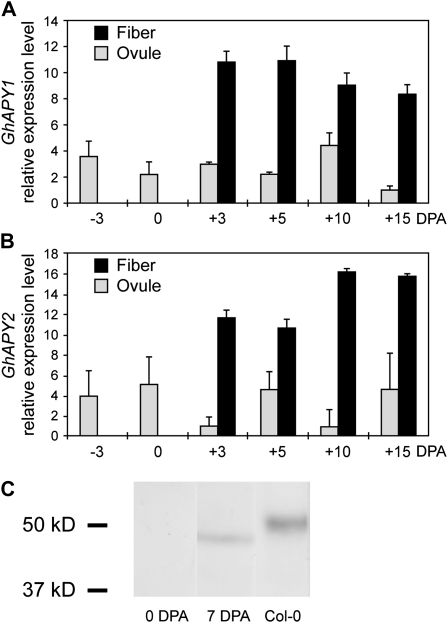
Figure 1.
Figure 1.
GhAPY1 and GhAPY2 are expressed in cotton fibers during elongation phase of growth. A, Transcript abundance of GhAPY1 is enhanced in fibers and is maintained at a high level during fiber growth. B, Transcript abundance of GhAPY2 is enhanced in fibers and is up-regulated during the later stages of fiber growth. Assays were done by qRT-PCR analysis using gene-specific primers, and the results were normalized to the level in ovules at 15 DPA (value of 1) for GhAPY1 and to the level in ovules at 10 DPA (value of 1) for GhAPY2. Error bars represent sd. C, Immunoblot detection of an apyrase in cotton fibers isolated from 7-DPA cultured ovules. The 0-DPA lane shows lack of immunostain for 0-DPA whole ovules. Col-0 lane shows immunostain of apyrase from a crude extract of primary roots from liquid-grown seedlings of Arabidopsis (Col cultivar).
Figure 2.
Figure 2.
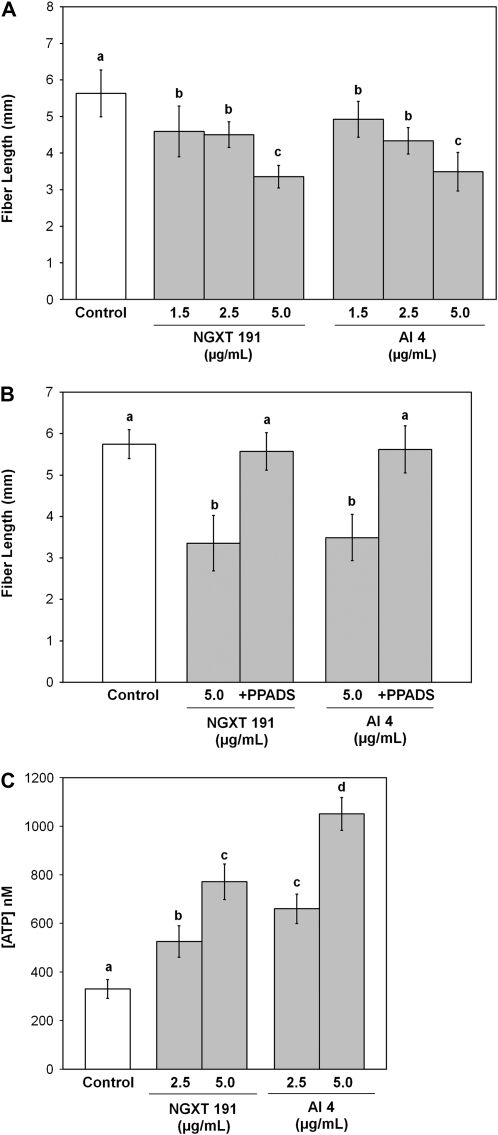
Inhibition of apyrase activity in cotton ovule cultures using chemical inhibitors decreases overall fiber growth and increases eATP levels. A, Treatment of cotton ovule cultures with apyrase inhibitor NGXT 191 and apyrase inhibitor 4 at 3 and 5 DPA decreases average fiber lengths at 7 DPA. B, Inhibition of fiber growth induced by NGXT 191 and apyrase inhibitor 4 (5 μg/mL) at 3 and 5 DPA is reversed by coincubation with 250 μm PPADS. C, Treatment of cotton ovule cultures with NGXT 191 and apyrase inhibitor 4 at 3 and 5 DPA increases the amount of ATP in the media surrounding the cotton fibers at 7 DPA. All values are the mean ± se from four biological replicates. Different letters above the bars indicate mean values that are significantly different from one another (P < 0.05; n ≥ 24).
Figure 3.
Figure 3.
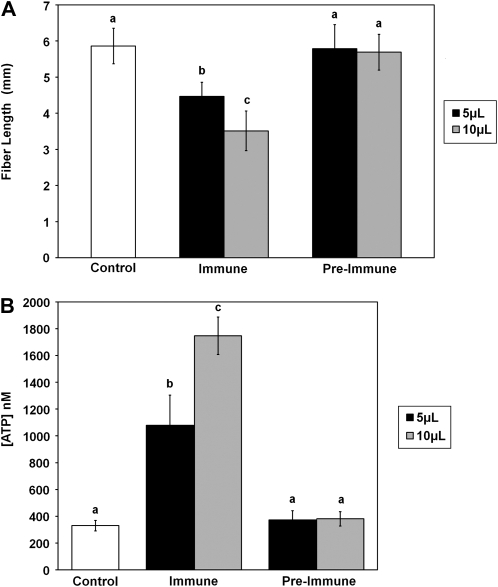
Inhibition of apyrase activity in cotton ovule cultures using apyrase antibodies decreases overall fiber growth and increases eATP levels. A, Treatment of cotton ovule cultures with polyclonal anti-apyrase antibodies at 3 and 5 DPA decreases average fiber lengths at 7 DPA. The difference in growth of fibers treated with preimmune serum was not statistically different (n ≥ 24); the difference in average fiber lengths treated with immune serum and treated with buffer is statistically significant (P < 10−9; n in every case ≥ 20). The protein concentration of the preimmune sera was 0.3 μg/μL, and of the immune sera was 0.46 μg/μL. B, Treatment of cotton ovule cultures with polyclonal anti-apyrase antibodies at 3 and 5 DPA increases the amount of ATP surrounding the cotton fibers at 7 DPA. All values are the mean ± se from four biological replicates. Different letters above the bars indicate mean values that are significantly different from one another (P < 0.05; n ≥ 24).
Figure 4.
Figure 4.
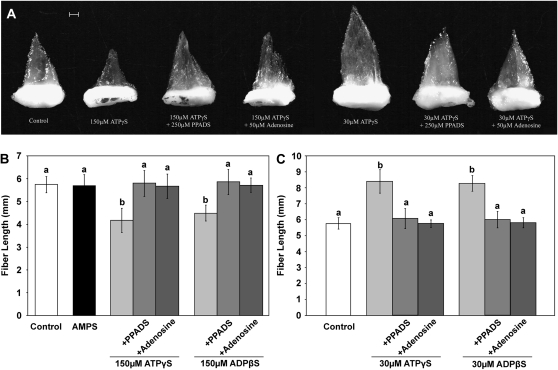
A total of 150 μm ATPγS or ADPβS decrease overall cotton fiber growth and 30 μm ATPγS or ADPβS increase overall cotton fiber growth. A, Representative image of effects of treatment with 150 μm ATPγS alone or 30 μm ATPγS alone, or these treatments coincubated with 250 μm PPADS or 50 μm adenosine on cotton fiber growth. Bar = 1 mm. B, Application of 150 μm ATPγS or ADPβS at 5 DPA to cotton ovule cultures decreases average fiber lengths at 7 DPA and this decrease is reversed by coincubation with 250 μm PPADS or 50 μm adenosine. AMPS was tested at 150 μm and had no effect on growth. C, Application of 30 μm ATPγS or ADPβS at 5 DPA to cotton ovule cultures increases average fiber lengths at 7 DPA, and this increase is reversed by coincubation with 250 μm PPADS or 50 μm adenosine. All values are the mean ± se from four biological replicates. Different letters above the bars indicate mean values that are significantly different from one another (P < 0.05; n ≥ 24).
Figure 5.
Figure 5.
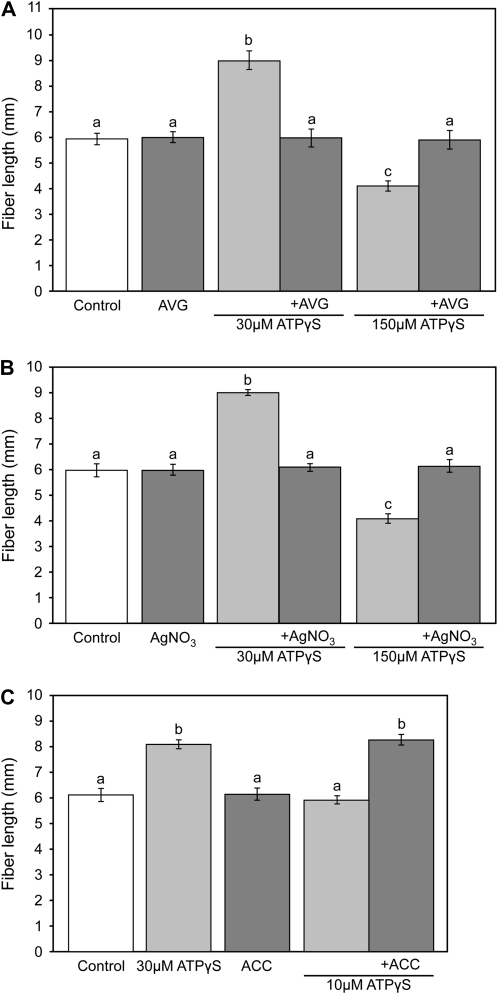
Agents that alter ethylene production or activity modify the effects of applied nucleotides on fiber growth. A, Increased cotton fiber growth induced by 30 μm ATPγS and decreased cotton fiber growth induced by 150 μm ATPγS are reversed by AVG. The difference in growth of fibers incubated with 10 μm AVG alone was not statistically different (n ≥ 24). B, Increased cotton fiber growth induced by 30 μm ATPγS and decreased cotton fiber growth induced by 150 μm ATPγS are reversed by AgNO3. The difference in growth of fibers incubated with 1 μm AgNO3 alone was not statistically different (n ≥ 24). C, Application of ACC at 5 DPA lowers the concentration of ATPγS needed to induce increased fiber elongation, measured at 7 DPA, from 30 to 10 μm. The difference in growth of fibers treated with 10 μm ATPγS or 1 μm ACC alone was not statistically different (n ≥ 24). All values are the mean ± se from four biological replicates. In all sections, different letters above the bars indicate mean values that are significantly different from one another (P < 0.05; n ≥ 24).

References

    1. Bendtsen JD, Nielsen H, von Heijne G, Brunak S (2004) Improved prediction of signal peptides: SignalP 3.0. J Mol Biol 340 783–795 - PubMed
    1. Bengtsson T, Zalavary S, Stendahl O, Grenegard M (1996) Release of oxygen metabolites from chemoattractant-stimulated neutrophils is inhibited by resting platelets: role of extracellular adenosine and actin polymerization. Blood 87 4411–4423 - PubMed
    1. Basra AS, Malik CP (1984) Development of the cotton fiber. Int Rev Cytol 89 65–113
    1. Burnstock G (1996) Purinoceptors: ontogeny and phylogeny. Drug Dev Res 39 204–242
    1. Burnstock G (2008) Purinergic signalling and disorders of the central nervous system. Nat Rev Drug Discov 7 575–590 - PubMed

Publication types

Associated data

LinkOut - more resources