


A role for suppressed incisor cuspal morphogenesis in the evolution of mammalian heterodont dentition
- PMID: 20018657
- PMCID: PMC2806730
- DOI: 10.1073/pnas.0907236107
A role for suppressed incisor cuspal morphogenesis in the evolution of mammalian heterodont dentition
Abstract
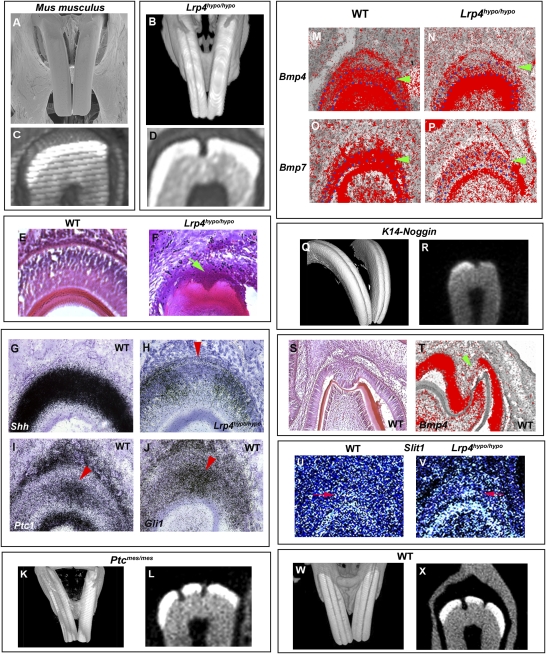
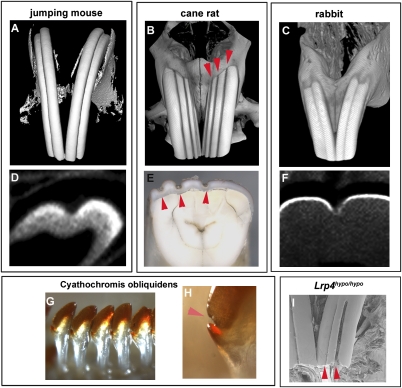
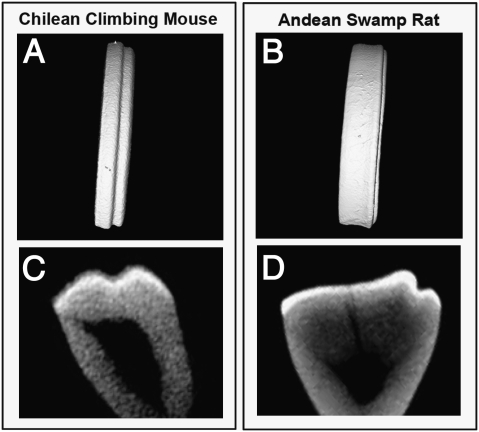
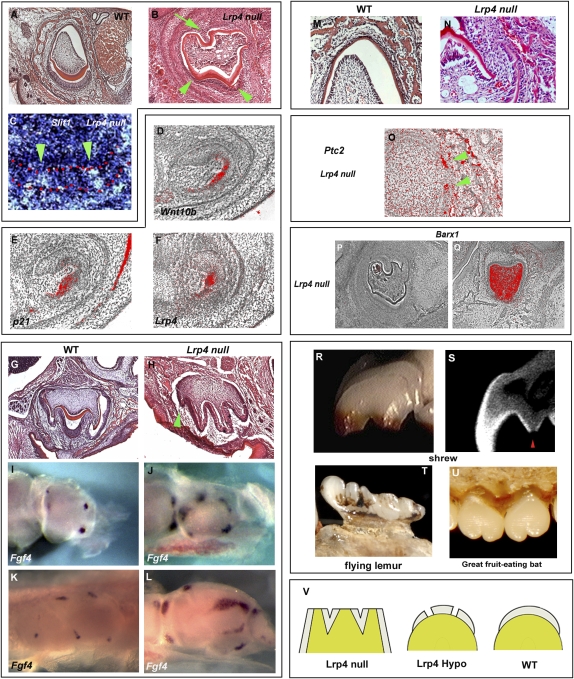
Changes in tooth shape have played a major role in vertebrate evolution with modification of dentition allowing an organism to adapt to new feeding strategies. The current view is that molar teeth evolved from simple conical teeth, similar to canines, by progressive addition of extra "cones" to form progressively complex multicuspid crowns. Mammalian incisors, however, are neither conical nor multicuspid, and their evolution is unclear. We show that hypomorphic mutation of a cell surface receptor, Lrp4, which modulates multiple signaling pathways, produces incisors with grooved enamel surfaces that exhibit the same molecular characteristics as the tips of molar cusps. Mice with a null mutation of Lrp4 develop extra cusps on molars and have incisors that exhibit clear molar-like cusp and root morphologies. Molecular analysis identifies misregulation of Shh and Bmp signaling in the mutant incisors and suggests an uncoupling of the processes of tooth shape determination and morphogenesis. Incisors thus possess a developmentally suppressed, cuspid crown-like morphogenesis program similar to that in molars that is revealed by loss of Lrp4 activity. Several mammalian species naturally possess multicuspid incisors, suggesting that mammals have the capacity to form multicuspid teeth regardless of location in the oral jaw. Localized loss of enamel may thus have been an intermediary step in the evolution of cusps, both of which use Lrp4-mediated signaling.
Conflict of interest statement
The authors declare no conflict of interest.
Figures
References
-
- Rose KD. The Beginning of the Age of Mammals. Baltimore: Johns Hopkins University Press; 2006.
-
- Tummers M, Yamashiro T, Thesleff I. Modulation of epithelial cell fate of the root in vitro. J Dent Res. 2007;86:1063–1067. - PubMed
-
- Tummers M, Thesleff I. Observations on continuously growing roots of the sloth and the K14-Eda transgenic mice indicate that epithelial stem cells can give rise to both the ameloblast and root epithelium cell lineage creating distinct tooth patterns. Evol Dev. 2008;10:187–195. - PubMed
-
- Nykjaer A, Willnow TE. The low-density lipoprotein receptor gene family: A cellular Swiss army knife? Trends Cell Biol. 2002;12:273–280. - PubMed
-
- Herz J, Bock HH. Lipoprotein receptors in the nervous system. Annu Rev Biochem. 2002;71:405–434. - PubMed
Publication types
MeSH terms
Substances
Grants and funding
LinkOut - more resources
Full Text Sources
Molecular Biology Databases
Miscellaneous
