


Avian population consequences of climate change are most severe for long-distance migrants in seasonal habitats
- PMID: 20018784
- PMCID: PMC2842804
- DOI: 10.1098/rspb.2009.1525
Avian population consequences of climate change are most severe for long-distance migrants in seasonal habitats
Abstract
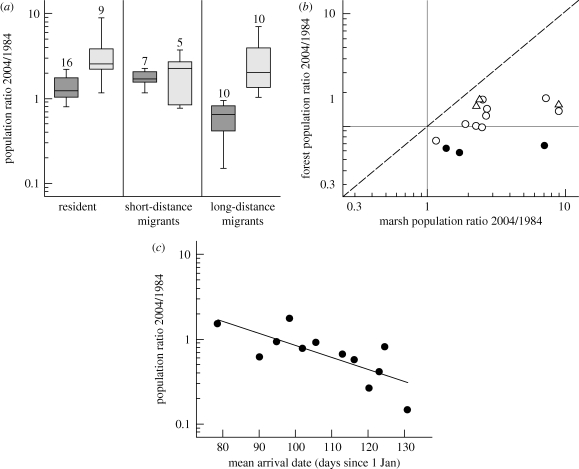
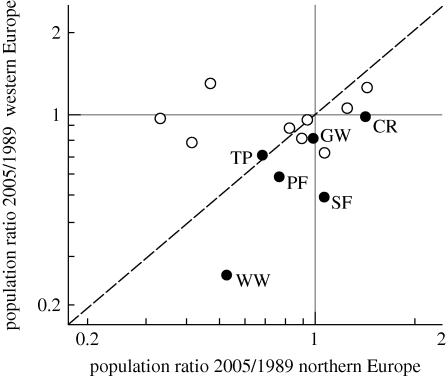
One consequence of climate change is an increasing mismatch between timing of food requirements and food availability. Such a mismatch is primarily expected in avian long-distance migrants because of their complex annual cycle, and in habitats with a seasonal food peak. Here we show that insectivorous long-distance migrant species in The Netherlands declined strongly (1984-2004) in forests, a habitat characterized by a short spring food peak, but that they did not decline in less seasonal marshes. Also, within generalist long-distance migrant species, populations declined more strongly in forests than in marshes. Forest-inhabiting migrant species arriving latest in spring declined most sharply, probably because their mismatch with the peak in food supply is greatest. Residents and short-distance migrants had non-declining populations in both habitats, suggesting that habitat quality did not deteriorate. Habitat-related differences in trends were most probably caused by climate change because at a European scale, long-distance migrants in forests declined more severely in western Europe, where springs have become considerably warmer, when compared with northern Europe, where temperatures during spring arrival and breeding have increased less. Our results suggest that trophic mismatches may have become a major cause for population declines in long-distance migrants in highly seasonal habitats.
Figures
References
-
- Ahola M., Laaksonen T., Sippola K., Eeva T., Rainio K., Lehikoinen E.2004Variation in climate warming along the migration route uncouples arrival and breeding date. Global Change Biol. 10, 1–8
-
- Ahola M. P., Laaksonen T., Eeva T., Lehikoinen E.2007Climate change can alter competitive relationships between resident and migratory birds. J. Anim. Ecol. 76, 1045–1052 (doi:10.1111/j.1365-2656.2007.01294.x) - DOI - PubMed
-
- Baillie S. R., Peach W. J.1992Population limitation in Palaearctic–African migrant passerines. Ibis 134, 120–132
-
- Berthold P., Fiedler W., Schlenker R., Querner U.199825-year study of the population development of Central European songbirds: a general decline, most evident in long-distance migrants. Naturwissenschaften 85, 350–353 (doi:10.1007/s001140050514) - DOI
-
- Bibby C. J., Burgess N. D., Hill D. A.1997Bird census techniques London, UK: Academic Press
Publication types
MeSH terms
LinkOut - more resources
Full Text Sources
Medical
