Evaluating the impact of menu labeling on food choices and intake
- PMID: 20019307
- PMCID: PMC2804627
- DOI: 10.2105/AJPH.2009.160226
Evaluating the impact of menu labeling on food choices and intake
Abstract
Objectives: We assessed the impact of restaurant menu calorie labels on food choices and intake.
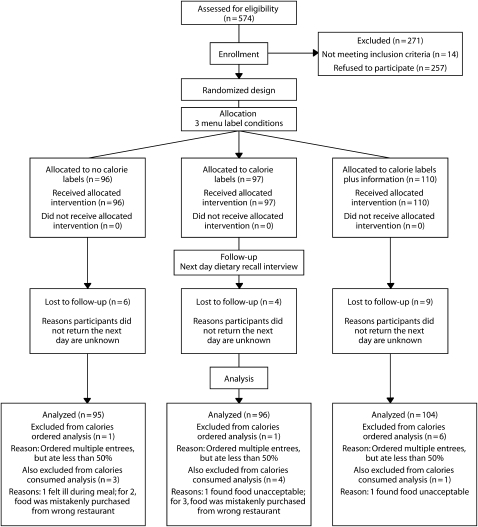
Methods: Participants in a study dinner (n=303) were randomly assigned to either (1) a menu without calorie labels (no calorie labels), (2) a menu with calorie labels (calorie labels), or (3) a menu with calorie labels and a label stating the recommended daily caloric intake for an average adult (calorie labels plus information). Food choices and intake during and after the study dinner were measured.
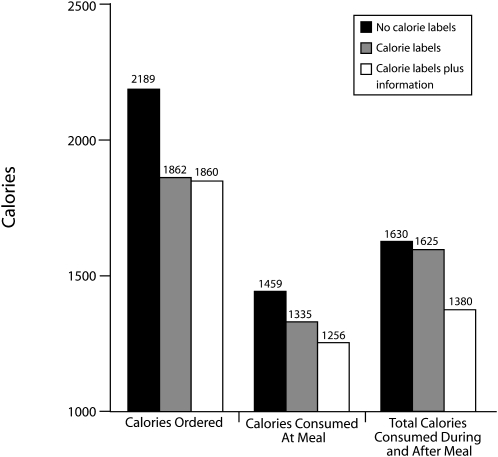
Results: Participants in both calorie label conditions ordered fewer calories than those in the no calorie labels condition. When calorie label conditions were combined, that group consumed 14% fewer calories than the no calorie labels group. Individuals in the calorie labels condition consumed more calories after the study dinner than those in both other conditions. When calories consumed during and after the study dinner were combined, participants in the calorie labels plus information group consumed an average of 250 fewer calories than those in the other groups.
Conclusions: Calorie labels on restaurant menus impacted food choices and intake; adding a recommended daily caloric requirement label increased this effect, suggesting menu label legislation should require such a label. Future research should evaluate menu labeling's impact on children's food choices and consumption.
Figures
References
-
- World Health Organization Diet and physical activity: a public health priority. Available at: http://www.who.int/dietphysicalactivity/en/index.html. Accessed September 30, 2008
-
- Centers for Disease Control and Prevention US obesity trends 1985–2007. Available at: http://www.cdc.gov/nccdphp/dnpa/obesity/trend/maps. Accessed September 30, 2008
-
- National Restaurant Association Industry at a glance. Available at: http://www.restaurant.org/pdfs/research/2008forecast_factbook.pdf. Accessed September 30, 2008
-
- Paeratakul S, Perdinand D, Champagne C, Ryan D, Bray G. Fast-food consumption among US adults and children: dietary and nutrient intake profile. J Am Diet Assoc 2003;103(10):1332–1338 - PubMed
-
- Young LR, Nestle M. Portion sizes and obesity: responses of fast-food companies. J Public Health Policy 2007;28(2):238–248 - PubMed
Publication types
MeSH terms
LinkOut - more resources
Full Text Sources
Medical