


Effects of handgrip training with venous restriction on brachial artery vasodilation
- PMID: 20019641
- PMCID: PMC2903220
- DOI: 10.1249/MSS.0b013e3181ca7b06
Effects of handgrip training with venous restriction on brachial artery vasodilation
Abstract
Previous studies have shown that resistance training with restricted venous blood flow (Kaatsu) results in significant strength gains and muscle hypertrophy. However, few studies have examined the concurrent vascular responses following restrictive venous blood flow training protocols.
Purpose: The purpose of this study was to examine the effects of 4 wk of handgrip exercise training, with and without venous restriction, on handgrip strength and brachial artery flow-mediated dilation (BAFMD).
Methods: Twelve participants (mean +/- SD: age = 22 +/- 1 yr, men = 5, women = 7) completed 4 wk of bilateral handgrip exercise training (duration = 20 min, intensity = 60% of the maximum voluntary contraction, cadence = 15 grips per minute, frequency = three sessions per week). During each session, venous blood flow was restricted in one arm (experimental (EXP) arm) using a pneumatic cuff placed 4 cm proximal to the antecubital fossa and inflated to 80 mm Hg for the duration of each exercise session. The EXP and the control (CON) arms were randomly selected. Handgrip strength was measured using a hydraulic hand dynamometer. Brachial diameters and blood velocity profiles were assessed, using Doppler ultrasonography, before and after 5 min of forearm occlusion (200 mm Hg) before and at the end of the 4-wk exercise.
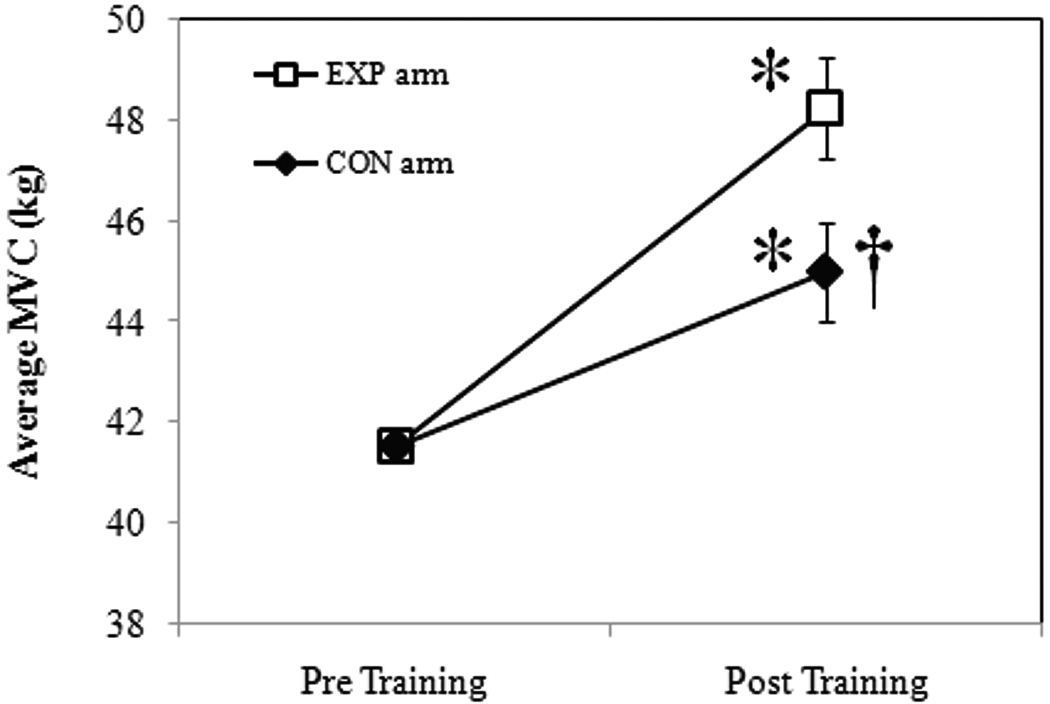
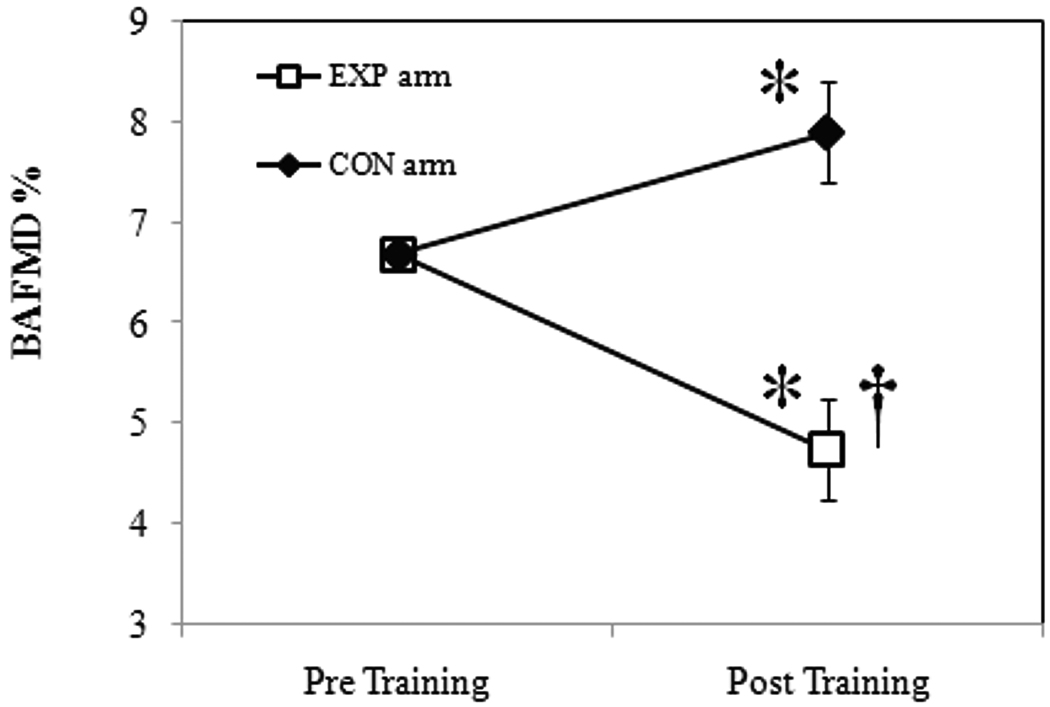
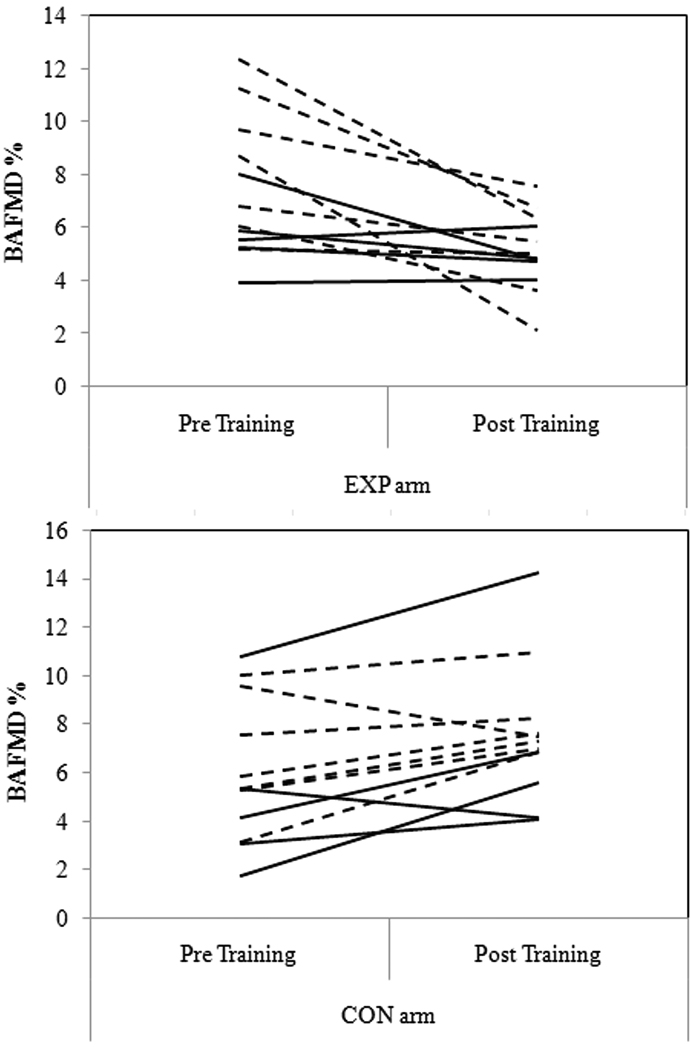
Results: After exercise training, handgrip strength increased 8.32% (P = 0.05) in the CON arm and 16.17% (P = 0.05) in the EXP arm. BAFMD increased 24.19% (P = 0.0001) in the CON arm and decreased 30.36% (P = 0.0001) in the EXP arm.
Conclusions: The data indicate handgrip training combined with venous restriction results in superior strength gains but reduced BAFMD compared with the nonrestricted arm.
Figures
References
-
- Abe T, Kearns CF, Sato Y. Muscle size and strength are increased following walk training with restricted venous blood flow from the leg muscle, Kaatsu-walk training. J Appl Physiol. 2006;100(5):1460–1466. - PubMed
-
- Allen JD, Geaghan JP, Greenway F, Welsch MA. Time course of improved flow-mediated dilation after short-term exercise training. Med Sci Sports Exerc. 2003;35(5):847–853. - PubMed
-
- Andreozzi GM, Leone A, Laudani R, Deinite G, Martini R. Acute impairment of the endothelial function by maximal treadmill exercise in patients with intermittent claudication, and its improvement after supervised physical training. Int Angiol. 2007;26(1):12–17. - PubMed
-
- Corretti MC, Anderson TJ, Benjamin EJ, Celermajer D, Charbonneau F, Creager MA, Deanfield J, Drexler H, Gerhard-Herman M, Herrington D, Vallance P, Vita J, Vogel R. Guidelines for the ultrasound assessment of endothelial-dependent flow-mediated vasodilation of the brachial artery: a report of the International Brachial Artery Reactivity Task Force. J Am Coll Cardiol. 2002;39(2):257–265. - PubMed
