


An information gap in DNA evidence interpretation
- PMID: 20020039
- PMCID: PMC2791197
- DOI: 10.1371/journal.pone.0008327
An information gap in DNA evidence interpretation
Abstract
Forensic DNA evidence often contains mixtures of multiple contributors, or is present in low template amounts. The resulting data signals may appear to be relatively uninformative when interpreted using qualitative inclusion-based methods. However, these same data can yield greater identification information when interpreted by computer using quantitative data-modeling methods. This study applies both qualitative and quantitative interpretation methods to a well-characterized DNA mixture and dilution data set, and compares the inferred match information. The results show that qualitative interpretation loses identification power at low culprit DNA quantities (below 100 pg), but that quantitative methods produce useful information down into the 10 pg range. Thus there is a ten-fold information gap that separates the qualitative and quantitative DNA mixture interpretation approaches. With low quantities of culprit DNA (10 pg to 100 pg), computer-based quantitative interpretation provides greater match sensitivity.
Conflict of interest statement
Figures
 and
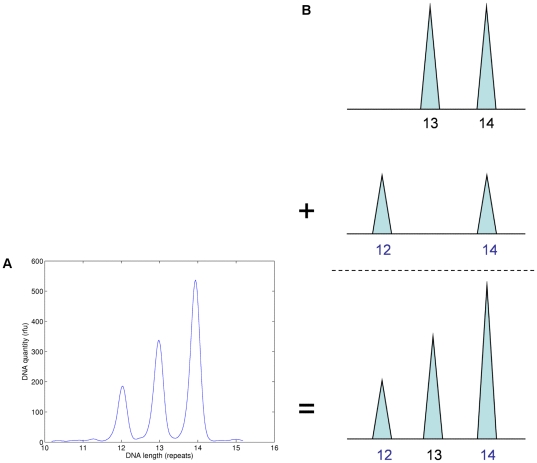
and  in respective 70% and 30% proportions forms a model of the observed allele peak height pattern.
 with three different unknown contributor allele pair candidates are shown at STR locus Penta D. The victim contribution is known to be 70%, and the culprit's is 30%. The allelic peak height pattern that best fits the observed data (Figure 1a) corresponds to the
  candidate (rightmost column). The other two candidates produce patterns that have a very poor fit to the quantitative data peaks. Therefore, based on a multivariate normal likelihood function, allele pair candidate
  would have the greatest probability of arising from the culprit genotype.


References
-
- National Research Council. Evaluation of Forensic DNA Evidence: Update on Evaluating DNA Evidence. Washington, DC: National Academies Press; 1996.
-
- Butler JM. Forensic DNA Typing: Biology, Technology, and Genetics of STR Markers. New York: Academic Press; 2005.
-
- Zedlewski E, Murphy MB. DNA analysis for “minor” crimes: a major benefit for law enforcement. NIJ Journal. 2006;253:2–5.
-
- Gill P, Whitaker J, Flaxman C, Brown N, Buckleton J. An investigation of the rigor of interpretation rules for STRs derived from less than 100 pg of DNA. Forensic Sci Intl. 2000;112:17–40. - PubMed
-
- Michaelis RC, Flanders RG, Wulff P. A Litigator's Guide to DNA: From the Laboratory to the Courtroom. New York: Academic Press; 2008.
Publication types
MeSH terms
LinkOut - more resources
Full Text Sources
Miscellaneous
