Mood-stabilizers target the brain arachidonic acid cascade
- PMID: 20021459
- PMCID: PMC2825027
- DOI: 10.2174/1874467210902020207
Mood-stabilizers target the brain arachidonic acid cascade
Abstract
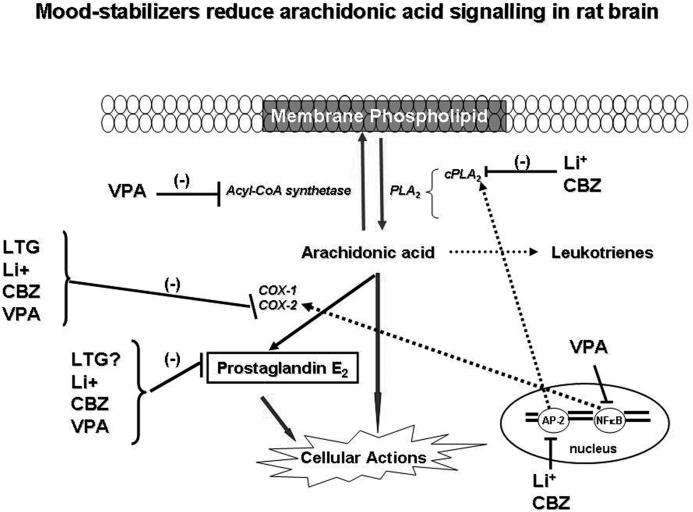
Bipolar disorder (BD) is a severe psychiatric illness characterized by recurrent manic and depressive episodes, without a characteristic neuropathology or clear etiology. Drugs effective in BD target many key signaling pathways in animal and cell studies. However, their mode of action in the BD brain remains elusive. In the rat brain, some of the mood stabilizers effective in treating mania (lithium, carbamazepine, valproate) or depression (lamotrigine) in BD are reported to decrease transcription of cytosolic phospholipase A(2) and cyclooxygenase-2 and to reduce levels of AP-2 and NF-kappaB, transcription factors of the two enzymes. The anti-manic drugs also decrease arachidonic acid (AA) turnover in brain phospholipids when given chronically to rats. Thus, drugs effective in BD commonly target AA cascade kinetics as well as AA cascade enzymes and their transcription factors in the rat brain. These studies suggest that of BD is associated with increased AA signaling in the brain. Developing therapeutic agents that suppress brain AA signaling could lead to additional treatments for BD. In this review, we discuss the mechanisms of action of mood stabilizers and the effects of docosahexaenoic acid on AA cascade enzymes in relation to BD.
Figures
References
-
- Judd LL, Akiskal HS. The prevalence and disability of bipolar spectrum disorders in the US population: re-analysis of the ECA database taking into account subthreshold cases. J. Affect. Disord. 2003;73:123–131. - PubMed
-
- Bostwick JM, Pankratz VS. Affective disorders and suicide risk: a reexamination. Am. J. Psychiatry. 2000;157:1925–1932. - PubMed
-
- Chang A, Li PP, Warsh JJ. Altered cAMP-dependent protein kinase subunit immunolabeling in post-mortem brain from patients with bipolar affective disorder. J. Neurochem. 2003;84:781–791. - PubMed
-
- Rajkowska G. Postmortem studies in mood disorders indicate altered numbers of neurons and glial cells. Biol. Psychiatry. 2000;48:766–777. - PubMed
-
- Brauch RA, Adnan El-Masri M., Parker JC, Jr., El-Mallakh RS. Glial cell number and neuron/glial cell ratios in postmortem brains of bipolar individuals. J. Affect. Disord. 2006;91:87–90. - PubMed
Publication types
MeSH terms
Substances
Grants and funding
LinkOut - more resources
Full Text Sources
Medical
Research Materials