Review
doi: 10.1242/dev.035493.
Promoting developmental transcription
Affiliations
- PMID: 20023156
- PMCID: PMC2796937
- DOI: 10.1242/dev.035493
Item in Clipboard
Review
Promoting developmental transcription
Development.
2010 Jan.
Abstract
Animal growth and development depend on the precise control of gene expression at the level of transcription. A central role in the regulation of developmental transcription is attributed to transcription factors that bind DNA enhancer elements, which are often located far from gene transcription start sites. Here, we review recent studies that have uncovered significant regulatory functions in developmental transcription for the TFIID basal transcription factors and for the DNA core promoter elements that are located close to transcription start sites.
Figures
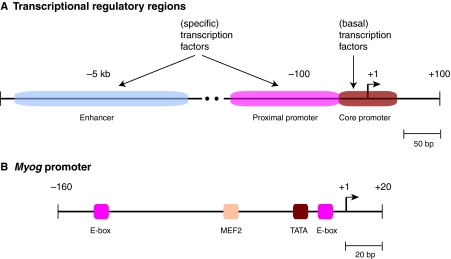
Cis-acting DNA transcription-regulatory elements. (A) The generic organization of transcription-regulatory regions of a eukaryotic gene, depicting the organization and location of enhancer, proximal promoter, and core promoter elements, as well as the regulatory factors that bind these elements. (B) Promoter structure of the mouse Myog gene, which is used as an example throughout the text. Known elements in the core and proximal promoter regions are indicated.
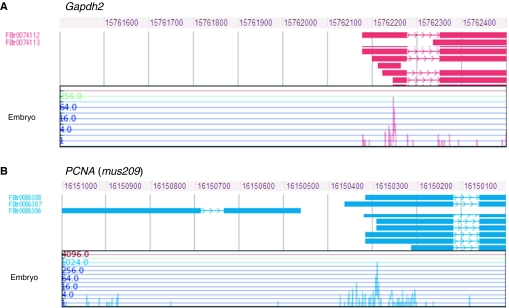
Eukaryotic transcription initiation patterns. High-throughput genomic data on transcription start sites (TSSs) allows different transcription initiation patterns to be visualized and analyzed. Two different embryonic initiation patterns for genes with previously mapped TSSs are shown, adapted from the MachiBase database browser, which contains high-throughput sequence read data from Drosophila libraries of 5′ capped transcripts (Ahsan et al., 2009). These displays show (top) the coordinates of a selected genomic region, followed (middle) by the gene structure annotations and transcript data for this region from FlyBase: first, transcripts with FlyBase transcript (FBtr) IDs; then, expressed sequence tag (EST) evidence (for the purposes of clarity, the displays only show a selection of tags that map to the region). Finally (bottom), the distribution of embryonic 5′ reads in the selected region that align to the same genomic location are shown (read numbers are on a logarithmic scale). (A) The Gapdh2 (Glyceraldehyde-3-phosphate dehydrogenase 2) gene on chromosome 2R exhibits a peaked initiation pattern, in which most transcription events originate from a small genomic region (Tso et al., 1985). (B) The PCNA [proliferating cell nuclear antigen, also known as mutagen sensitive 209 (mus209)] gene on chromosome 2R exhibits a broad pattern, in which initiation events are spread out over a larger genomic region of typically 100-200 nucleotides (Hochheimer et al., 2002). These examples demonstrate that the major sites of transcription initiation do not necessarily correspond to the 5′ ends of transcripts annotated in genomic databases, but that they are often supported by existing transcript evidence in the form of ESTs.
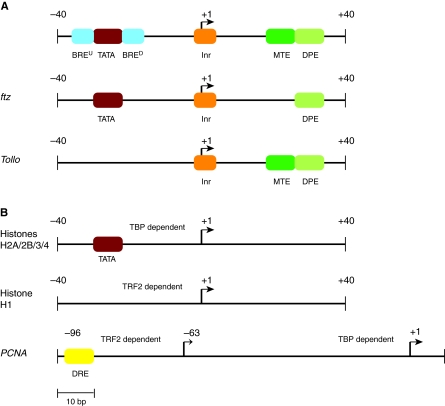
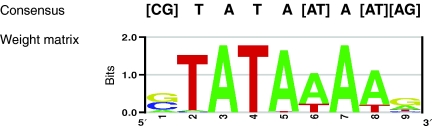
Core promoter element configurations. (A) Promoters with canonical position-specific elements. (Top) The relative locations of known elements (see Table 1). (Middle) fushi tarazu (ftz) contains an Inr, a TATA box and DPE. ftz activation by Caudal is primarily dependent on the DPE site (Juven-Gershon et al., 2008). (Bottom) Tollo contains both of the Drosophila downstream elements, the MTE and DPE, which both contribute to transcriptional activation (Lim et al., 2004). (B) Promoters with non-position-specific elements. (Top) The Drosophila genes encoding histones H2A, H2B, H3 and H4 have canonical TATA boxes, but (middle) the H1 gene is TRF2 dependent and not bound by TBP (Isogai et al., 2007a). TRF2 is a conserved TBP-replacing factor, which does not directly associate with DNA but rather interacts with specific transcription factors, such as DREF, which binds the DRE (Hochheimer et al., 2002). (Bottom) TBP- and TRF2-dependent promoters can regulate the same gene via alternative TSSs, as is the case for PCNA, in which one TSS is TRF2 dependent via its interaction with DREF, and a second downstream promoter is TBP dependent (Hochheimer et al., 2002). Only experimentally validated elements are shown.
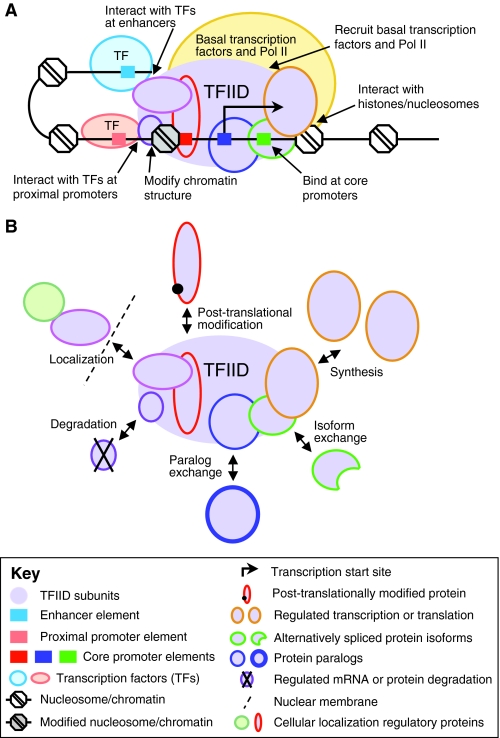
General functions of TFIID and mechanisms that regulate the diversity of TFIID subunits. (A) The general functions of TFIID that facilitate transcription initiation by Pol II. (B) The general mechanisms by which the structure and function of TFIID are modified. Specific examples are described in the text.
Similar articles
-
Novel cofactors and TFIIA mediate functional core promoter selectivity by the human TAFII150-containing TFIID complex.Mol Cell Biol. 1998 Nov;18(11):6571-83. doi: 10.1128/MCB.18.11.6571. Mol Cell Biol. 1998. PMID: 9774672 Free PMC article.
-
Taspase1 processing alters TFIIA cofactor properties in the regulation of TFIID.Transcription. 2015;6(2):21-32. doi: 10.1080/21541264.2015.1052178. Transcription. 2015. PMID: 25996597 Free PMC article.
-
RNA polymerase II and TAFs undergo a slow isomerization after the polymerase is recruited to promoter-bound TFIID.J Mol Biol. 2010 Mar 19;397(1):57-68. doi: 10.1016/j.jmb.2010.01.025. Epub 2010 Jan 18. J Mol Biol. 2010. PMID: 20083121
-
Shifting players and paradigms in cell-specific transcription.Mol Cell. 2009 Dec 25;36(6):924-31. doi: 10.1016/j.molcel.2009.12.011. Mol Cell. 2009. PMID: 20064459 Free PMC article. Review.
-
An unexpected role of TAFs and TRFs in skeletal muscle differentiation: switching core promoter complexes.Cold Spring Harb Symp Quant Biol. 2008;73:217-25. doi: 10.1101/sqb.2008.73.028. Epub 2008 Nov 6. Cold Spring Harb Symp Quant Biol. 2008. PMID: 19022758 Review.
Cited by
-
Highly redundant function of multiple AT-rich sequences as core promoter elements in the TATA-less RPS5 promoter of Saccharomyces cerevisiae.Nucleic Acids Res. 2011 Jan;39(1):59-75. doi: 10.1093/nar/gkq741. Epub 2010 Aug 30. Nucleic Acids Res. 2011. PMID: 20805245 Free PMC article.
-
Chromatin-associated SUMOylation controls the transcriptional switch between plant development and heat stress responses.Plant Commun. 2020 Jul 2;2(1):100091. doi: 10.1016/j.xplc.2020.100091. eCollection 2021 Jan 11. Plant Commun. 2020. PMID: 33511343 Free PMC article.
-
The Core Promoter Is a Regulatory Hub for Developmental Gene Expression.Front Cell Dev Biol. 2021 Sep 10;9:666508. doi: 10.3389/fcell.2021.666508. eCollection 2021. Front Cell Dev Biol. 2021. PMID: 34568311 Free PMC article. Review.
-
A Random Screen Using a Novel Reporter Assay System Reveals a Set of Sequences That Are Preferred as the TATA or TATA-Like Elements in the CYC1 Promoter of Saccharomyces cerevisiae.PLoS One. 2015 Jun 5;10(6):e0129357. doi: 10.1371/journal.pone.0129357. eCollection 2015. PLoS One. 2015. PMID: 26046838 Free PMC article.
-
Incorporating Sequence-Dependent DNA Shape and Dynamics into Transcriptome Data Analysis.Methods Mol Biol. 2024;2812:317-343. doi: 10.1007/978-1-0716-3886-6_18. Methods Mol Biol. 2024. PMID: 39068371
References
-
- Auty R., Steen H., Myers L. C., Persinger J., Bartholomew B., Gygi S. P., Buratowski S. (2004). Purification of active TFIID from Saccharomyces cerevisiae: Extensive promoter contact and co-activator function. J. Biol. Chem. 279, 49973-49981 - PubMed
-
- Bártfai R., Balduf C., Hilton T., Rathmann Y., Hadzhiev Y., Tora L., Orbán L., Müller F. (2004). TBP2, a vertebrate-specific member of the TBP family, is required in embryonic development of zebrafish. Curr. Biol. 14, 593-598 - PubMed
Publication types
MeSH terms
Substances
LinkOut - more resources
Full Text Sources