


doi: 10.4161/cc.9.2.10419.
Epub 2010 Jan 23.
A systematic approach to understand the functional consequences of non-protein coding risk regions
Affiliations
- PMID: 20023379
- PMCID: PMC3319348
- DOI: 10.4161/cc.9.2.10419
Item in Clipboard
A systematic approach to understand the functional consequences of non-protein coding risk regions
Cell Cycle.
.
Abstract
A primary goal of genetic association studies is to elucidate genes and novel biological mechanisms involved in disease. Recently, genome-wide association studies have identified many common genetic variants that are significantly associated with complex diseases such as cancer. In contrast to Mendelian disorders, a sizable fraction of the variants lies outside known protein-coding regions; therefore, understanding their biological consequences presents a major challenge in human genetics. Here we describe an integrated framework to allow non-protein coding loci to be annotated with respect to regulatory functions. This will facilitate identification of target genes as well as prioritize variants for functional testing.
Figures
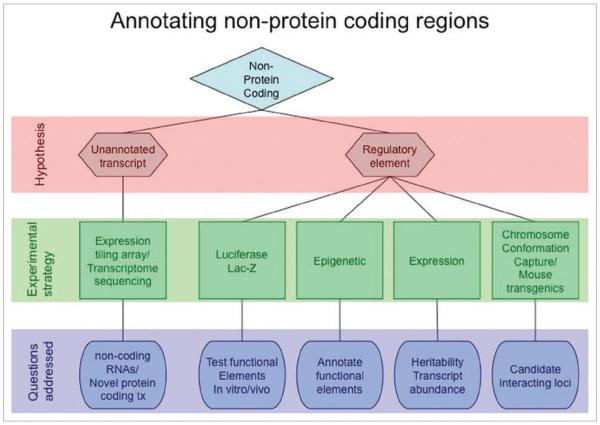
Strategy to annotate non-protein coding regions.
Similar articles
-
On the identification of potential regulatory variants within genome wide association candidate SNP sets.BMC Med Genomics. 2014 Jun 11;7:34. doi: 10.1186/1755-8794-7-34. BMC Med Genomics. 2014. PMID: 24920305 Free PMC article.
-
An integrative functional genomics framework for effective identification of novel regulatory variants in genome-phenome studies.Genome Med. 2018 Jan 29;10(1):7. doi: 10.1186/s13073-018-0513-x. Genome Med. 2018. PMID: 29378629 Free PMC article.
-
Lessons from postgenome-wide association studies: functional analysis of cancer predisposition loci.J Intern Med. 2013 Nov;274(5):414-24. doi: 10.1111/joim.12085. J Intern Med. 2013. PMID: 24127939 Free PMC article. Review.
-
Phenotype-Specific Enrichment of Mendelian Disorder Genes near GWAS Regions across 62 Complex Traits.Am J Hum Genet. 2018 Oct 4;103(4):535-552. doi: 10.1016/j.ajhg.2018.08.017. Am J Hum Genet. 2018. PMID: 30290150 Free PMC article.
-
Prostate cancer genomics, biology, and risk assessment through genome-wide association studies.Cancer Sci. 2012 Apr;103(4):607-13. doi: 10.1111/j.1349-7006.2011.02193.x. Epub 2012 Jan 29. Cancer Sci. 2012. PMID: 22181854 Free PMC article. Review.
Cited by
-
HERC2 rs12913832 modulates human pigmentation by attenuating chromatin-loop formation between a long-range enhancer and the OCA2 promoter.Genome Res. 2012 Mar;22(3):446-55. doi: 10.1101/gr.128652.111. Epub 2012 Jan 10. Genome Res. 2012. PMID: 22234890 Free PMC article.
-
Networks of intergenic long-range enhancers and snpRNAs drive castration-resistant phenotype of prostate cancer and contribute to pathogenesis of multiple common human disorders.Cell Cycle. 2011 Oct 15;10(20):3571-97. doi: 10.4161/cc.10.20.17842. Cell Cycle. 2011. PMID: 22067658 Free PMC article.
-
Principles for the post-GWAS functional characterization of cancer risk loci.Nat Genet. 2011 Jun;43(6):513-8. doi: 10.1038/ng.840. Nat Genet. 2011. PMID: 21614091 Free PMC article. No abstract available.
-
Current status of genome-wide association studies in cancer.Hum Genet. 2011 Jul;130(1):59-78. doi: 10.1007/s00439-011-1030-9. Epub 2011 Jun 16. Hum Genet. 2011. PMID: 21678065 Review.
-
FunciSNP: an R/bioconductor tool integrating functional non-coding data sets with genetic association studies to identify candidate regulatory SNPs.Nucleic Acids Res. 2012 Oct;40(18):e139. doi: 10.1093/nar/gks542. Epub 2012 Jun 8. Nucleic Acids Res. 2012. PMID: 22684628 Free PMC article.
References
-
- Haiman CA, Stram DO. Utilizing HapMap and tagging SNPs. Methods Mol Med. 2008;141:37–54. - PubMed
Publication types
MeSH terms
Substances
Grants and funding
LinkOut - more resources
Full Text Sources
