


High-frequency stimulation of the subthalamic nucleus restores neural and behavioral functions during reaction time task in a rat model of Parkinson's disease
- PMID: 20025062
- PMCID: PMC4387000
- DOI: 10.1002/jnr.22313
High-frequency stimulation of the subthalamic nucleus restores neural and behavioral functions during reaction time task in a rat model of Parkinson's disease
Abstract
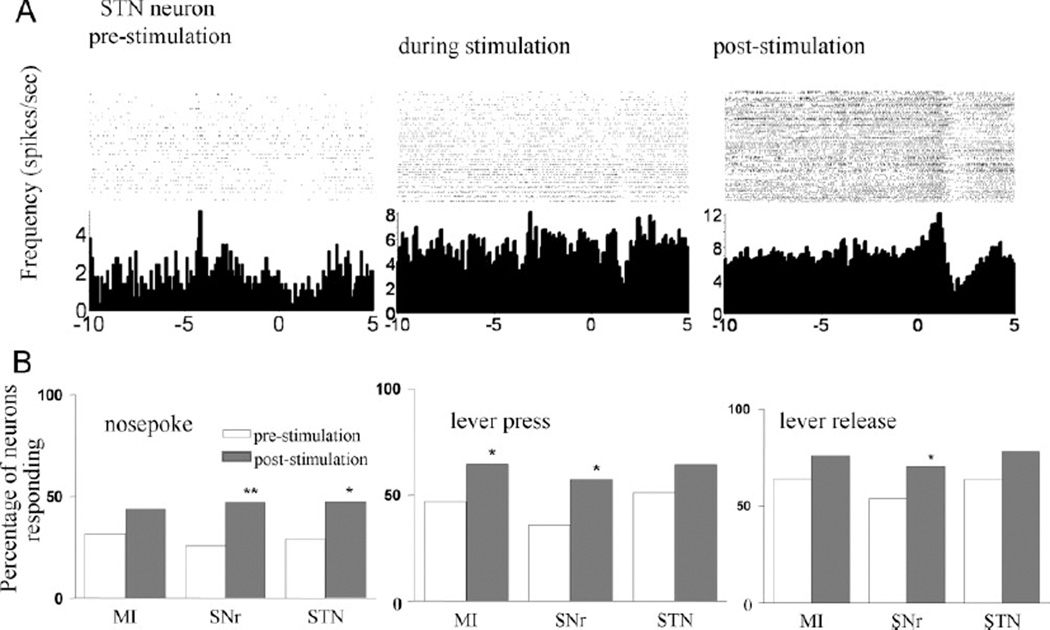
Deep brain stimulation (DBS) has been used in the clinic to treat Parkinson's disease (PD) and other neuropsychiatric disorders. Our previous work has shown that DBS in the subthalamic nucleus (STN) can improve major motor deficits, and induce a variety of neural responses in rats with unilateral dopamine (DA) lesions. In the present study, we examined the effect of STN DBS on reaction time (RT) performance and parallel changes in neural activity in the cortico-basal ganglia regions of partially bilateral DA- lesioned rats. We recorded neural activity with a multiple-channel single-unit electrode system in the primary motor cortex (MI), the STN, and the substantia nigra pars reticulata (SNr) during RT test. RT performance was severely impaired following bilateral injection of 6-OHDA into the dorsolateral part of the striatum. In parallel with such behavioral impairments, the number of responsive neurons to different behavioral events was remarkably decreased after DA lesion. Bilateral STN DBS improved RT performance in 6-OHDA lesioned rats, and restored operational behavior-related neural responses in cortico-basal ganglia regions. These behavioral and electrophysiological effects of DBS lasted nearly an hour after DBS termination. These results demonstrate that a partial DA lesion-induced impairment of RT performance is associated with changes in neural activity in the cortico-basal ganglia circuit. Furthermore, STN DBS can reverse changes in behavior and neural activity caused by partial DA depletion. The observed long-lasting beneficial effect of STN DBS suggests the involvement of the mechanism of neural plasticity in modulating cortico-basal ganglia circuits.
(c) 2009 Wiley-Liss, Inc.
Figures


References
-
- Abbruzzese G, Berardelli A. Sensorimotor integration in movement disorders. Movement Disord. 2003;18:231–240. - PubMed
-
- Alexander GE, Crutcher MD. Functional architecture of basal ganglia circuits: neural substrates of parallel processing. Trends Neurosci. 1990;13:266–271. - PubMed
-
- Alexander GE, DeLong MR, Strick PL. Parallel organization of functionally segregated circuits linking basal ganglia and cortex. Annu Rev Neurosci. 1986;9:357–381. - PubMed
-
- Amalric M, Koob GF. Dorsal pallidum as a functional motor output of the corpus striatum. Brain Res. 1989;483:389–394. - PubMed
Publication types
MeSH terms
Substances
Grants and funding
LinkOut - more resources
Full Text Sources
Medical
Miscellaneous
