Thinking about drinking: need for cognition and readiness to change moderate the effects of brief alcohol interventions
- PMID: 20025374
- PMCID: PMC2834212
- DOI: 10.1037/a0016235
Thinking about drinking: need for cognition and readiness to change moderate the effects of brief alcohol interventions
Abstract
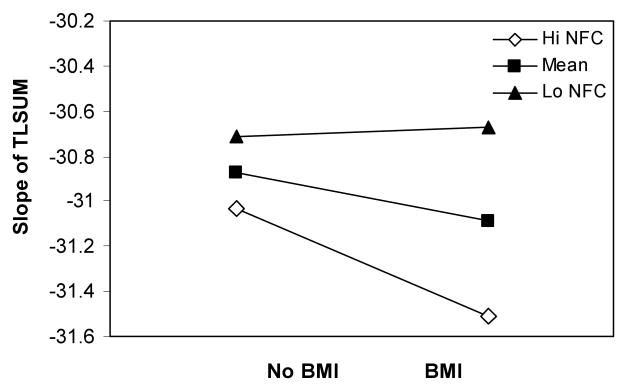
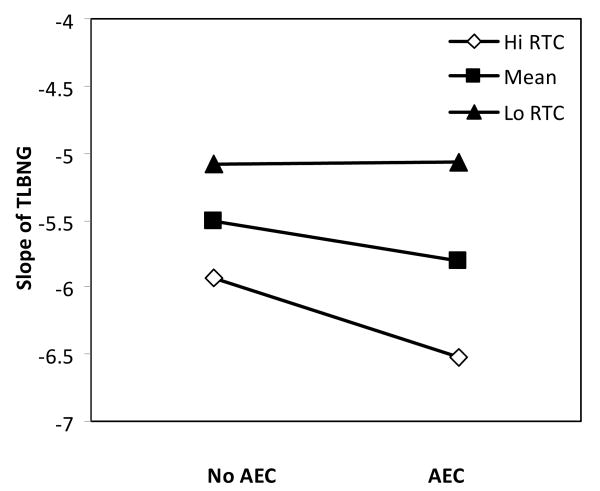
Research has demonstrated the efficacy of brief motivational interventions (BMI) and alcohol expectancy challenge (AEC) in reducing alcohol use and/or problems among college students. However, little is known about variables that may qualify the effectiveness of these approaches. The present analyses tested the hypothesis that need for cognition (NFC), impulsivity/sensation seeking (IMPSS) and readiness to change (RTC) would moderate the effects of BMI and AEC. Participants (N = 335) were heavy drinking college students enrolled in a randomized 2 x 2 factorial study of BMI and AEC. Latent growth curve analyses indicated significant interactions for BMI x NFC and AEC x RTC on alcohol use but not problems. Simple slopes analyses were used to probe these relationships and revealed that higher levels of NFC at baseline were associated with a stronger BMI effect on drinking outcomes over time. Similarly, higher levels of baseline RTC were associated with stronger AEC effects on alcohol use. Future preventive interventions with this population may profit by considering individual differences and targeting approaches accordingly.
Copyright 2009 APA
Figures
References
-
- Aiken LS, West SG. Multiple regression: Testing and interpreting interactions. Thousand Oaks, CA: Sage; 1991.
-
- Biener L, Abrams DB. The Contemplation Ladder: validation of a measure of readiness to consider smoking cessation. Health Psychology. 1991;10:360–365. - PubMed
-
- Cacioppo JT, Petty RE, Feinstein JA, Jarvis WBG. Dispositional differences in cognitive motivation: The life and times of individuals varying in need for cognition. Psychological Bulletin. 1996;119:197–253.
-
- Cacioppo JT, Petty RE, Kao CF. The efficient assessment of need for cognition. Journal of Personality Assessment. 1984;48:306–307. - PubMed
-
- Capone C, Wood MD. Density of familial alcoholism and its effects on alcohol use and problems in college students. Alcoholism, Clinical and Experimental Research. 2008;32:1451–1458. - PubMed