


Performance characteristics of scintigraphic colon transit measurement in health and irritable bowel syndrome and relationship to bowel functions
- PMID: 20025675
- PMCID: PMC2852474
- DOI: 10.1111/j.1365-2982.2009.01441.x
Performance characteristics of scintigraphic colon transit measurement in health and irritable bowel syndrome and relationship to bowel functions
Abstract
Background: The inter- and intra-subject variations of scintigraphy, which are used to identify colonic transit disturbances in irritable bowel syndrome (IBS), are unclear. The relationship between colonic transit and bowel functions is incompletely understood. To assess inter- and intra-subject variations of scintigraphic colonic transit measurements in 86 IBS patients and 17 healthy subjects and to quantify the relationship between colonic transit and bowel symptoms in 147 IBS patients and 46 healthy subjects.
Methods: Data from participants with multiple colonic transit measurements were analysed. Primary end points were colonic filling at 6 h (CF6h) and geometric center (GC) at 24 and 48 h for colonic transit. Bowel functions were assessed by daily stool diaries.
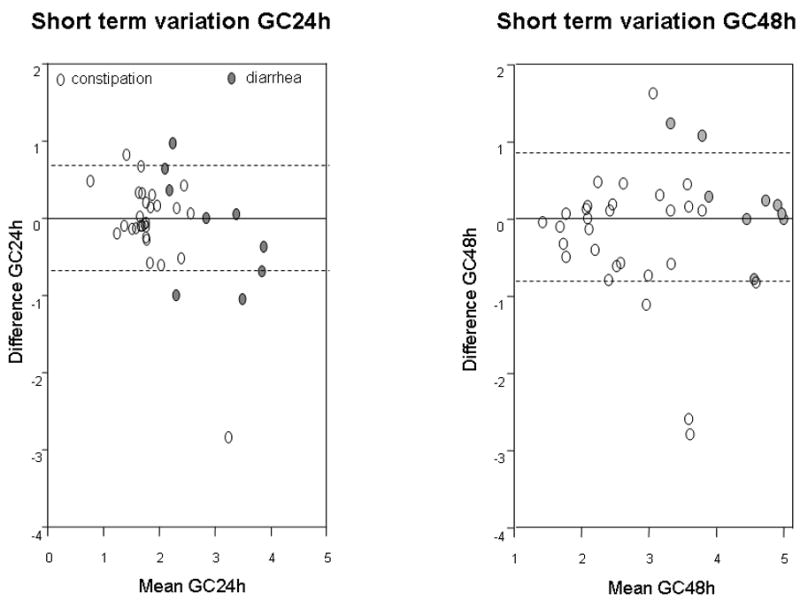
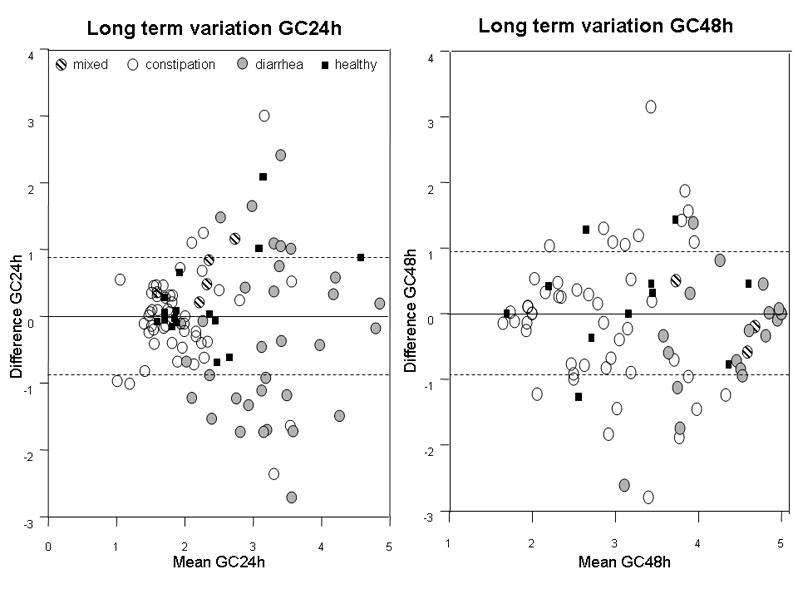
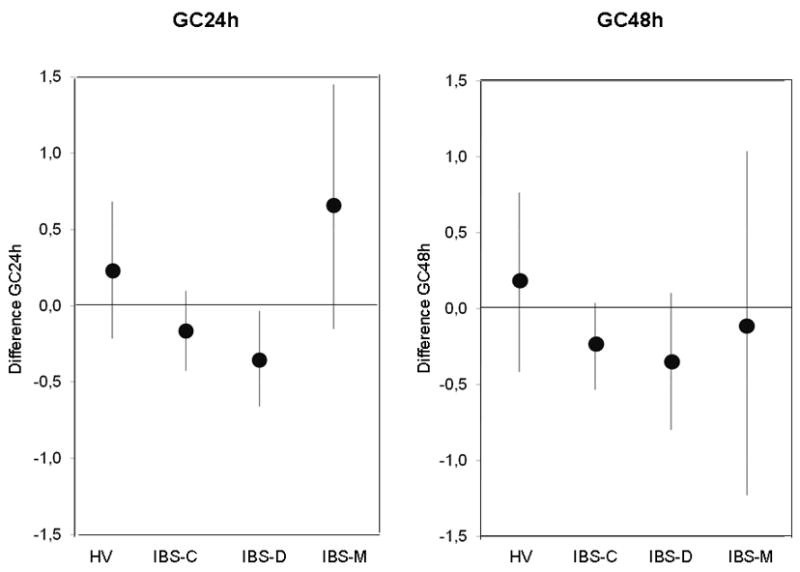
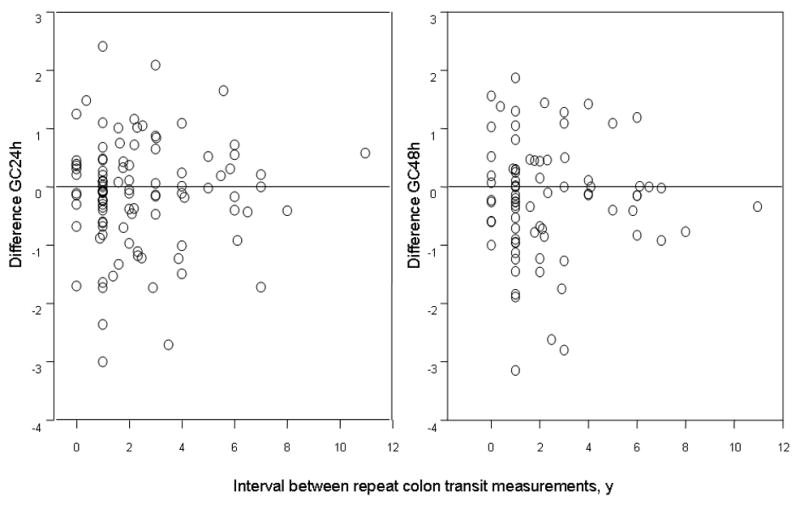
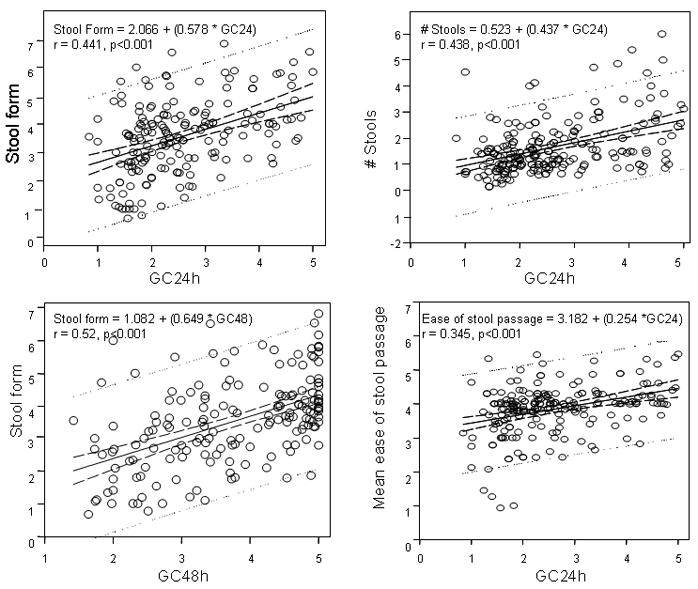
Key results: Inter- and intra-subject variations were greater for small intestinal than colonic transit. Overall, inter- and intra-subject variations were relatively narrow for colonic transit (both GC24h and GC48h, with lower COV at 48 h); there was little intra-subject variation in health and IBS-constipation over a period of <or=3 weeks and over 2.0 years (median, range 0.1, 11.0 years). Significant intra-individual differences in GC24h were observed only in IBS-D patients. Colonic transit was significantly associated with stool form (accounting for 19-27% of the variance), frequency (19%), and ease of stool passage (12%).
Conclusions & inferences: Despite inter-subject variation in scintigraphic colonic transit results, the intra-subject measurements are reproducible over time in healthy volunteers and patients with IBS; significant changes in colonic transit at 24 h were observed only in IBS-D. Colonic transit is associated with stool form, frequency and ease of passage.
Keywords: inter-subject; intra-subject; reproducibility; variation.
Conflict of interest statement
The authors have no competing interests.
Figures
References
-
- Parkman HP, Miller MA, Fisher RS. Role of nuclear medicine in evaluating patients with suspected gastrointestinal motility disorders. Semin Nucl Med. 1995 Oct;25(4):289–305. - PubMed
-
- Bouchoucha M, Devroede G, Arhan P, Strom B, Weber J, Cugnenc PH, et al. What is the meaning of colorectal transit time measurement? Dis Colon Rectum. 1992 Aug;35(8):773–82. - PubMed
-
- Sadik R, Stotzer P, Simren M, Abrahamsson H. Gastrointestinal transit abnormalities are frequently detected in patients with unexplained GI symptoms at a tertiary centre. Neurogastroenterol Motil. 2008 Mar;20(3):197–205. - PubMed
-
- Nam Y, Pikarsky A, Wexner S, Singh J, Weiss E, Nogueras J, et al. Reproducibility of colonic transit study in patients with chronic constipation. Dis Colon Rectum. 2001 Jan;44(1):86–92. - PubMed
Publication types
MeSH terms
Grants and funding
LinkOut - more resources
Full Text Sources
Medical
Miscellaneous
