


Splicing factor Spf30 assists exosome-mediated gene silencing in fission yeast
- PMID: 20028739
- PMCID: PMC2820897
- DOI: 10.1128/MCB.01317-09
Splicing factor Spf30 assists exosome-mediated gene silencing in fission yeast
Erratum in
-
Correction for Bernard et al., "Splicing Factor Spf30 Assists Exosome-Mediated Gene Silencing in Fission Yeast".Mol Cell Biol. 2017 May 16;37(11):e00115-17. doi: 10.1128/MCB.00115-17. Print 2017 Jun 1. Mol Cell Biol. 2017. PMID: 28512211 Free PMC article. No abstract available.
Abstract
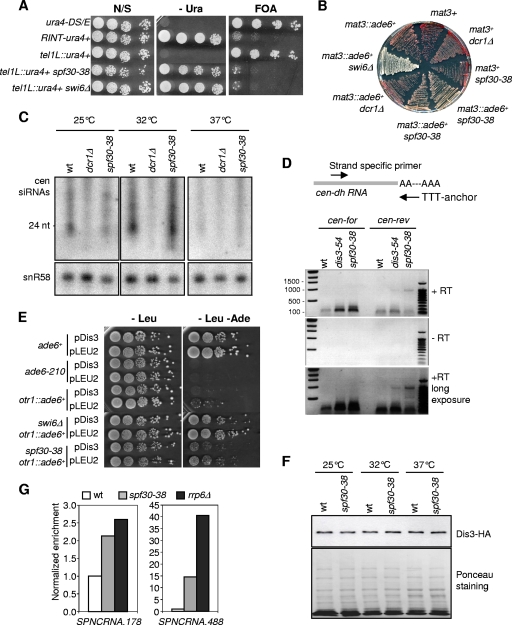
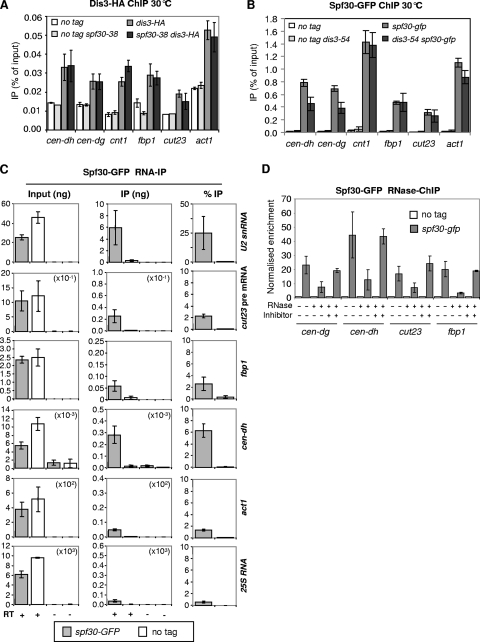
Heterochromatin assembly in fission yeast relies on the processing of cognate noncoding RNAs by both the RNA interference and the exosome degradation pathways. Recent evidence indicates that splicing factors facilitate the cotranscriptional processing of centromeric transcripts into small interfering RNAs (siRNAs). In contrast, how the exosome contributes to heterochromatin assembly and whether it also relies upon splicing factors were unknown. We provide here evidence that fission yeast Spf30 is a splicing factor involved in the exosome pathway of heterochromatin silencing. Spf30 and Dis3, the main exosome RNase, colocalize at centromeric heterochromatin and euchromatic genes. At the centromeres, Dis3 helps recruiting Spf30, whose deficiency phenocopies the dis3-54 mutant: heterochromatin is impaired, as evidenced by reduced silencing and the accumulation of polyadenylated centromeric transcripts, but the production of siRNAs appears to be unaffected. Consistent with a direct role, Spf30 binds centromeric transcripts and locates at the centromeres in an RNA-dependent manner. We propose that Spf30, bound to nascent centromeric transcripts, perhaps with other splicing factors, assists their processing by the exosome. Splicing factor intercession may thus be a common feature of gene silencing pathways.
Figures
References
-
- Allshire, R. C., E. R. Nimmo, K. Ekwall, J. P. Javerzat, and G. Cranston. 1995. Mutations derepressing silent centromeric domains in fission yeast disrupt chromosome segregation. Genes Dev. 9:218-233. - PubMed
-
- Andrulis, E. D., J. Werner, A. Nazarian, H. Erdjument-Bromage, P. Tempst, and J. T. Lis. 2002. The RNA processing exosome is linked to elongating RNA polymerase II in Drosophila. Nature 420:837-841. - PubMed
-
- Bahler, J., J. Q. Wu, M. S. Longtine, N. G. Shah, A. McKenzie III, A. B. Steever, A. Wach, P. Philippsen, and J. R. Pringle. 1998. Heterologous modules for efficient and versatile PCR-based gene targeting in Schizosaccharomyces pombe. Yeast 14:943-951. - PubMed
-
- Bentley, D. L. 2005. Rules of engagement: co-transcriptional recruitment of pre-mRNA processing factors. Curr. Opin. Cell Biol. 17:251-256. - PubMed
Publication types
MeSH terms
Substances
LinkOut - more resources
Full Text Sources
Molecular Biology Databases
