. 2009 Dec;21(12):4002-17.
doi: 10.1105/tpc.109.071282. Epub 2009 Dec 22.

The small subunit of snapdragon geranyl diphosphate synthase modifies the chain length specificity of tobacco geranylgeranyl diphosphate synthase in planta

Affiliations

The small subunit of snapdragon geranyl diphosphate synthase modifies the chain length specificity of tobacco geranylgeranyl diphosphate synthase in planta

Irina Orlova et al. Plant Cell. 2009 Dec.

Abstract

Geranyl diphosphate (GPP), the precursor of many monoterpene end products, is synthesized in plastids by a condensation of dimethylallyl diphosphate and isopentenyl diphosphate (IPP) in a reaction catalyzed by homodimeric or heterodimeric GPP synthase (GPPS). In the heterodimeric enzymes, a noncatalytic small subunit (GPPS.SSU) determines the product specificity of the catalytic large subunit, which may be either an active geranylgeranyl diphosphate synthase (GGPPS) or an inactive GGPPS-like protein. Here, we show that expression of snapdragon (Antirrhinum majus) GPPS.SSU in tobacco (Nicotiana tabacum) plants increased the total GPPS activity and monoterpene emission from leaves and flowers, indicating that the introduced catalytically inactive GPPS.SSU found endogenous large subunit partner(s) and formed an active snapdragon/tobacco GPPS in planta. Bimolecular fluorescence complementation and in vitro enzyme analysis of individual and hybrid proteins revealed that two of four GGPPS-like candidates from tobacco EST databases encode bona fide GGPPS that can interact with snapdragon GPPS.SSU and form a functional GPPS enzyme in plastids. The formation of chimeric GPPS in transgenic plants also resulted in leaf chlorosis, increased light sensitivity, and dwarfism due to decreased levels of chlorophylls, carotenoids, and gibberellins. In addition, these transgenic plants had reduced levels of sesquiterpene emission, suggesting that the export of isoprenoid intermediates from the plastids into the cytosol was decreased. These results provide genetic evidence that GPPS.SSU modifies the chain length specificity of phylogenetically distant GGPPS and can modulate IPP flux distribution between GPP and GGPP synthesis in planta.


Figures
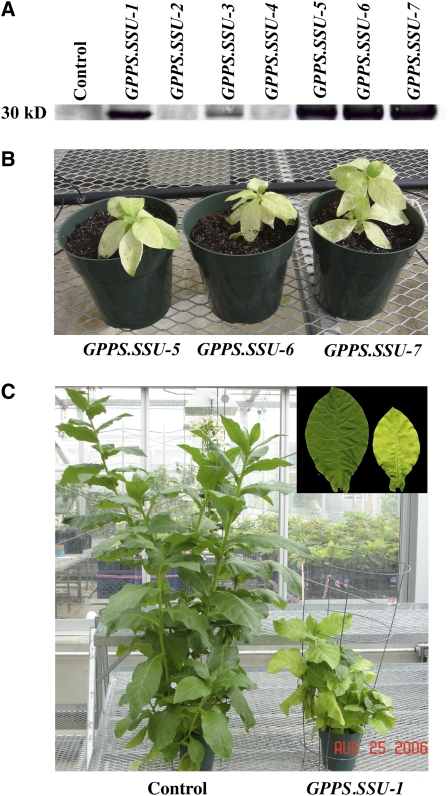
Figure 1.
Figure 1.
Effect of Am GPPS.SSU Expression on the Phenotype of Transgenic Tobacco Plants. (A) Am GPPS.SSU protein levels in different transgenic tobacco lines. The representative protein gel blot shows the 30-kD protein recognized by anti-Am GPPS.SSU antibodies. Proteins were extracted from tobacco leaves of untransformed control and seven independent transgenic lines (shown on the top), and 20 μg of protein were loaded in each lane. The blot shown represents a typical result of three independent experiments. (B) Effect of high levels of Am GPPS.SSU protein on the phenotype of transgenic tobacco plants. Three transgenic lines with the highest levels of Am GPPS.SSU protein (GPPS.SSU-5 to GPPS.SSU-7) show strong chlorosis and dwarfism relative to the control plant shown in (C). (C) Phenotype of GPPS.SSU-1 line, which in contrast with GPPS.SSU-5 to GPPS.SSU-7, was able to produce mature plants. The inset shows leaves from control (left) and GPPS.SSU-1 transgenic plants (right). All plants in (B) and (C) are 6 to 7 weeks old.
Figure 2.
Figure 2.
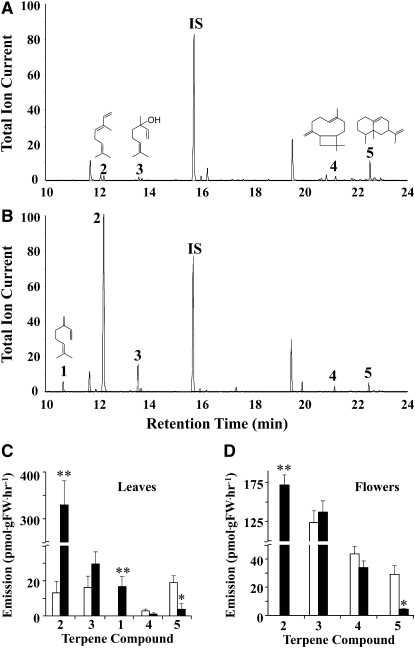
Effect of Am GPPS.SSU Expression on Terpenoid Emission from Leaves and Flowers of Transgenic Tobacco Plants. (A) and (B) Metabolic profiling of volatiles emitted from leaves of untransformed control (A) and transgenic GPPS.SSU-1 (B) tobacco plants. Volatiles collected from detached leaves were analyzed by electron ionization GC-MS, and total ion currents are plotted. Compounds were identified based on their mass spectra and retention time: 1, myrcene; 2, (E)-β-ocimene; 3, linalool: IS, internal standard (naphthalene); 4, β-caryophyllene; 5, 5-epi-aristolochene. (C) and (D) Quantitative changes in terpenoids emitted from leaves (C) and flowers (D) of GPPS.SSU-1 tobacco plants relative to the control. White and black bars represent the amount of terpenoids in the control and transgenic line, respectively. Data are means ± sd (n = 3 to 10). Asterisks indicate values that are significantly different from the control. Confidence levels were tested by a Student's t test; *, P < 0.05; **, P < 0.001.
Figure 3.
Figure 3.
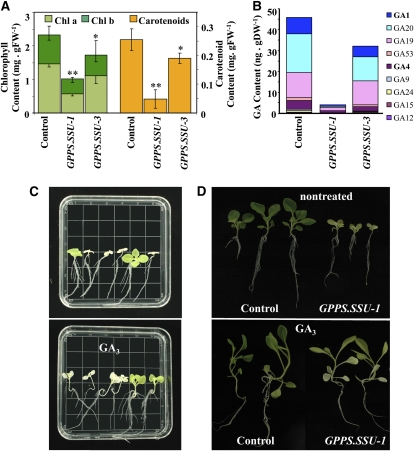
Effect of Am GPPS.SSU Expression on GGPP-Derived Isoprenoids in Transgenic Tobacco Plants. (A) Chlorophyll and carotenoid contents in the leaves of control and transgenic lines GPPS.SSU-1 and GPPS.SSU-3. Data are means ± sd (n = 3 to 10). Asterisks indicate values that are significantly different from the control. Confidence levels were tested by a Student's t test; * P < 0.05; ** P < 0.001. (B) Levels of GAs in the leaves of control and transgenic lines GPPS.SSU-1 and GPPS.SSU-3. (C) Germination of T1 seeds of GPPS.SSU-1 line without (top panel) or with (bottom panel) 30 μM GA3. Resulting 10-d-old T1 seedlings show the expected segregation of the wild type and bleached/reduced growth phenotype. Addition of GA3 rescued the growth of transgenic seedlings. (D) Continued treatment of transgenic GPPS.SSU-1 seedlings with GA3 recovered their growth to almost that of control plants. Fourteen-day-old plants grown without (top panel) or with (bottom panel) 30 μM GA3 are shown.
Figure 4.
Figure 4.
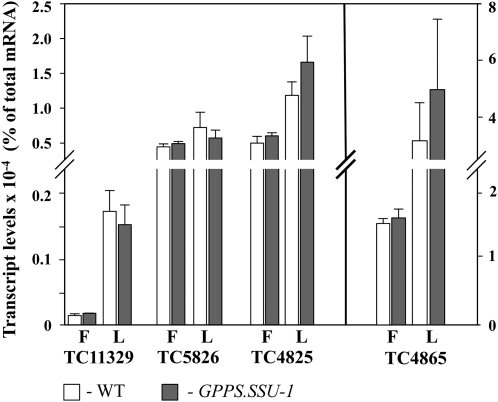
Expression Levels of Genes Encoding Potential Endogenous Tobacco Partners for Am GPPS.SSU in the Control and GPPS.SSU-1 Transgenic Line. Quantitative RT-PCR analysis of expression of tobacco candidates for GPPS.LSU in leaves (L) and flowers (F) of control (white) and GPPS.SSU-1 (gray) is shown. Expression is represented as a percentage of the large subunit candidate mRNA to total mRNA. Each point is the average of three independent experiments. Standard error values are indicated by vertical bars.
Figure 5.
Figure 5.
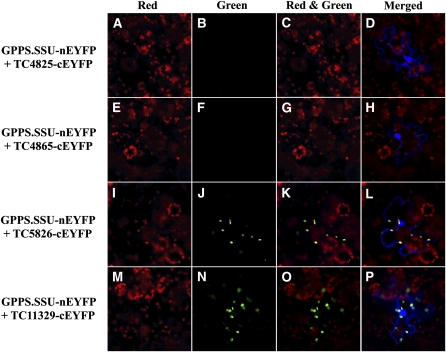
BiFC Detection of Protein–Protein Interactions of Snapdragon Am GPPS.SSU with Tobacco GGPPS-Like Proteins in N. benthamiana Leaf Epidermal Cells. (A) to (D) Coexpression of GPPS.SSU-nEYFP and TC4825-cEYFP. (E) to (H) Coexpression of GPPS.SSU-nEYFP and TC4865-cEYFP. (I) to (L) Coexpression of GPPS.SSU-nEYFP and TC5826-cEYFP. (M) to (P) Coexpression of GPPS.SSU-nEYFP and TC11329-cEYFP. Fluorescence of reconstructed YFP was detected in the green channel and is shown in the “Green” panel. Chlorophyll autofluorescence was detected in the red channel and is shown in the “Red” panel. The “Red and Green” panel shows merged chlorophyll autoflourescence and YFP signals. Cytosol and nuclear-localized cyan fluorescent protein (CFP) was used to demarcate the boundary of the cell. The “Merged” panel shows combined “Red and Green” and CFP signals.
Figure 6.
Figure 6.
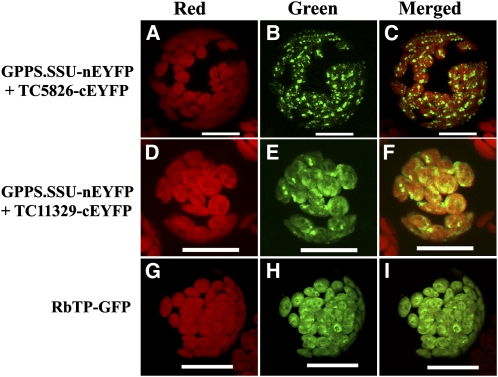
BiFC Detection of Protein–Protein Interactions of Am GPPS.SSU with Tobacco GGPPS-Like Proteins in Arabidopsis Leaf Protoplasts. (A) to (C) Coexpression of Am GPPS.SSU-nEYFP and TC5826-cEYFP. (D) to (F) Coexpression of Am GPPS.SSU-nEYFP and TC11329-cEYFP. (G) to (I) Expression of the RbTP-GFP chloroplast marker. Reconstructed YFP ([B] and [E]) and GFP (H) fluorescence was detected in the green channel and is shown in the “Green” panel; chlorophyll autofluorescence was detected in the red channel and is shown in the “Red” panel; the “Merged” panel shows combined green and red channels. Bars = 50 μm.
Figure 7.
Figure 7.
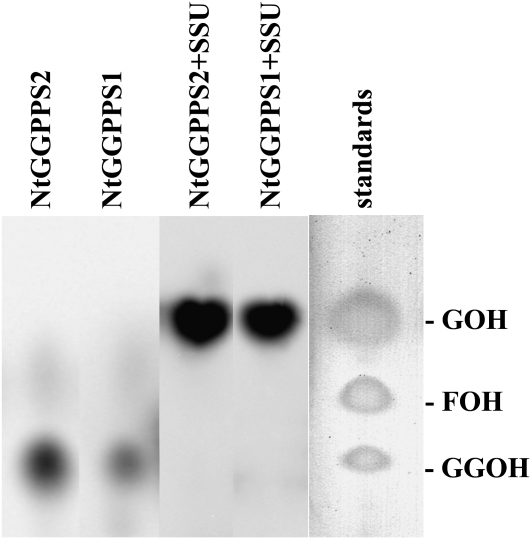
Products Generated by Tobacco GGPPS1, GGPPS2, and Chimeric Snapdragon/Tobacco Heterodimeric GPPSs from DMAPP and [1-14C]-IPP in Vitro. Reaction products were hydrolyzed to their corresponding alcohols, extracted with hexane, and separated by reverse-phase thin layer chromatography. Authentic standards (GOH, geranol; FOH, farnesol; GGOH, geranylgeranol) were visualized by exposing thin layer chromatography plates to iodine vapor. Assays contained 5 μg of recombinant Nt GGPPS1 or Nt GGPPS2 proteins or 40 μg of hybrid heterodimers.

References

    1. Aharoni, A., Giri, A.P., Deuerlein, S., Griepink, F., de Kogel, W.J., Verstappen, F.W., Verhoeven, H.A., Jongsma, M.A., Schwab, W., and Bouwmeester, H.J. (2003). Terpenoid metabolism in wild-type and transgenic Arabidopsis plants. Plant Cell 15 2866–2884. - PMC - PubMed
    1. Aharoni, A., Giri, A.P., Verstappen, F.W., Bertea, C.M., Sevenier, R., Sun, Z., Jongsma, M.A., Schwab, W., and Bouwmeester, H.J. (2004). Gain and loss of fruit flavor compounds produced by wild and cultivated strawberry species. Plant Cell 16 3110–3131. - PMC - PubMed
    1. Aharoni, A., Jongsma, M.A., and Bouwmeester, H.J. (2005). Volatile science? Metabolic engineering of terpenoids in plants. Trends Plant Sci. 10 594–602. - PubMed
    1. Aharoni, A., Jongsma, M.A., Kim, T., Ri, M., Giri, A.P., Verstappen, F.W., Schwab, W., and Bouwmeester, H.J. (2006). Metabolic engineering of terpenoid biosynthesis in plants. Phytochem. Rev. 5 49–58.
    1. Ament, K., Van Schie, C.C., Bouwmeester, H.J., Haring, M.A., and Schuurink, R.C. (2006). Induction of a leaf specific geranylgeranyl pyrophosphate synthase and emission of (E,E)-4,8,12-trimethyltrideca-1,3,7,11-tetraene in tomato are dependent on both jasmonic acid and salicylic acid signaling pathways. Planta 224 1197–1208. - PubMed

Publication types

MeSH terms