. 2010 Jan 1;70(1):229-39.
doi: 10.1158/0008-5472.CAN-09-2788. Epub 2009 Dec 22.

Alternative splicing of the cyclin D1 proto-oncogene is regulated by the RNA-binding protein Sam68

Affiliations

Alternative splicing of the cyclin D1 proto-oncogene is regulated by the RNA-binding protein Sam68

Maria Paola Paronetto et al. Cancer Res. .

Abstract

Human cyclin D1 is expressed as two isoforms derived by alternate RNA splicing, termed D1a and D1b, which differ for the inclusion of intron 4 in the D1b mRNA. Both isoforms are frequently upregulated in human cancers, but cyclin D1b displays relatively higher oncogenic potential. The splicing factors that regulate alternative splicing of cyclin D1b remain unknown despite the likelihood that they contribute to cyclin D1 oncogenicity. In this study, we report that Sam68, an RNA-binding protein frequently overexpressed in prostate cancer cells, enhances splicing of cyclin D1b and supports its expression in prostate cancer cells. Chromatin immunoprecipitation and RNA coimmunoprecipitation experiments showed that Sam68 is recruited to the human CCND1 gene encoding cyclin D1 and that it binds to cyclin D1 mRNA. Transient overexpression and RNAi knockdown experiments indicated that Sam68 acts to enhance endogenous expression of cyclin D1b. Minigene reporter assays showed that Sam68 directly affected alternative splicing of CCND1 message, with a preference for the A870 allele that is known to favor cyclin D1b splicing. Sam68 interacted with the proximal region of intron 4, and its binding correlated inversely with recruitment of the spliceosomal component U1-70K. Sam68-mediated splicing was modulated by signal transduction pathways that elicit phosphorylation of Sam68 and regulate its affinity for CCND1 intron 4. Notably, Sam68 expression positively correlates with levels of cyclin D1b, but not D1a, in human prostate carcinomas. Our results identify Sam68 as the first splicing factor to affect CCND1 alternative splicing in prostate cancer cells, and suggest that increased levels of Sam68 may stimulate cyclin D1b expression in human prostate cancers.


Conflict of interest statement

Disclosure of Potential Conflicts of Interest

No potential conflicts of interest were disclosed.

Figures
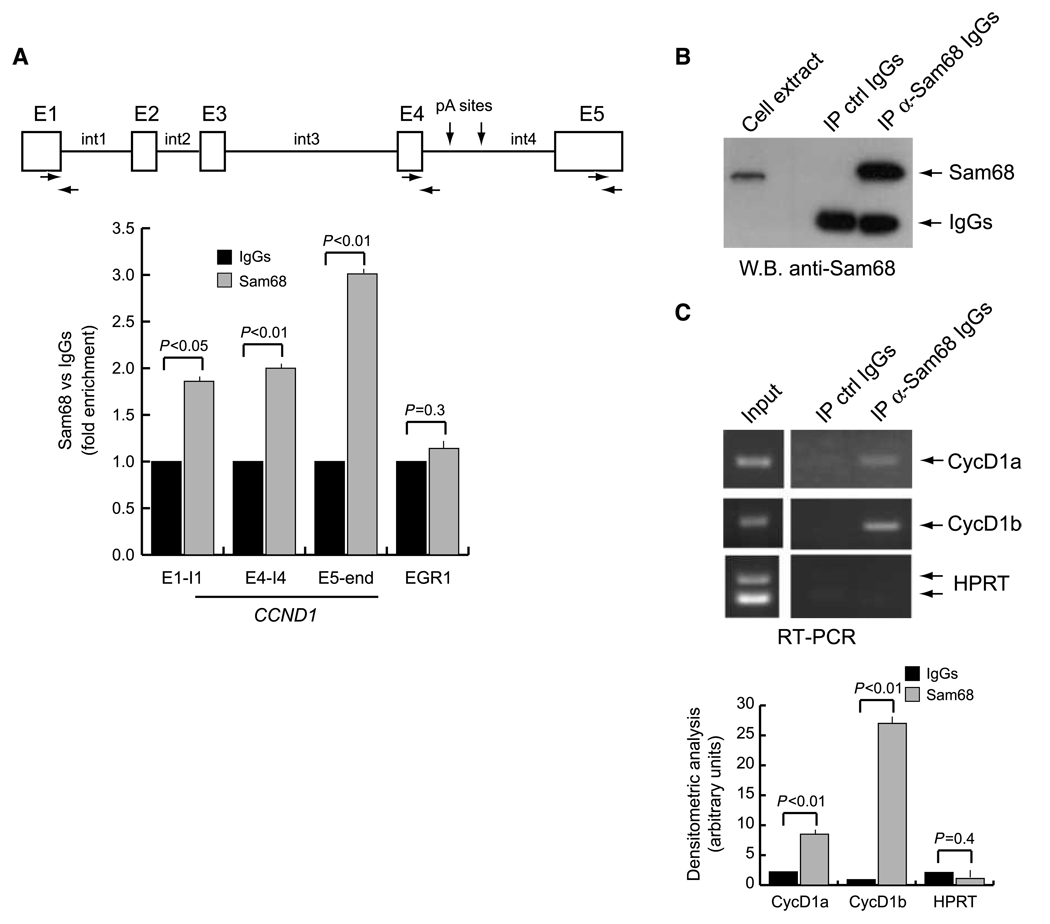
Figure 1
Figure 1
Sam68 associates with CCND1 gene and with cyclin D1 mRNA in LNCaP cells. A, scheme of the CCND1 gene. Boxes identify the five exons (E1–E5), whereas the lines identify the four introns (int1–int4). Horizontal arrows, position of the primers used for the PCR of the immunoprecipitated chromatin; vertical arrows, position of the polyadenylation sites in intron 4 (28). Cross-linked chromatin derived from LNCaP cells was immunoprecipitated with anti-Sam68 antibody or control IgGs. The immunoprecipitated chromatin was analyzed by quantitative real-time PCR using the indicated primers. Early growth response 1 (EGR1) primers were used as internal control for a gene not regulated by Sam68. Results are shown as fold enrichment in the anti-Sam68 immunoprecipitates versus the control IgGs. B and C, coimmunoprecipitation of endogenous Sam68 with cyclin D1 mRNA. LNCaP cell extracts were immunoprecipitated with anti–Sam68-specific antibody; IgGs were used as mock reaction; coprecipitated RNAs were analyzed by RT-PCR with primers specific for cyclin D1a (CycD1a), cyclin D1b (CycD1b), and hypoxanthine phosphoribosyltransferase (HPRT) used as negative control (C). An aliquot of the immunoprecipitates was saved for Western blot analysis of Sam68 (B). A and C, columns, mean of three independent experiments; bars, SD. P values of Student's t test are reported.
Figure 2
Figure 2
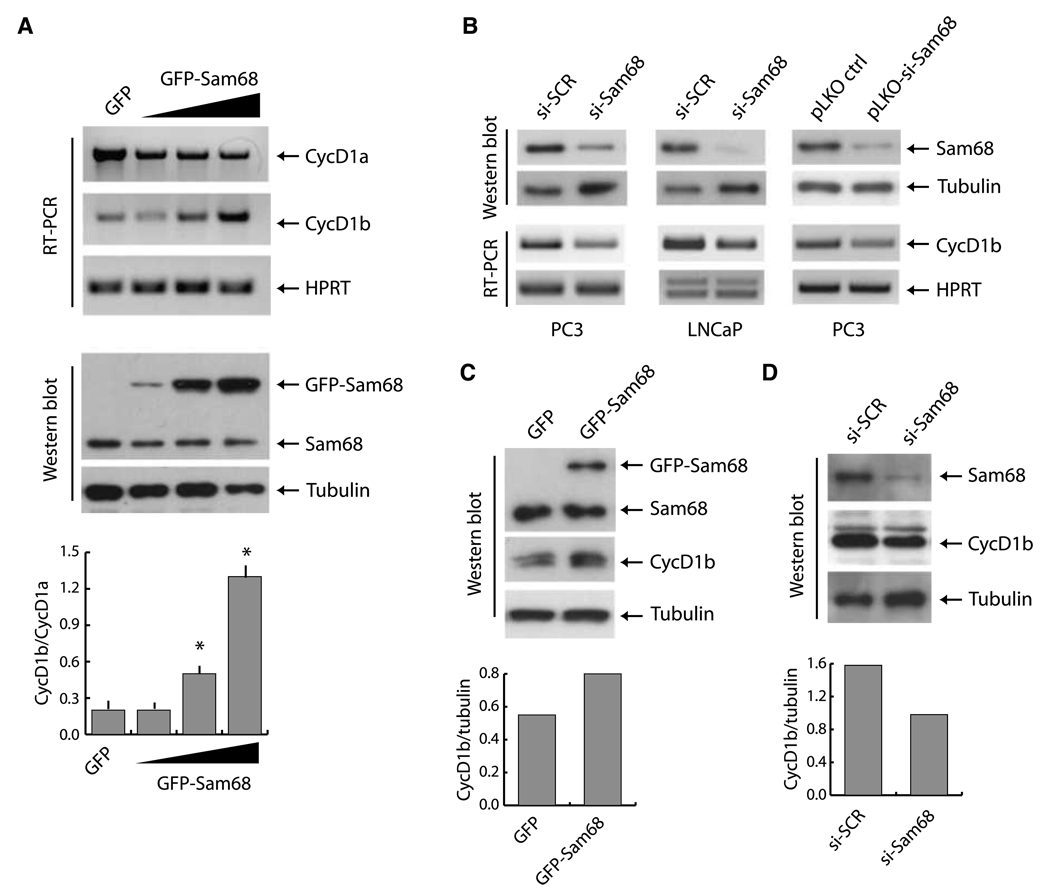
Sam68 enhances expression of cyclin D1b in PCa cells. A, PC3 cells were transfected either with GFP or with increasing amounts of GFP-Sam68 constructs. Top, cyclin D1a and cyclin D1b transcripts were analyzed by RT-PCR; middle, Western blot analysis of GFP-Sam68 and endogenous Sam68. Staining of the blot with α-tubulin was used as internal loading control. Bottom, densitometric analysis of the cyclin D1b/cyclin D1a ratio. Columns, mean of three separate experiments; bars, SD. Statistical significance was determined by Student's t test. *, P < 0.05. B, effect of Sam68 knockdown on cyclin D1b expression was detected after silencing of Sam68 mRNA in PC3 and LNCaP cells, either with siRNA oligo or with stable transfection of pLKO or pLKO-si-Sam68. Cells were harvested 48 h after transfection and analyzed by immunoblot for Sam68 and tubulin expression or by RT-PCR to determine the expression of cyclin D1b or HPRT. C and D, Sam68 overexpression (C) and downregulation (D) modulate cyclin D1b protein level. Immunoblot analysis of Sam68 and cyclin D1b was normalized for the β-tubulin abundance. Bottom, densitometric analysis of the ratio of cyclin D1b/tubulin.
Figure 3
Figure 3
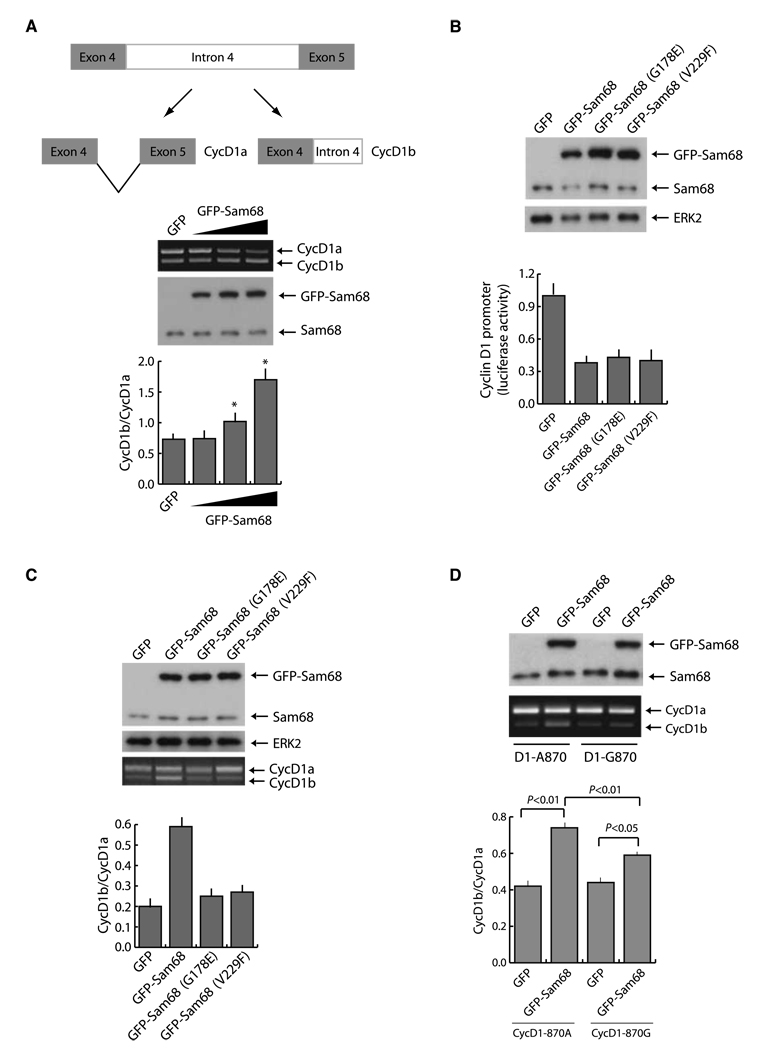
Sam68 modulates the AS of cyclin D1. A, schematic representation of the cyclin D1 minigene and of the PCR products from the in vivo splicing assay. Top, splicing assay of the cyclin D1 minigene in PC3 cells transfected with the cyclin D1 minigene together with increasing amounts of GFP-Sam68. Cells were harvested 20 h after transfection and processed for RT-PCR and protein extraction. Middle, immunoblot analysis of the same samples of the splicing assay. Bottom, columns, mean of the cyclin D1b/cyclin D1a ratio from three independent experiments; bars, SD. *, P < 0.01. B, cyclin D1 luciferase reporter assay of PC3 cells transfected with pGL3-cyclinD1-luc and GFP-Sam68wt or G178E and V229F mutants. Top, Western blot analysis of the transfected cells; bottom, cell extracts were prepared and assayed for firefly and Renilla luciferase (to normalize for transfection efficiency). Columns, mean of three experiments; bars, SD. C, splicing assay of the cyclin D1 minigene described in A in PC3 cells transfected with the indicated GFP or GFP-Sam68 constructs. Top, immunoblot analysis of the same samples of the splicing assay; bottom, PCR from the splicing assay with the cyclin D1 minigene. Columns, mean of the cyclin D1b/cyclin D1a ratio from three independent experiments; bars, SD. D, in vivo splicing assay of cyclin D1 minigenes 870G or 870A in the presence of GFP-Sam68. PC3 cells were transfected with the indicated constructs and collected 30 h after transfection for RNA and protein extraction. Top, immunoblot analysis of the transfected cells. Middle, PCR analysis for cyclin D1a and cyclin D1b. Bottom, densitometric analysis of three different experiments. Columns, mean; bars, SD. P value is indicated.
Figure 4
Figure 4
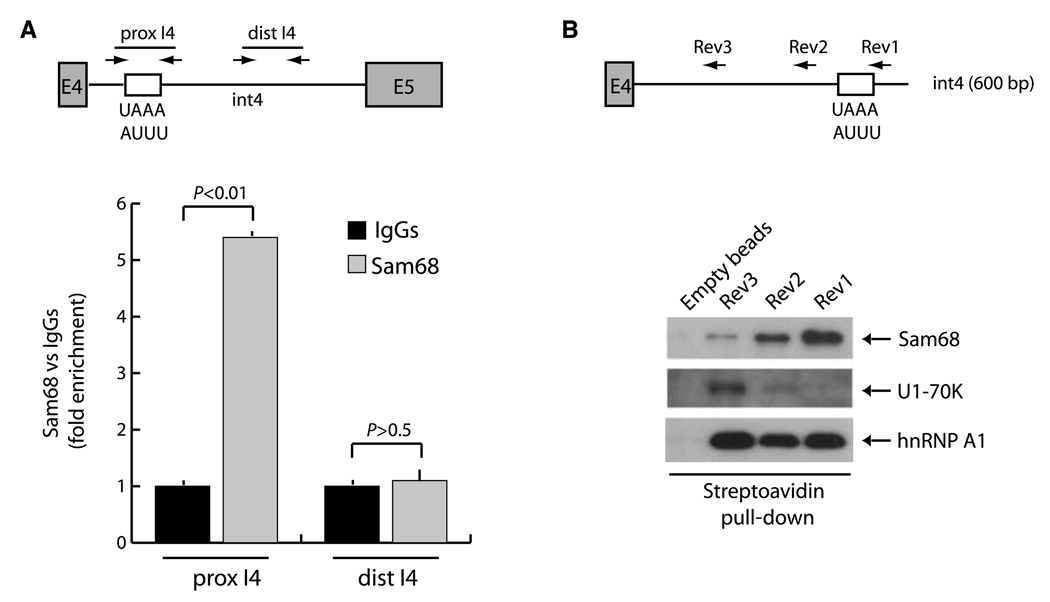
Sam68 binds to intron 4 sequences in the cyclin D1 pre-mRNA. A, scheme of the CCND1 gene comprised between exon 4 (E4) and exon 5 (E5). White box, position of the Sam68-binding sites in intron 4 (int4). Arrows, genomic regions amplified in the ChIP experiment. Cross-linked chromatin derived from LNCaP cells was immunoprecipitated and analyzed by quantitative real-time PCR using the indicated primers as described in Fig. 1. Columns, mean of three independent experiments; bars, SD. P values of Student's t test are reported. B, pull-down assays of Sam68, U1-70K, and hnRNP A1 with biotinylated RNA containing CCND1 exon 4 and different regions of intron 4 with (Rev1) or without (Rev2 and Rev3) the potential Sam68-binding sites. The proteins pulled down with the RNAs were analyzed by Western blot with antibodies for Sam68, U1-70K, or hnRNP A1.
Figure 5
Figure 5
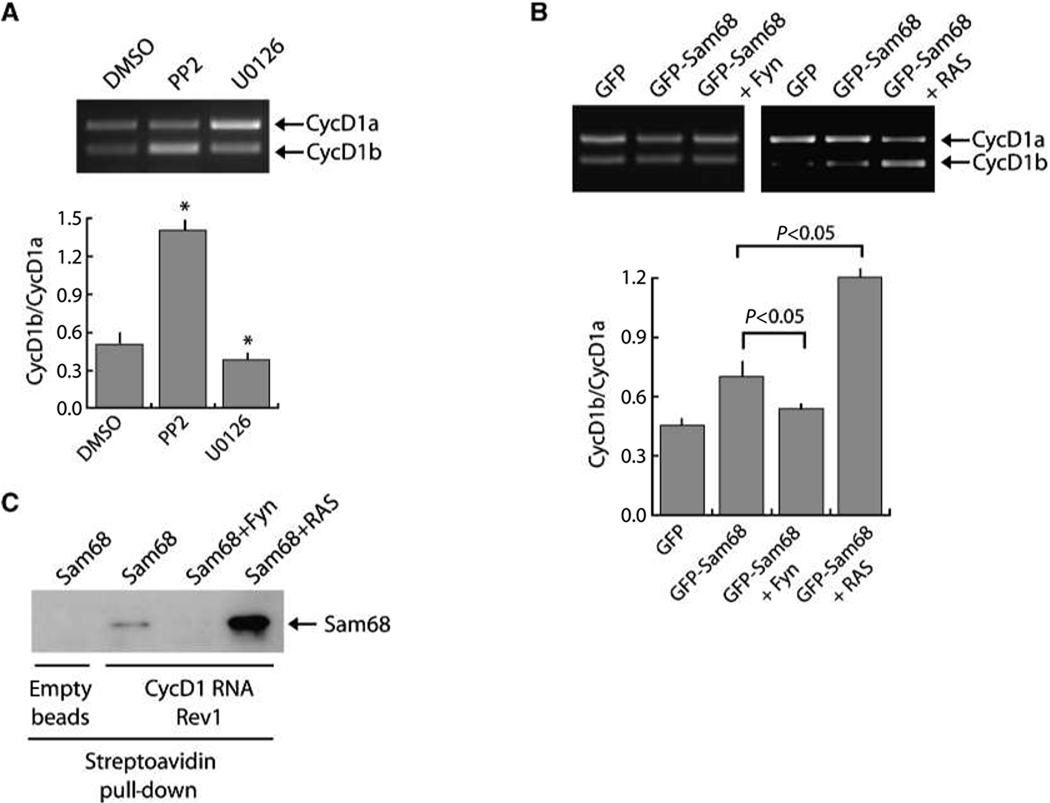
RAS/ERKs and Src-related kinases modulate Sam68-dependent AS of cyclin D1. A, PC3 cells were transfected with the CCND1 minigene and treated for 12 h with the Src inhibitor PP2 or the MEK1/2 inhibitor U0126. Cells were harvested after the treatment, RNA was extracted, and RT-PCR was performed. Columns, mean of the cyclin D1b/cyclin D1a ratio from three independent experiment; bars, SD. *, P < 0.05. B, in vivo splicing assay of cyclin D1 870G minigene in the presence of GFP-Sam68 coexpressed with Fyn or with RASL61Q, which stimulates the ERK1/2 pathway. Columns, mean of the cyclin D1b/D1a ratio from three independent experiments; bars, SD. P value is indicated above. C, pull-down assay with biotinylated RNA containing CCND1 exon 4 and the proximal 600 bases of intron 4 containing the potential Sam68-binding sites. HEK293T cells were transfected with Sam68 alone or together with Fyn or RASL61Q. Nuclear extracts prepared from the transfected cells were used for pull-down assays with biotinylated cyclin D1 RNA and bound proteins were analyzed by immunoblot for Sam68.
Figure 6
Figure 6
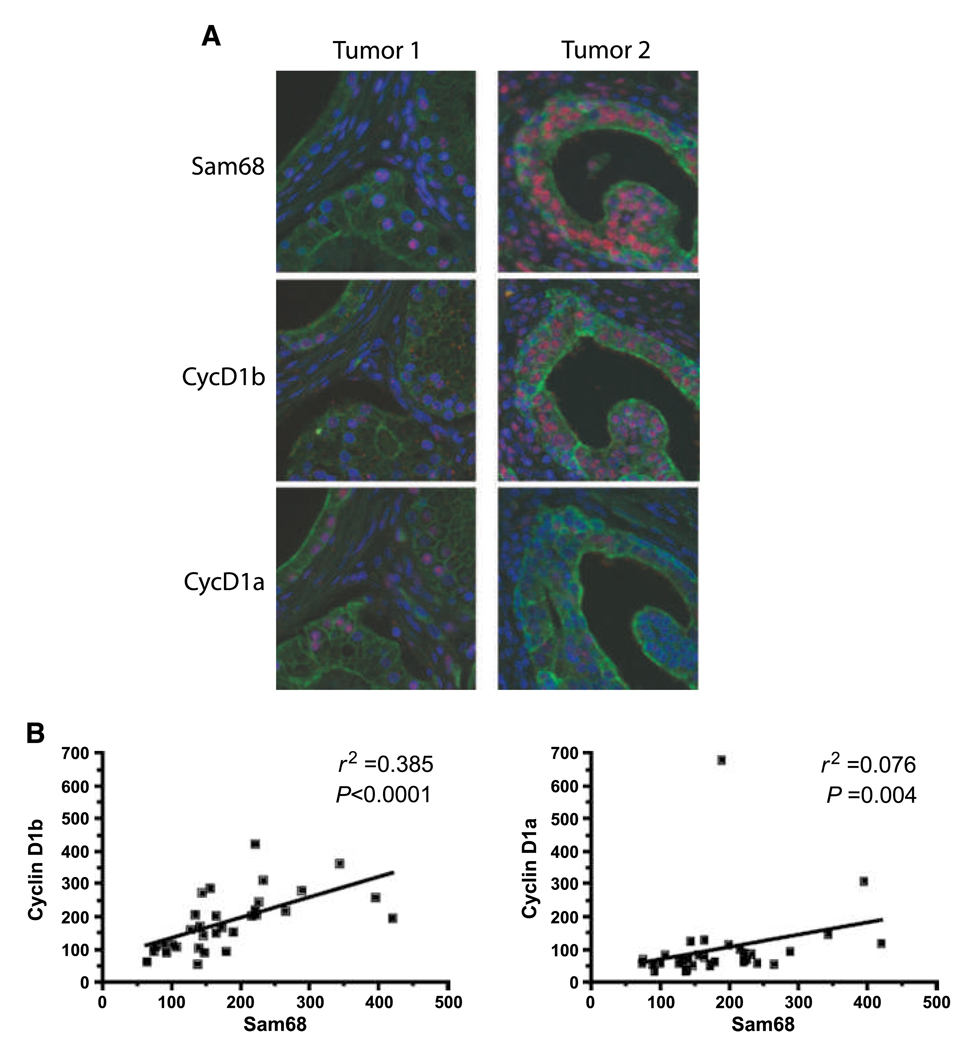
Sam68 correlates with cyclin D1b levels in human PCa. A, representative fluorescence-based immunohistochemistry for Sam68 (top), cyclin D1b (middle), and cyclin D1a (bottom) in serial sections from two human PCa specimens with low (Tumor 1) and high Sam68 (Tumor 2). Red fluorescence, Sam68, cyclin D1b, and cyclin D1a; green fluorescence, epithelial cytokeratin; blue fluorescence, 4′,6-diamidino-2-phenylindole–stained nuclei. B, correlation analysis between Sam68 and cyclin D1b (left) or cyclin D1a (right) using nuclear intensities obtained from cytokeratin-positive epithelia using the AQUA system. Linear regression analysis is indicated by an r2 value. Spearman correlation statistics are indicated by a P value.

References

    1. Feldman BJ, Feldman D. The development of androgen-independent prostate cancer. Nat Rev Cancer. 2001;1:34–45. - PubMed
    1. Li HR, Wang-Rodriguez J, Nair TM, et al. Two-dimensional transcriptome profiling: identification of messenger RNA isoform signatures in prostate cancer from archived paraffin-embedded cancer specimens. Cancer Res. 2006;66:4079–4088. - PubMed
    1. Zhang C, Li HR, Fan JB, et al. Profiling alternatively spliced mRNA isoforms for prostate cancer classification. BMC Bioinformatics. 2006;7:202–213. - PMC - PubMed
    1. Dehm SM, Schmidt LJ, Heemers HV, Vessella RL, Tindall DJ. Splicing of a novel androgen receptor exon generates a constitutively active androgen receptor that mediates prostate cancer therapy resistance. Cancer Res. 2008;68:5469–5477. - PMC - PubMed
    1. Hu R, Dunn TA, Wei S, et al. Ligand-independent androgen receptor variants derived from splicing of cryptic exons signify hormone-refractory prostate cancer. Cancer Res. 2009;69:16–22. - PMC - PubMed

Publication types

MeSH terms