


Class III beta-tubulin expression and in vitro resistance to microtubule targeting agents
- PMID: 20029418
- PMCID: PMC2816659
- DOI: 10.1038/sj.bjc.6605489
Class III beta-tubulin expression and in vitro resistance to microtubule targeting agents
Abstract
Background: Class III beta-tubulin overexpression is a marker of resistance to microtubule disruptors in vitro, in vivo and in the clinic for many cancers, including breast cancer. The aims of this study were to develop a new model of class III beta-tubulin expression, avoiding the toxicity associated with chronic overexpression of class III beta-tubulin, and study the efficacy of a panel of clinical and pre-clinical drugs in this model.
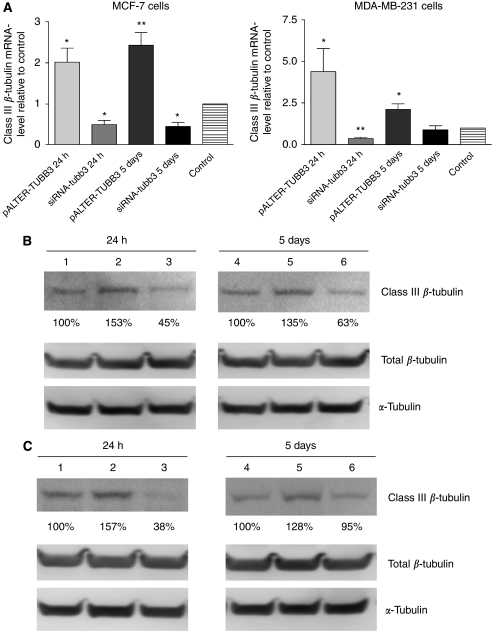
Methods: MCF-7 (ER+ve) and MDA-MB-231 (ER-ve) were either transfected with pALTER-TUBB3 or siRNA-tubb3 and 24 h later exposed to test compounds for a further 96 h for proliferation studies. RT-PCR and immunoblotting were used to monitor the changes in class III beta-tubulin mRNA and protein expression.
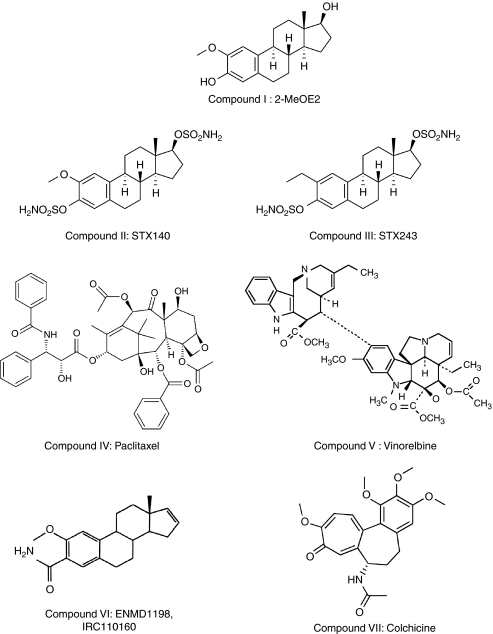
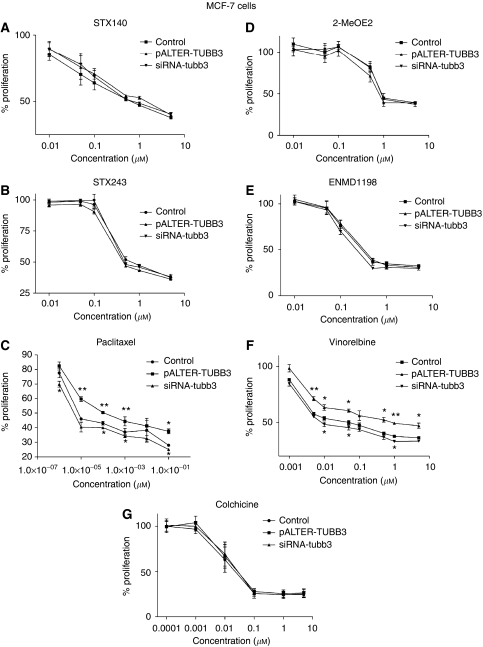
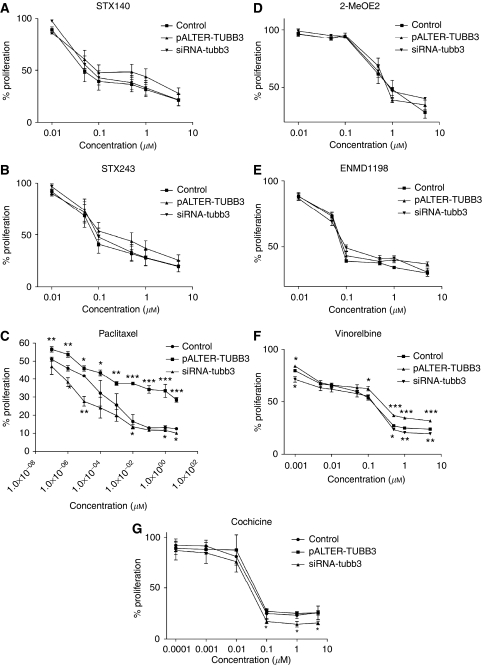
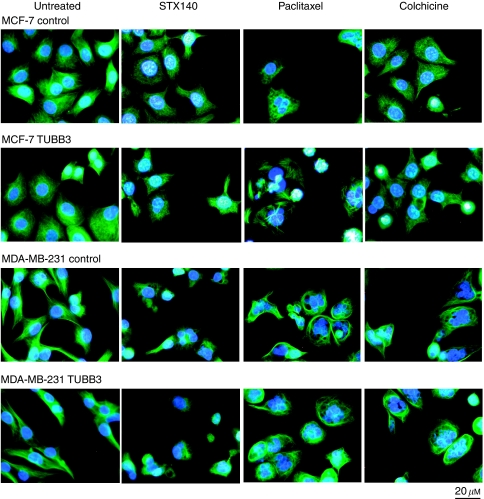
Results: The model allowed for subtle changes in class III beta-tubulin expression to be achieved, which had no direct effect on the viability of the cells. Class III beta-tubulin overexpression conferred resistance to paclitaxel and vinorelbine, whereas downregulation of class III beta-tubulin rendered cells more sensitive to these two drugs. The efficacy of the colchicine-site binding agents, 2-MeOE2, colchicine, STX140, ENMD1198 and STX243 was unaffected by the changes in class III beta-tubulin expression.
Conclusion: These data indicate that the effect of class III beta-tubulin overexpression may depend on where the drug's binding site is located on the tubulin. Therefore, this study highlights for the first time the potential key role of targeting the colchicine-binding site, to develop new treatment modalities for taxane-refractory breast cancer.
Figures
References
-
- Correnti M, Cavazza ME, Guedez N, Herrera O, Suarez-Chacon NR (1995) Expression of the multidrug-resistance (MDR) gene in breast cancer. J Chemother 7: 449–451 - PubMed
-
- Ferlini C, Raspaglio G, Mozzetti S, Cicchillitti L, Filippetti F, Gallo D, Fattorusso C, Campiani G, Scambia G (2005) The seco-taxane IDN5390 is able to target class III beta-tubulin and to overcome paclitaxel resistance. Cancer Res 65: 2397–2405 - PubMed
-
- Foster PA, Stengel C, Ali T, Leese MP, Potter BVL, Reed MJ, Purohit A, Newman SP (2008) A comparison of two orally bioavailable anti-cancer agents, IRC-110160 and STX140. Anticancer Res 28: 1483–1491 - PubMed
-
- Gan PP, Pasquier E, Kavallaris M (2007) Class III beta-tubulin mediates sensitivity to chemotherapeutic drugs in non small cell lung cancer. Cancer Res 67: 9356–9363 - PubMed
-
- Giannakakou P, Sackett DL, Kang YK, Zhan Z, Buters JT, Fojo T, Poruchynsky MS (1997) Paclitaxel-resistant human ovarian cancer cells have mutant beta-tubulins that exhibit impaired paclitaxel-driven polymerization. J Biol Chem 272: 17118–17125 - PubMed
Publication types
MeSH terms
Substances
LinkOut - more resources
Full Text Sources
Other Literature Sources
Miscellaneous
