


CASK mutations are frequent in males and cause X-linked nystagmus and variable XLMR phenotypes
- PMID: 20029458
- PMCID: PMC2987321
- DOI: 10.1038/ejhg.2009.220
CASK mutations are frequent in males and cause X-linked nystagmus and variable XLMR phenotypes
Erratum in
- Eur J Hum Genet. 2010 May;18(5):552
Abstract
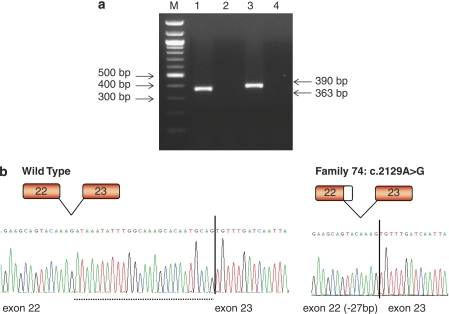
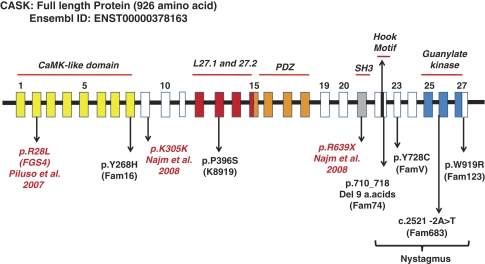
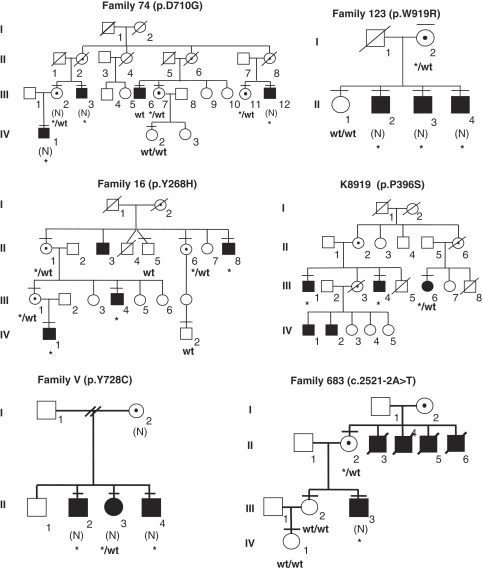
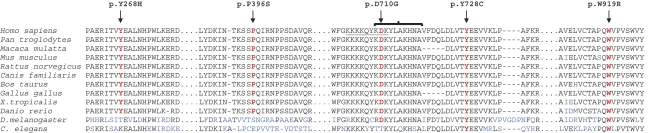
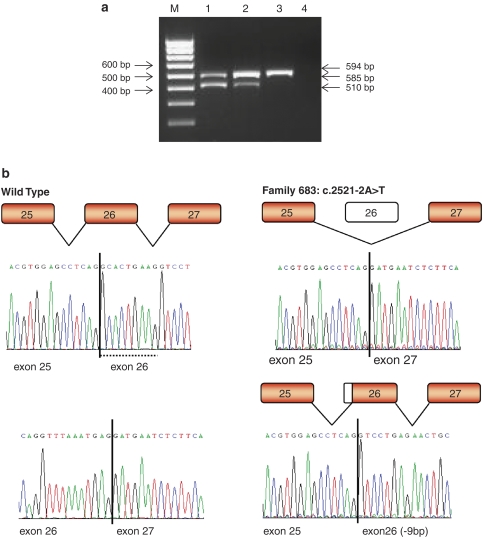
Mutations of the calcium/calmodulin-dependent serine protein kinase (CASK) gene have recently been associated with X-linked mental retardation (XLMR) with microcephaly, optic atrophy and brainstem and cerebellar hypoplasia, as well as with an X-linked syndrome having some FG-like features. Our group has recently identified four male probands from 358 probable XLMR families with missense mutations (p.Y268H, p.P396S, p.D710G and p.W919R) in the CASK gene. Congenital nystagmus, a rare and striking feature, was present in two of these families. We screened a further 45 probands with either nystagmus or microcephaly and mental retardation (MR), and identified two further mutations, a missense mutation (p.Y728C) and a splice mutation (c.2521-2A>T) in two small families with nystagmus and MR. Detailed clinical examinations of all six families, including an ophthalmological review in four families, were undertaken to further characterise the phenotype. We report on the clinical features of 24 individuals, mostly male, from six families with CASK mutations. The phenotype was variable, ranging from non-syndromic mild MR to severe MR associated with microcephaly and dysmorphic facial features. Carrier females were variably affected. Congenital nystagmus was found in members of four of the families. Our findings reinforce the CASK gene as a relatively frequent cause of XLMR in females and males. We further define the phenotypic spectrum and demonstrate that affected males with missense mutations or in-frame deletions in CASK are frequently associated with congenital nystagmus and XLMR, a striking feature not previously reported.
Figures

References
-
- Dimitratos SD, Stathakis DG, Nelson CA, Woods DF, Bryant PJ. The location of human CASK at Xp11.4 identifies this gene as a candidate for X-linked optic atrophy. Genomics. 1998;51:308–309. - PubMed
-
- Froyen G, Van Esch H, Bauters M, et al. Detection of genomic copy number changes in patients with idiopathic mental retardation by high-resolution X-array-CGH: important role for increased gene dosage of XLMR genes. Hum Mutat. 2007;28:1034–1042. - PubMed
-
- Hayashi S, Mizuno S, Migita O, et al. The CASK gene harbored in a deletion detected by array-CGH as a potential candidate for a gene causative of X-linked dominant mental retardation. Am J Med Genet A. 2008;146A:2145–2151. - PubMed
-
- Najm J, Horn D, Wimplinger I, et al. Mutations of CASK cause an X-linked brain malformation phenotype with microcephaly and hypoplasia of the brainstem and cerebellum. Nat Genet. 2008;40:1065–1067. - PubMed
Publication types
MeSH terms
Substances
Grants and funding
LinkOut - more resources
Full Text Sources
Medical
