. 2010 Jan;85(1):29-35.
doi: 10.1002/ajh.21572.

Genetic modifiers of the severity of sickle cell anemia identified through a genome-wide association study

Affiliations

Genetic modifiers of the severity of sickle cell anemia identified through a genome-wide association study

Paola Sebastiani et al. Am J Hematol. 2010 Jan.

Abstract

We conducted a genome-wide association study (GWAS) to discover single nucleotide polymorphisms (SNPs) associated with the severity of sickle cell anemia in 1,265 patients with either "severe" or "mild" disease based on a network model of disease severity. We analyzed data using single SNP analysis and a novel SNP set enrichment analysis (SSEA) developed to discover clusters of associated SNPs. Single SNP analysis discovered 40 SNPs that were strongly associated with sickle cell severity (odds for association >1,000); of the 32 that we could analyze in an independent set of 163 patients, five replicated, eight showed consistent effects although failed to reach statistical significance, whereas 19 did not show any convincing association. Among the replicated associations are SNPs in KCNK6 a K(+) channel gene. SSEA identified 27 genes with a strong enrichment of significant SNPs (P < 10(-6)); 20 were replicated with varying degrees of confidence. Among the novel findings identified by SSEA is the telomere length regulator gene TNKS. These studies are the first to use GWAS to understand the genetic diversity that accounts the phenotypic heterogeneity sickle cell anemia as estimated by an integrated model of severity. Additional validation, resequencing, and functional studies to understand the biology and reveal mechanisms by which candidate genes might have their effects are the future goals of this work.


Figures

Figure 1
Figure 1
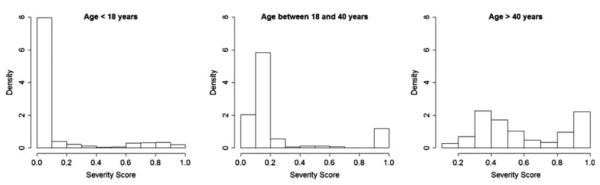
Distribution of the severity score in patients of the CSSCD. The three histograms show the different distribution of disease severity score in three age groups (655 patients, age < 18; 504 ages between 18 and 40 years, and 150 patients, age 40 and older). Note that each y-axis reports the density, so that the area of each bar is the relative frequency of patients with score within the limits in the x-axis.
Figure 2
Figure 2
Display of the principal components 1 and 2 that capture the largest amount of genetic variability in the subjects of the discovery and validation sets. The total overlapping of principal components 1 (PC1, x-axis) and 2 (PC2, y-axis) in subjects of the discovery set (CSSCD) and validation set (BMC and Duke) shows that the subjects in the two sets have similar genetic diversity. [Color figure can be viewed in the online issue, which is available at www.interscience.wiley.com.]
Figure 3
Figure 3
Manhattan plot displaying the log10 (Bayes Factor) for the GWAS of severity of sickle cell disease. We tested the association of each SNP with severity of sickle cell disease using general, allelic, dominant, and recessive models. The x-axis reports the physical positions of SNPs in chromosomes 1–22, and the y-axis reports the maximum log10 Bayes factor observed for each SNP. Genome-wide significant is met with a Bayes factor >1,000 (log10 Bayes factor >3). [Color figure can be viewed in the online issue, which is available at www.interscience.wiley.com.]
Figure 4
Figure 4
LD heatmap of the gene TNKS, using the HapMap Yoruban. Red stars denote the SNPs that are associated with SCA severity. The heatmap displays the estimate of LD using D’ and was produced using the software Haploview and the data from HapMap Yorubans. [Color figure can be viewed in the online issue, which is available at www.interscience.wiley.com.]

References

    1. Kato GJ, Gladwin MT, Steinberg MH. Deconstructing sickle cell disease: Reappraisal of the role of hemolysis in the development of clinical subphenotypes. Blood Rev. 2007;21:37–47. - PMC - PubMed
    1. Serjeant GR, Higgs DR, Hambleton IR. Elderly survivors with homozygous sickle cell disease. N Engl J Med. 2007;356:642–643. - PubMed
    1. Taylor JG, VI, Nolan VG, Mendelsohn L, et al. Chronic hyper-hemolysis in sickle cell anemia: Association of vascular complications and mortality with less frequent vasoocclusive pain. PLoS ONE. 2008;3:e2095. - PMC - PubMed
    1. Platt OS, Brambilla DJ, Rosse WF, et al. Mortality in sickle cell disease. Life expectancy and risk factors for early death. N Engl J Med. 1994;330:1639–1644. - PubMed
    1. Sebastiani P, Nolan VG, Baldwin CT, et al. A network model to predict the risk of death in sickle cell disease. Blood. 2007;110:2727–2735. - PMC - PubMed

Publication types