


Meningitis and a febrile vomiting illness caused by echovirus type 4, Northern Territory, Australia
- PMID: 20031044
- PMCID: PMC2874345
- DOI: 10.3201/eid1601.081519
Meningitis and a febrile vomiting illness caused by echovirus type 4, Northern Territory, Australia
Abstract
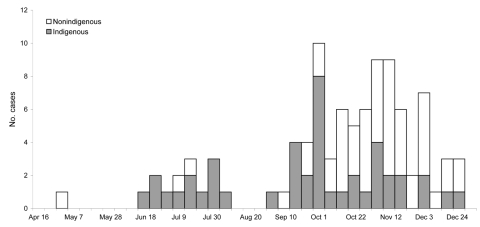
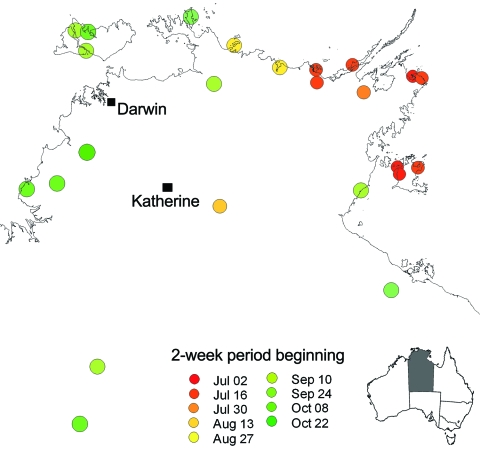
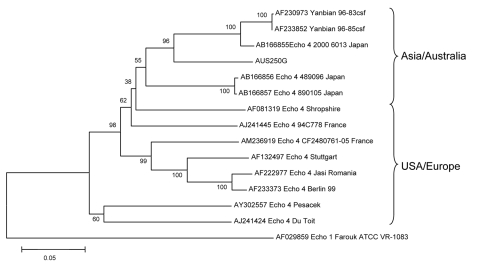
In July 2007, a cluster of meningitis cases caused by an echovirus 4 strain was detected in 1 indigenous community in the Top End of the Northern Territory of Australia. Illness was characterized by fever, vomiting, and headache. Over the next 4 months, additional cases of meningitis and the fever and vomiting syndrome emerged in other indigenous communities and subsequently in the major urban center of Darwin. We describe the epidemiology of 95 laboratory-confirmed meningitis cases and conclude that the epidemic fever and vomiting syndrome was caused by the same enterovirus. Nucleotide sequencing of the whole genome verified this enterovirus (AUS250G) as a strain of echovirus type 4. Viral protein 1 nucleotide sequencing demonstrated 96% homology with an echovirus 4 strain responsible for a large outbreak of meningitis in the Yanbian Prefecture of China in 1996.
Figures
References
-
- Khetsuriani N, Lamonte-Fowlkes A, Oberst S, Pallansch MA. Enterovirus surveillance—United States, 1970–2005. MMWR Surveill Summ. 2006;55(No. SS-8). - PubMed
-
- Chen L, Zhang L, Hou X, Li J. Complete nucleotide sequence of new enterovirus isolated from the cerebrospinal fluid of meningoencephalitis patients. Chin J Virol. 2000;164:289–93.
-
- Australian Bureau of Statistics. Census quickstats by location [cited 2007 Oct 15]. Available from http://www.abs.gov.au/websitedbs/d3310114.nsf/Home/census
MeSH terms
Associated data
- Actions
LinkOut - more resources
Full Text Sources
Medical
Research Materials