


Telomere length and cognitive function in community-dwelling elders: findings from the Health ABC Study
- PMID: 20031273
- PMCID: PMC2916948
- DOI: 10.1016/j.neurobiolaging.2009.12.006
Telomere length and cognitive function in community-dwelling elders: findings from the Health ABC Study
Abstract
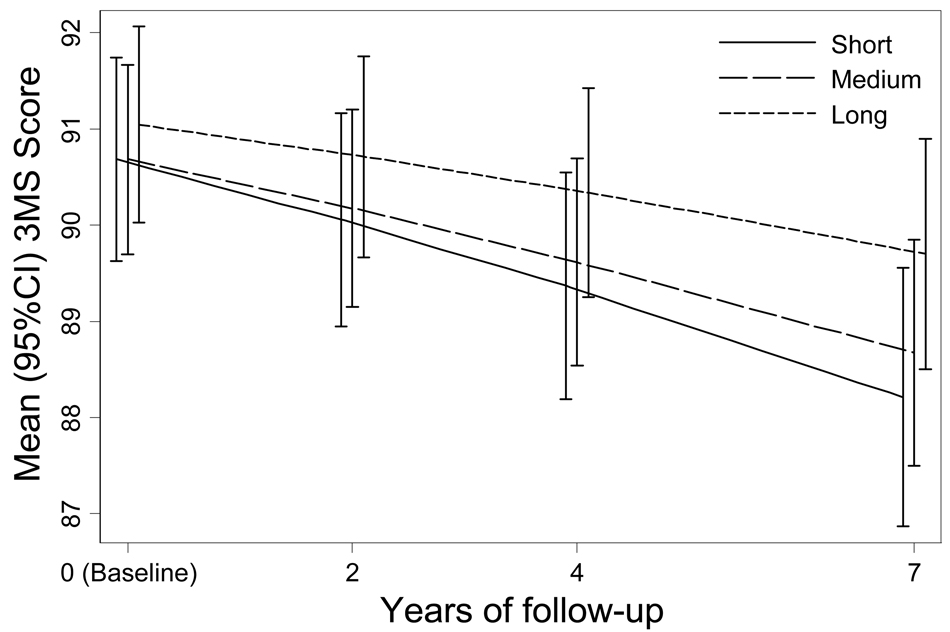
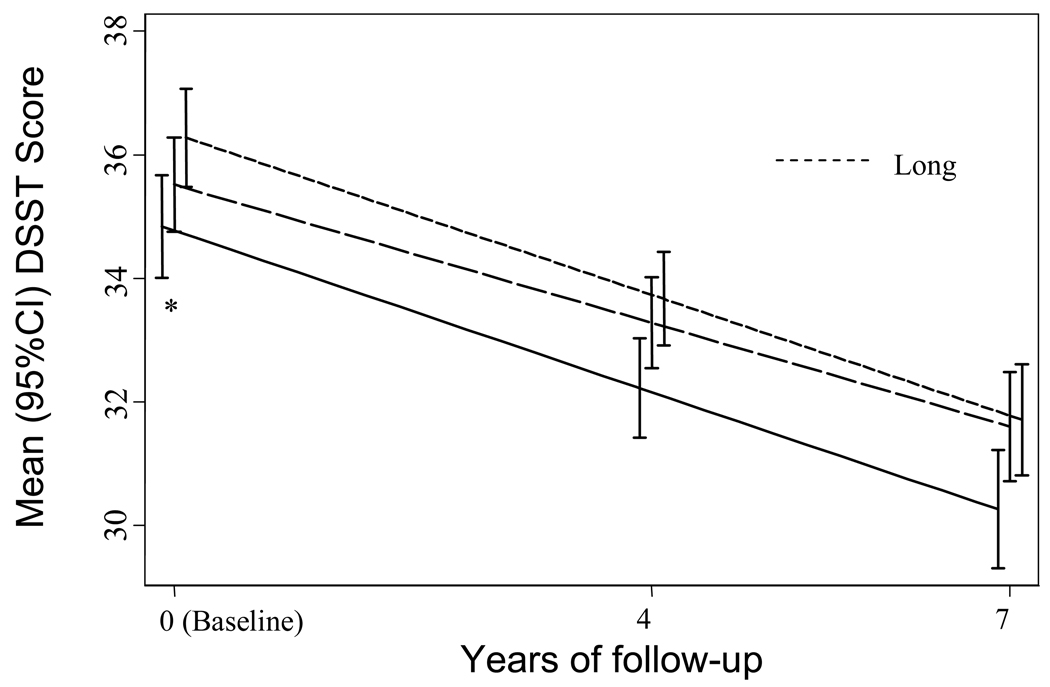
Telomere shortening is a marker of cellular aging and has been associated with risk of Alzheimer's disease. Few studies have determined if telomere length is associated with cognitive decline in non-demented elders. We prospectively studied 2734 non-demented elders (mean age: 74 years). We measured cognition with the Modified Mini-Mental State Exam (3MS) and Digit Symbol Substitution Test (DSST) repeatedly over 7 years. Baseline telomere length was measured in blood leukocytes and classified by tertile as "short", "medium", or "long". At baseline, longer telomere length was associated with better DSST score (36.4, 34.9 and 34.4 points for long, medium and short, p<0.01) but not for change in score. However, 7-year 3MS change scores were less among those with longer telomere length (-1.7 points vs. -2.5 and -2.9, p=0.01). Findings were similar after multivariable adjustment for age, gender, race, education, assay batch, and baseline score. There was a borderline statistically significant interaction for telomere length and APOE e4 on 3MS change score (p=0.06). Thus, telomere length may serve as a biomarker for cognitive aging.
Published by Elsevier Inc.
Conflict of interest statement
The authors declare not conflicts of interest.
Figures
References
-
- Aviv A. Telomeres and human somatic fitness. J Gerontol A Biol Sci Med Sci. 2006;61(8):871–873. - PubMed
-
- Barnham KJ, Masters CL, Bush AI. Neurodegenerative diseases and oxidative stress. Nat Rev Drug Discov. 2004;3:205–214. - PubMed
-
- Bekaert S, De Meyer T, Rietzschel ER, De Buyzere ML, De Bacquer D, Langlois M, Segers P, Cooman L, Van Damme P, Cassiman P, Van Criekinge W, Verdonck P, DeBacker GG, Gillebert TC, Van Oostveldt P. Telomere length and cardiovascular risk factors in a middle-aged population free of overt cardiovascular disease. Aging Cell. 2007;6:639–647. - PubMed
-
- Benetos A, Gardner JP, Zureik M, Labat C, Xiaobin L, Adamopoulos C, Temmar M, Bean KE, Thomas F, Aviv A. Short telomeres are associated with increased carotid atherosclerosis in hypertensive subjects. Hypertension. 2004;43(2):182–185. - PubMed
Publication types
MeSH terms
Grants and funding
LinkOut - more resources
Full Text Sources
Medical
Miscellaneous
