


The FTO gene is associated with an atherogenic lipid profile and myocardial infarction in patients with type 2 diabetes: a Genetics of Diabetes Audit and Research Study in Tayside Scotland (Go-DARTS) study
- PMID: 20031593
- PMCID: PMC3045745
- DOI: 10.1161/CIRCGENETICS.108.822320
The FTO gene is associated with an atherogenic lipid profile and myocardial infarction in patients with type 2 diabetes: a Genetics of Diabetes Audit and Research Study in Tayside Scotland (Go-DARTS) study
Abstract
Background: Common variation in the fat mass and obesity (FTO)-related gene is associated with increased body fat and susceptibility to type 2 diabetes. We hypothesized that this would also associate with metabolic phenotypes of insulin resistance and increased risk of cardiovascular morbidity and mortality.
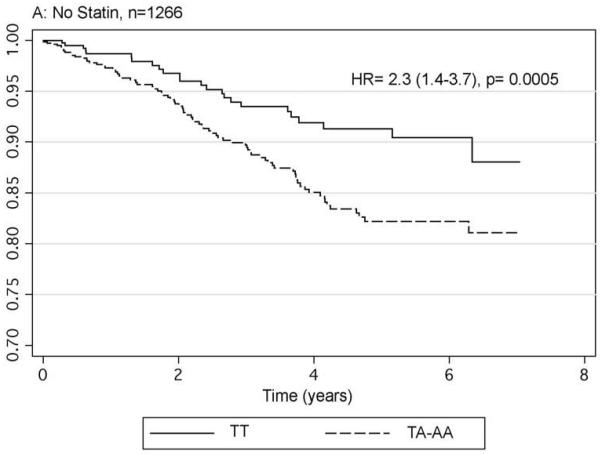
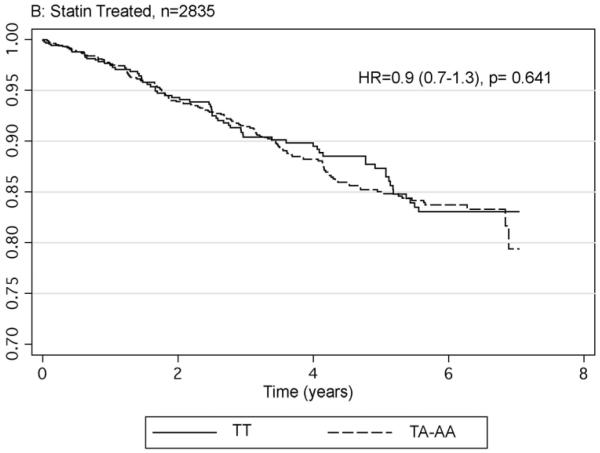
Methods and results: FTO rs9939609 genotype was determined in 4897 patients with type 2 diabetes in the prospective Genetics of Diabetes Audit and Research Study in Tayside Scotland study. The A allele was associated with lower plasma high-density lipoprotein cholesterol (mean difference, 0.03 mmol/L; P=0.008), higher triglycerides (0.1 mmol/L, P=0.007), higher atherogenic index of plasma (0.03, P=0.003), and, as expected, increased body mass index (0.77 kg/m(2), P=8.8 x 10(-6)). During a mean follow-up of 3.6 years, the A allele was also associated with increased risk (hazard ratio, 2.36; CI, 1.49 to 3.74; P=0.0002) of fatal and nonfatal myocardial infarction (total of 324 events) in a model, including baseline age, gender, prevalent myocardial infarction, smoking status, statin, and insulin use. This association diminished but remained significant when obesity-related traits, such as body mass index, glycohemoglobin, and lipid parameters, were also included (hazard ratio, 2.01; CI, 1.18 to 3.45, P=0.011). There was a strong interaction of FTO genotype and statin use and cardiovascular outcome (P=0.001), such that cardiovascular morbidity and mortality was completely abrogated in individuals who were prescribed statins.
Conclusions: The increased fat mass in carriers of the A allele of rs9939609 of FTO is associated not only with increased risk of type 2 diabetes, but also with an increase in atherogenic lipid profile and myocardial infarction in these patients. This variant may, therefore, in the future contribute to more effective targeting of specific preventative therapy.
Figures
References
-
- Petrelli JM, Calle EE, Rodriguez C, Thun MJ. Body mass index, height, and postmenopausal breast cancer mortality in a prospective cohort of US women. Cancer Causes Control. 2002;13:325–32. - PubMed
-
- Frayling TM, Timpson NJ, Weedon MN, Zeggini E, Freathy RM, Lindgren CM, Perry JR, Elliott KS, Lango H, Rayner NW, Shields B, Harries LW, Barrett JC, Ellard S, Groves CJ, Knight B, Patch AM, Ness AR, Ebrahim S, Lawlor DA, Ring SM, Ben-Shlomo Y, Jarvelin MR, Sovio U, Bennett AJ, Melzer D, Ferrucci L, Loos RJ, Barroso I, Wareham NJ, Karpe F, Owen KR, Cardon LR, Walker M, Hitman GA, Palmer CN, Doney AS, Morris AD, Smith GD, Hattersley AT, McCarthy MI. A common variant in the FTO gene is associated with body mass index and predisposes to childhood and adult obesity. Science. 2007;316:889–94. - PMC - PubMed
-
- Scuteri A, Sanna S, Chen WM, Uda M, Albai G, Strait J, Najjar S, Nagaraja R, Orru M, Usala G, Dei M, Lai S, Maschio A, Busonero F, Mulas A, Ehret GB, Fink AA, Weder AB, Cooper RS, Galan P, Chakravarti A, Schlessinger D, Cao A, Lakatta E, Abecasis GR. Genome-Wide Association Scan Shows Genetic Variants in the FTO Gene Are Associated with Obesity-Related Traits. PLoS Genet. 2007;3:e115. - PMC - PubMed
-
- Dina C, Meyre D, Gallina S, Durand E, Korner A, Jacobson P, Carlsson LM, Kiess W, Vatin V, Lecoeur C, Delplanque J, Vaillant E, Pattou F, Ruiz J, Weill J, Levy-Marchal C, Horber F, Potoczna N, Hercberg S, Le Stunff C, Bougneres P, Kovacs P, Marre M, Balkau B, Cauchi S, Chevre JC, Froguel P. Variation in FTO contributes to childhood obesity and severe adult obesity. Nat Genet. 2007;39:724–6. - PubMed
Publication types
MeSH terms
Substances
Grants and funding
LinkOut - more resources
Full Text Sources
Medical
