


Co-administration of fluconazole increases nevirapine concentrations in HIV-infected Ugandans
- PMID: 20032007
- PMCID: PMC2809247
- DOI: 10.1093/jac/dkp451
Co-administration of fluconazole increases nevirapine concentrations in HIV-infected Ugandans
Abstract
Background: Data from retrospective studies have suggested that there may be an interaction between fluconazole and nevirapine, increasing nevirapine concentrations and potentially leading to hepatotoxicity.
Methods: This study was nested within a large double-blind placebo-controlled study designed to determine if primary prophylaxis with fluconazole (200 mg three times per week) could reduce cryptococcal disease [CRYPTOPRO (ISRCTN 76481529)] in HIV-infected adults in rural south-western Uganda. Detailed pharmacokinetic studies were performed on 49 participants (22 on placebo and 27 on fluconazole) who had been on fluconazole or placebo with nevirapine for > or =4 weeks.
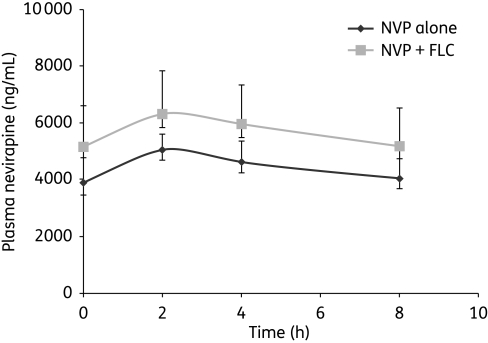
Results: The geometric mean pre-dose concentrations of nevirapine were 3865 ng/mL [95% confidence interval (95% CI) 3452-4758 ng/mL] and 5141 ng/mL (95% CI 4760-6595 ng/mL) (P = 0.009) in the placebo and fluconazole arms, respectively. The change in the peak nevirapine concentration in plasma (C(max)) was also higher in the fluconazole arm compared with the placebo arm [median 6546 (95% CI 6040-7974) versus 5126 (95% CI 4739-5773) ng/mL, P = 0.012]. Fluconazole increased the nevirapine area under the curve (AUC) from 0 to 8 h by 29% [geometric mean AUC(0-8) 46 135 (95% CI 42 432-57 173) versus 35 871 (95% CI 32 808-41 372) ng.h/mL, P = 0.016]. In the larger cohort from which the participants were drawn, co-administration of fluconazole did not increase the risk of hepatotoxicity.
Conclusions: Fluconazole led to significant increases in nevirapine exposure, but was not associated with evidence of increased hepatotoxicity.
Figures
References
-
- Parkes-Ratanshi R, Kamali A, Wakeham K, et al. Successful primary prevention of cryptococcal disease using fluconazole prophylaxis in HIV-infected Ugandan adults. Abstracts of the Sixteenth Conference on Retroviruses and Opportunistic Infections; 2009; Montreal. Abstract P-32. Foundation for Retrovirology and Human Health, Alexandria, VA, USA.
-
- Bruggemann RJ, Alffenaar JW, Blijlevens NM, et al. Clinical relevance of the pharmacokinetic interactions of azole antifungal drugs with other coadministered agents. Clin Infect Dis. 2009;48:1441–58. - PubMed
-
- Wen B, Chen Y, Fitch WL. Metabolic activation of nevirapine in human liver microsomes: dehydrogenation and inactivation of cytochrome P450 3A4. Drug Metab Dispos. 2009;37:1557–62. - PubMed
-
- Manosuthi W, Sungkanuparph S, Tansuphaswadikul S, et al. Incidence and risk factors of nevirapine-associated severe hepatitis among HIV-infected patients with CD4 cell counts less than 250 cells/microL. J Med Assoc Thai. 2008;91:159–65. - PubMed
-
- World Health Organization. Antiretroviral Therapy for HIV Infection in Adults and Adolescents: Recommendations for a Public Health Approach, 2006 Revision. http://www.who.int/hiv/pub/guidelines/artadultguidelines.pdf. (18 November 2009, date last accessed) - PubMed
Publication types
MeSH terms
Substances
Associated data
Grants and funding
LinkOut - more resources
Full Text Sources
Medical
