


Antidepressant pharmacotherapy in adults with type 2 diabetes: rates and predictors of initial response
- PMID: 20032276
- PMCID: PMC2827493
- DOI: 10.2337/dc09-1466
Antidepressant pharmacotherapy in adults with type 2 diabetes: rates and predictors of initial response
Abstract
OBJECTIVE Initial treatment with antidepressant medication is insufficiently effective in some patients with type 2 diabetes, and factors predicting treatment outcome are poorly understood. RESEARCH DESIGN AND METHODS Aggregate data from two published trials were analyzed to determine the rates and predictors of response to antidepressant pharmacotherapy in adults with type 2 diabetes using conventional markers of initial treatment outcome (improvement, response, partial remission, and remission). Three hundred eighty-seven patients who received up to 16 weeks of open-label, acute-phase treatment using bupropion (n = 93) or sertraline (n = 294) were studied. Logistic regression was used to identify predictors of poor treatment outcome. Candidate predictors included age, race, sex, initial Beck Depression Inventory (iBDI) score, treatment received (sertraline or bupropion), family history of depression, extant diabetes complications (eDC), and A1C level. RESULTS Of 387 patients initiated on treatment, 330 (85.3%) met criteria for improvement, 232 (59.9%) for response, 207 (53.5%) for partial remission, and 179 (46.3%) for full remission. Significant independent predictors of poor outcome included eDC (for no improvement); sertraline treatment, eDC, and younger age (for nonresponse); sertraline treatment, eDC, and higher iBDI (for failure to partially remit); and younger age and higher iBDI (for failure to fully remit). Higher pain scores predicted three of the four markers of poor outcome in the subset with pain data. CONCLUSIONS In patients with type 2 diabetes, poor initial response to antidepressant medication is predicted by multiple factors. Auxiliary treatment of pain and impairment may be required to achieve better outcomes.
Figures
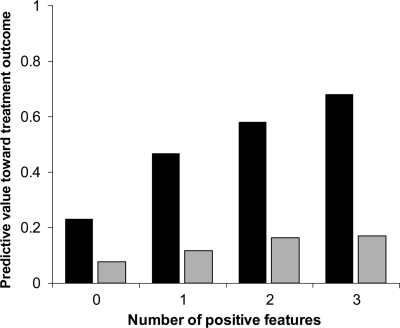
 ]) by cumulative number of the three features most often found to be significant in the regression analyses (presence of any diabetes complications, younger age [<50 years], and higher iBDI score [>23]). Patients without any of these features had a 23% chance of not remitting and an 8% chance of not improving. Presence of all three features had a positive predictive value of 68% for nonremission and 17% for nonimprovement.
References
-
- Anderson RJ, Freedland KE, Clouse RE, Lustman PJ: The prevalence of comorbid depression in adults with diabetes: a meta-analysis. Diabetes Care 2001;24:1069–1078 - PubMed
-
- Lustman PJ, Griffith LS, Clouse RE: Depression in adults with diabetes: results of a 5-year follow-up study. Diabetes Care 1988;11:605–612 - PubMed
-
- Lustman PJ, Anderson RJ, Freedland KE, de Groot M, Carney RM: Depression and poor glycemic control: a meta-analytic review of the literature. Diabetes Care 2000;23:434–442 - PubMed
-
- de Groot M, Anderson RJ, Freedland KE, Clouse RE, Lustman PJ: Association of depression and diabetes complications: a meta-analysis. Psychosom Med 2001;63:619–630 - PubMed
-
- Zhang X, Norris SL, Gregg EW, Cheng YJ, Beckles G, Kahn HS: Depressive symptoms and mortality among persons with and without diabetes. Am J Epidemiol 2005;161:652–660 - PubMed
Publication types
MeSH terms
Substances
LinkOut - more resources
Full Text Sources
Medical
Miscellaneous
