. 2010 Mar;77(6):519-26.
doi: 10.1038/ki.2009.501. Epub 2009 Dec 23.

Major contribution of tubular secretion to creatinine clearance in mice

Affiliations

Major contribution of tubular secretion to creatinine clearance in mice

Christoph Eisner et al. Kidney Int. 2010 Mar.

Abstract

This study was performed to quantify the fraction of excreted creatinine not attributable to creatinine filtration for accurately determining the glomerular filtration rate in mice. To measure this we compared creatinine filtration with the simultaneous measurement of inulin clearance using both single-bolus fluorescein isothiocyanate (FITC)-inulin elimination kinetics and standard FITC-inulin infusion. During anesthesia, creatinine filtration was found to be systematically higher than inulin clearance in both male and female C57BL/6J mice. The secretion fraction was significantly less in female mice. Administration of either cimetidine or para-aminohippuric acid, competitors of organic cation and anion transport respectively, significantly reduced the secretion fraction in male and female mice and both significantly increased the plasma creatinine level. Creatinine secretion in both genders was not mediated by the organic cation transporters OCT1 or OCT 2 since secretion fraction levels were identical in FVB wild-type and OCT1/2 knockout mice. Thus, secretion accounts for about 50 and 35% of excreted creatinine in male and female mice, respectively. Increasing plasma creatinine threefold by infusion further increased the secretion fraction. Renal organic anion transporter 1 mRNA expression was higher in male than in female mice, reflecting the gender difference in creatinine secretion. Hence we show that there is a major secretory contribution to creatinine excretion mediated through the organic anion transport system. This feature adds to problems associated with measuring endogenous creatinine filtration in mice.


Conflict of interest statement

DISCLOSURE

All the authors declare no competing interests.

Figures
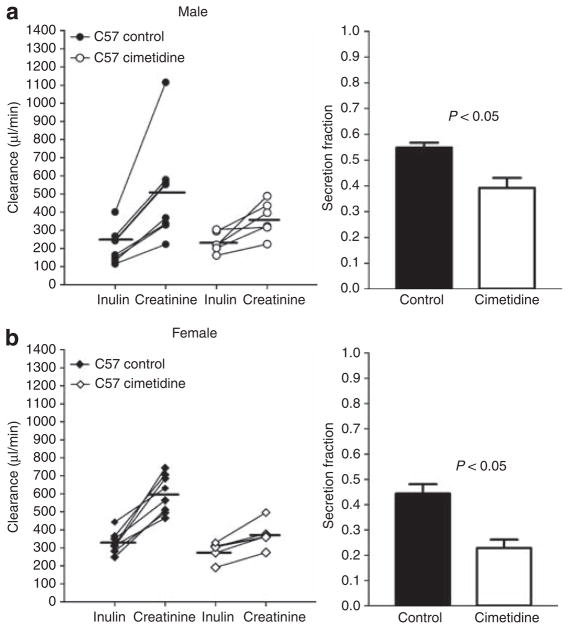
Figure 1
Figure 1. Inulin and creatinine clearances in male and female C57BL/6J mice: effect of cimetidine
Left: Comparison between the clearances of inulin and creatinine in male (a; n = 8) and female (b; n = 8) C57BL/6J mice without (closed symbols) and with cimetidine-treatment (open symbols). Lines connect simultaneous clearance measurements from individual animals; horizontal bars indicate mean values. Right: Secretion fractions calculated from the difference between creatinine and inulin clearances as indicated in Materials and Methods section.
Figure 2
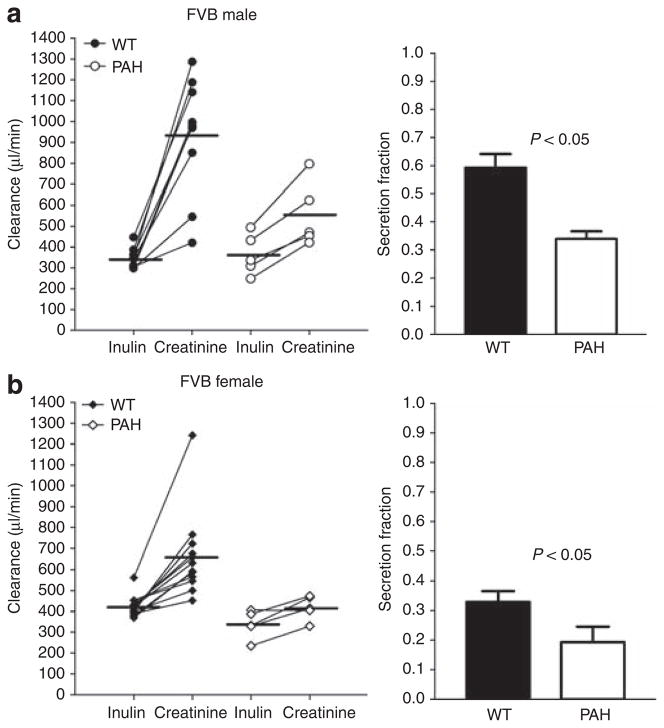
Figure 2. Measurements of the clearances of inulin (Cin) and creatinine (Ccr) in FVB wild-type mice without (closed symbols) and during PAH administration (open symbols)
(a) Male mice under control conditions (n = 9) and during PAH administration (n = 5) and calculated SFcr (bars on the right). (b) Female mice without treatment (n = 12) and with PAH treatment (n = 5) and calculated SFcr (bars on the right). Lines connect simultaneous clearance measurements from individual animals and horizontal bars are mean values.
Figure 3
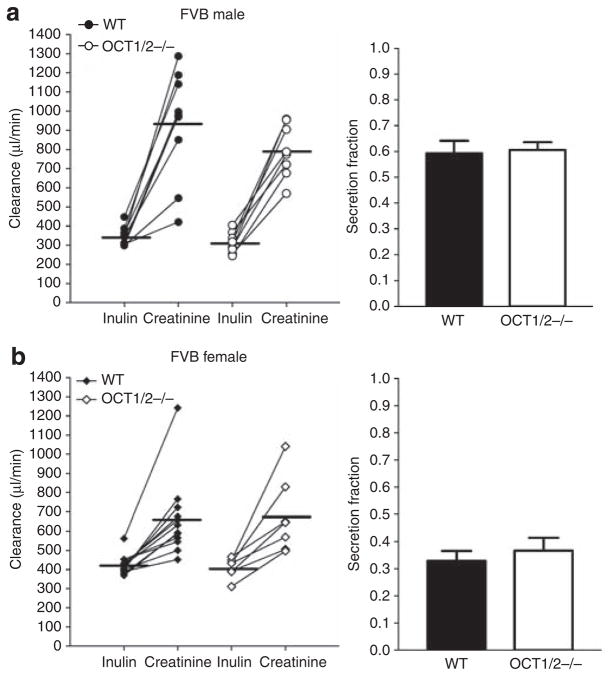
Figure 3. Comparison between the clearances of inulin and creatinine in FVB wild-type and Oct1/2 −/− mice
(a) Inulin and creatinine clearances in male WT (closed symbols; n = 9) and OCT1/2 −/− mice (open symbols; n = 8) and calculated secretion fractions (bars on the right). (b) Inulin and creatinine clearances in female WT (closed symbols; n = 12) and OCT1/2 −/− mice (open symbols; n = 7) and calculated secretion fractions (bars on the right). Lines connect simultaneous clearance measurements from individual animals and horizontal bars are mean values.
Figure 4
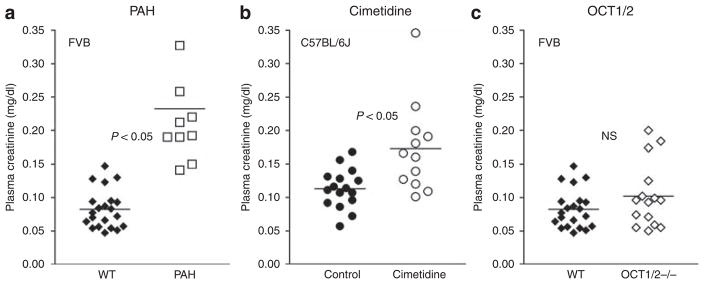
Figure 4. Effects of PAH, cimetidine, and genetic deletion of OCT1 and OCT2 on plasma creatinine concentration of FVB mice
(a) Plasma creatinine concentrations in FVB wild-type mice without (closed symbols; n = 21) and with PAH treatment (open symbols; n = 10); horizontal bars indicate mean values. (b) Plasma creatinine concentrations in C57BL/J wild-type mice (closed symbols; n = 16) before (control) and during treatment with cimetidine; horizontal bars indicate mean values. (c) Plasma creatinine concentrations in FVB wild-type mice (closed symbols; n = 21) and in OCT1/2 −/− (open symbols; n = 15); horizontal bars indicate mean values.
Figure 5
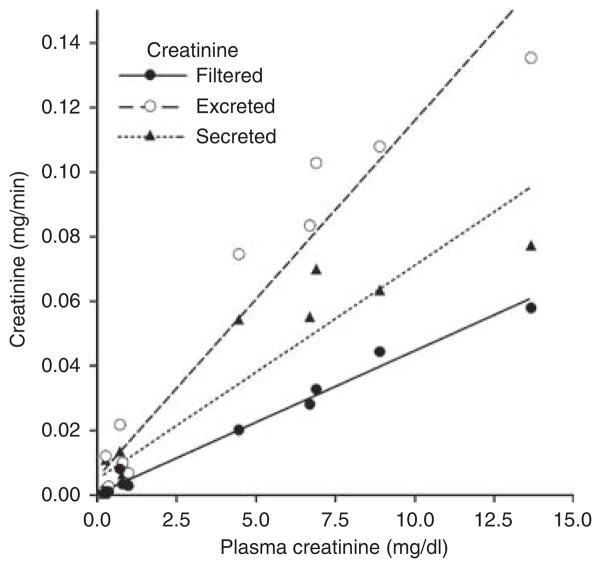
Figure 5. Relationship between plasma creatinine concentration and the filtered, excreted, and secreted amounts of creatinine in CD1 mice; plasma creatinine concentration was changed by infusion of creatinine at 5 μg/min (n = 5) and 50 μg/min (n = 5)
Lines represent linear regressions.
Figure 6
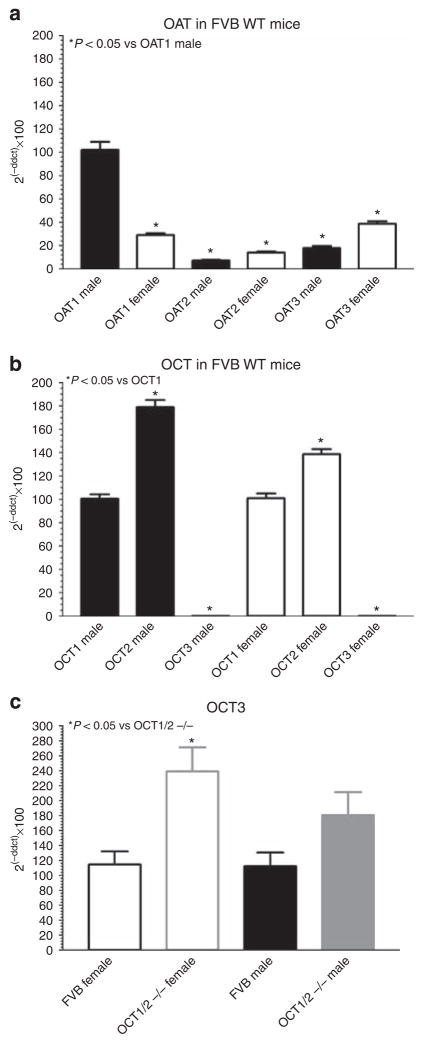
Figure 6. Expression of organic anion (OAT) and organic cation (OCT) transporter mRNA in male and female FVB mice
(a) OAT1, OAT2, and OAT3 mRNA quantification in male (closed bars; n = 9) and female FVB mice (open bars; n = 12); mRNA of OAT1 from male mice was used as reference point (100%). (b) OCT1, OCT2, and OCT3 mRNA quantification in male (closed bars; n = 9) and female FVB mice (open bars; n = 12); mRNA of OCT1 was set to 100%. (c) OCT3 mRNA quantification in FVB wild-type mice (female: black open bars, n = 12; male: black closed bar, n = 9) and OCT1/2 −/− mice (female: gray open bar, n = 7; male: gray closed bar, n = 8); mRNA of FVB wild-type mice was set to 100%.

Comment in

References

    1. Miller BF, Winkler AW. The renal excretion of endogenous creatinine in man. Comparison with exogenous creatinine and inulin. J Clin Invest. 1938;17:31–40. - PMC - PubMed
    1. Olsen NV, Ladefoged SD, Feldt-Rasmussen B, et al. The effects of cimetidine on creatinine excretion, glomerular filtration rate and tubular function in renal transplant recipients. Scand J Clin Lab Invest. 1989;49:155–159. - PubMed
    1. Sansoe G, Ferrari A, Castellana CN, et al. Cimetidine administration and tubular creatinine secretion in patients with compensated cirrhosis. Clin Sci (Lond) 2002;102:91–98. - PubMed
    1. Zaltzman JS, Whiteside C, Cattran DC, et al. Accurate measurement of impaired glomerular filtration using single-dose oral cimetidine. Am J Kidney Dis. 1996;27:504–511. - PubMed
    1. Lorenz JN, Gruenstein E. A simple, nonradioactive method for evaluating single-nephron filtration rate using FITC-inulin. Am J Physiol Renal Physiol. 1999;276:F172–F177. - PubMed

Publication types