


Comment
doi: 10.1038/462992b.
Structural biology: Translocation chamber's secrets
- PMID: 20033031
- PMCID: PMC3873764
- DOI: 10.1038/462992b
Item in Clipboard
Comment
Structural biology: Translocation chamber's secrets
Nature.
.
Abstract
DNA transfer across membranes is a fundamental life process. The structure of part of a protein channel that performs this task offers insight into the mechanism of DNA passage through bacterial cell envelopes.
Figures
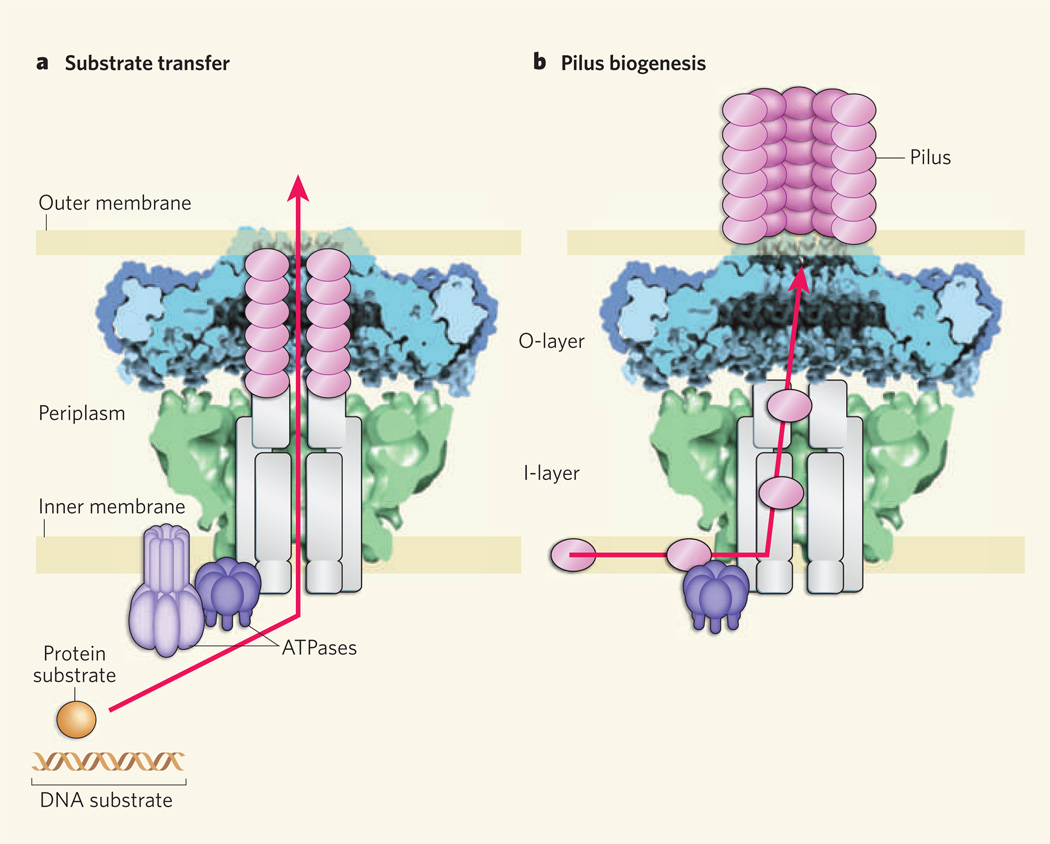
Bacteria transfer DNA and protein substrates to each other and to eukaryotic cells, such as those of plants and animals, using type IV secretion (T4S) systems. These systems span the periplasm region between the outer and inner membranes of bacterial cell envelopes. T4S systems contain a core complex that consists of two layers, the O-layer and the I-layer. The X-ray crystal structure of an O-layer (blue) reported by Waksman and colleagues is shown here with a cryoelectron-microscope image (green) of the same core complex. The remaining subunits of the system are depicted in schematic form. Waksman and colleagues propose two possible functions for the core complex. a, It might serve as a structural scaffold that houses the translocation channel through which substrates pass. Several channel subunits, including pilin proteins (magenta ovals), form a conduit encased within the core chamber, and ATPase subunits bind the substrates ready for translocation. b, The core complex might also act as a scaffold and assembly platform for the conjugative pilus — the hair-like appendage of the T4S system that is used to make contact with other bacteria (or eukaryotic cells) prior to substrate transfer. Pilin proteins in the inner membrane would be passed through the core chamber to the bacterial cell surface to build the pilus.
Comment on
-
Structure of the outer membrane complex of a type IV secretion system.Nature. 2009 Dec 24;462(7276):1011-5. doi: 10.1038/nature08588. Epub 2009 Nov 29. Nature. 2009. PMID: 19946264 Free PMC article.
References
-
- Yeo H-J, Savvides SN, Herr AB, Lanka E, Waksman G. Mol. Cell. 2000;6:1461–1472. - PubMed
Publication types
MeSH terms
Substances
Grants and funding
LinkOut - more resources
Full Text Sources
