


Motor cortical hyperexcitability in idiopathic scoliosis: could focal dystonia be a subclinical etiological factor?
- PMID: 20033462
- PMCID: PMC2899814
- DOI: 10.1007/s00586-009-1243-y
Motor cortical hyperexcitability in idiopathic scoliosis: could focal dystonia be a subclinical etiological factor?
Abstract
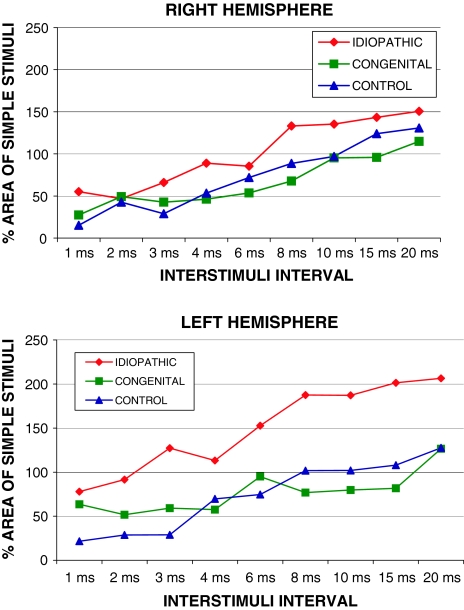
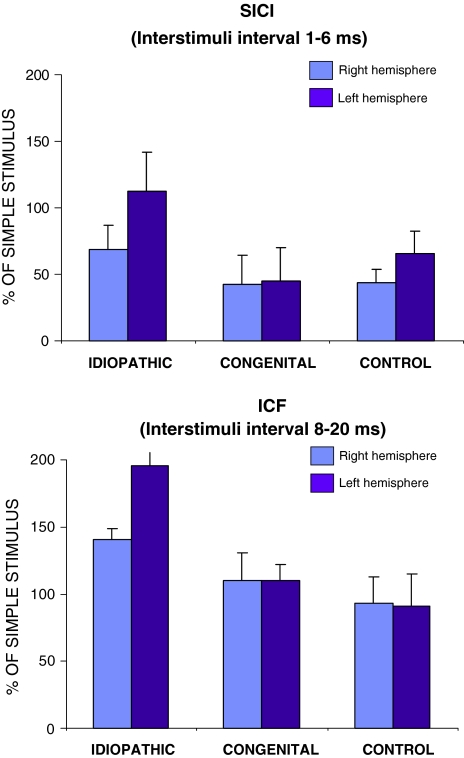
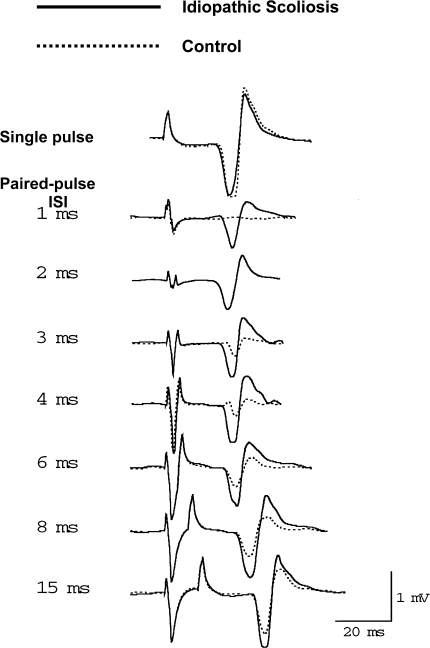
The aetiology of idiopathic scoliosis (IS) remains unknown; however, there is a growing body of evidence suggesting that the spine deformity could be the expression of a subclinical nervous system disorder. A defective sensory input or an anomalous sensorimotor integration may lead to an abnormal postural tone and therefore the development of a spine deformity. Inhibition of the motor cortico-cortical excitability is abnormal in dystonia. Therefore, the study of cortico-cortical inhibition may shed some insight into the dystonia hypothesis regarding the pathophysiology of IS. Paired pulse transcranial magnetic stimulation was used to study cortico-cortical inhibition and facilitation in nine adolescents with IS, five teenagers with congenital scoliosis (CS) and eight healthy age-matched controls. The effect of a previous conditioning stimulus (80% intensity of resting motor threshold) on the amplitude of the motor-evoked potential induced by the test stimulus (120% of resting motor threshold) was examined at various interstimulus intervals (ISIs) in both abductor pollicis brevis muscles. The results of healthy adolescents and those with CS showed a marked inhibitory effect of the conditioning stimulus on the response to the test stimulus at interstimulus intervals shorter than 6 ms. These findings do not differ from those reported for normal adults. However, children with IS revealed an abnormally reduced cortico-cortical inhibition at the short ISIs. Cortico-cortical inhibition was practically normal on the side of the scoliotic convexity while it was significantly reduced on the side of the scoliotic concavity. In conclusion, these findings support the hypothesis that a dystonic dysfunction underlies in IS. Asymmetrical cortical hyperexcitability may play an important role in the pathogenesis of IS and represents an objective neurophysiological finding that could be used clinically.
Figures
References
-
- Sahlstrand T, Örtengren R, Nachemson A. Postural equilibrium in adolescent idiopathic scoliosis. Acta Orthop Scand. 1978;49:54–65. - PubMed
-
- Lao MLM, Chow DHK, Guo X, Cheng JCY, Holmes AD. Impaired dynamic balance in adolescent with idiopathic scoliosis and abnormal somatosensory evoked potential. J Pediatr Orthop. 2008;28:846–849. - PubMed
MeSH terms
LinkOut - more resources
Full Text Sources
Medical
