


Changes in paraspinal muscles and their association with low back pain and spinal degeneration: CT study
- PMID: 20033739
- PMCID: PMC2900015
- DOI: 10.1007/s00586-009-1257-5
Changes in paraspinal muscles and their association with low back pain and spinal degeneration: CT study
Abstract
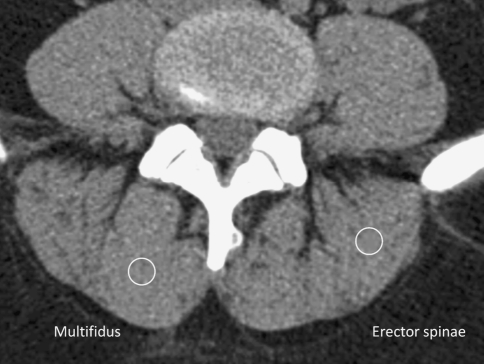
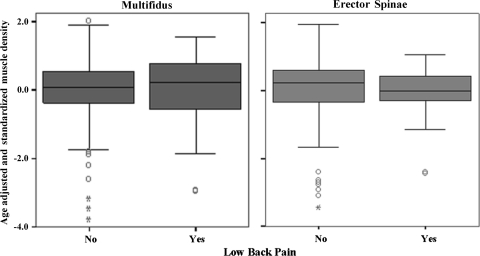
The objectives of the study were to evaluate the association between lumbar paraspinal muscle density, evaluated on computed tomography (CT) and age, sex and BMI; and to evaluate the association of those changes with low back pain (LBP) and spinal degeneration features in a community-based sample. This study was an ancillary project to the Framingham Study. A sample of 3,529 participants aged 40-80 years had a CT scan performed to assess aortic calcification. 187 individuals were randomly enrolled in this study. LBP in the last 12 months was evaluated using self-report questionnaire. Density (in Hounsfield units) of multifidus and erector spinae was evaluated on CT. The prevalence of intervertebral disc narrowing, facet joint osteoarthritis (FJOA), spondylolysis, spondylolisthesis and spinal stenosis were also evaluated. We used linear regression models to examine the association of paraspinal muscles density with age, sex, BMI, LBP, and spinal degeneration features. The results show that in our study, men have higher density of paraspinal muscles than women, younger individuals have higher density than older ones and individuals with lower weight have higher muscle density than overweight. No differences between individuals with and without LBP were found. Significant association was found between L4 multifidus/erector spinae density and FJOA at L4-L5; between multifidus at L4 and spondylolisthesis at L4-5; and between erector spinae at L4 and L5 with disc narrowing at L4-5 and L5-S1, respectively. We conclude that the paraspinal muscle density decreases with age, and increases BMI. It is associated with at some levels FJOA, spondylolisthesis and disc narrowing at the same level, but not associated with occurrence of LBP.
Figures
References
-
- Bolender NF, Schonstrom NS, Spengler DM. Role of computed tomography and myelography in the diagnosis of central spinal stenosis. J Bone Joint Surg Am. 1985;67:240–246. - PubMed
-
- Bulcke JA, Termote JL, Palmers Y, Crolla D. Computed tomography of the human skeletal muscular system. Neuroradiology. 1979;17:127–136. - PubMed
Publication types
MeSH terms
Grants and funding
LinkOut - more resources
Full Text Sources
Medical
Miscellaneous
