


Default network connectivity reflects the level of consciousness in non-communicative brain-damaged patients
- PMID: 20034928
- PMCID: PMC2801329
- DOI: 10.1093/brain/awp313
Default network connectivity reflects the level of consciousness in non-communicative brain-damaged patients
Abstract
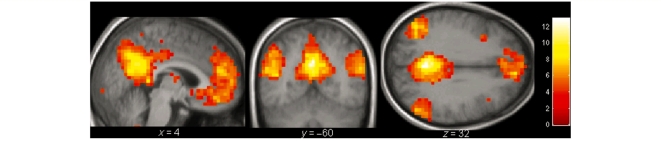
The 'default network' is defined as a set of areas, encompassing posterior-cingulate/precuneus, anterior cingulate/mesiofrontal cortex and temporo-parietal junctions, that show more activity at rest than during attention-demanding tasks. Recent studies have shown that it is possible to reliably identify this network in the absence of any task, by resting state functional magnetic resonance imaging connectivity analyses in healthy volunteers. However, the functional significance of these spontaneous brain activity fluctuations remains unclear. The aim of this study was to test if the integrity of this resting-state connectivity pattern in the default network would differ in different pathological alterations of consciousness. Fourteen non-communicative brain-damaged patients and 14 healthy controls participated in the study. Connectivity was investigated using probabilistic independent component analysis, and an automated template-matching component selection approach. Connectivity in all default network areas was found to be negatively correlated with the degree of clinical consciousness impairment, ranging from healthy controls and locked-in syndrome to minimally conscious, vegetative then coma patients. Furthermore, precuneus connectivity was found to be significantly stronger in minimally conscious patients as compared with unconscious patients. Locked-in syndrome patient's default network connectivity was not significantly different from controls. Our results show that default network connectivity is decreased in severely brain-damaged patients, in proportion to their degree of consciousness impairment. Future prospective studies in a larger patient population are needed in order to evaluate the prognostic value of the presented methodology.
Figures


References
-
- American Congress of Rehabilitation Medicine. Recommendations for use of uniform nomenclature pertinent to patients with severe alterations of consciousness. Arch Phys Med Rehabil. 1995;76:205–9. - PubMed
-
- Baars BJ, Ramsoy TZ, Laureys S. Brain, conscious experience and the observing self. Trends Neurosci. 2003;26:671–5. - PubMed
-
- Beckmann CF, Smith SM. Probabilistic independent component analysis for functional magnetic resonance imaging. IEEE Trans Med Imaging. 2004;23:137–52. - PubMed
-
- Beckmann CF, Smith SM. Tensorial extensions of independent component analysis for multisubject FMRI analysis. Neuroimage. 2005;25:294–311. - PubMed
Publication types
MeSH terms
Grants and funding
LinkOut - more resources
Full Text Sources
Other Literature Sources
Medical
