


A large-scale genetic association study to evaluate the contribution of Omi/HtrA2 (PARK13) to Parkinson's disease
- PMID: 20036034
- PMCID: PMC4724437
- DOI: 10.1016/j.neurobiolaging.2009.11.021
A large-scale genetic association study to evaluate the contribution of Omi/HtrA2 (PARK13) to Parkinson's disease
Abstract
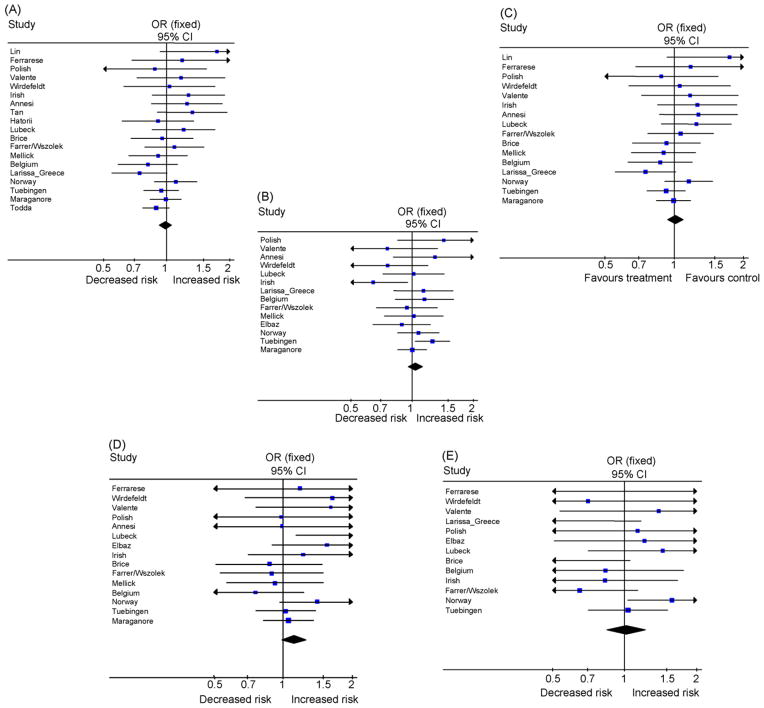
High-profile studies have provided conflicting results regarding the involvement of the Omi/HtrA2 gene in Parkinson's disease (PD) susceptibility. Therefore, we performed a large-scale analysis of the association of common Omi/HtrA2 variants in the Genetic Epidemiology of Parkinson's disease (GEO-PD) consortium. GEO-PD sites provided clinical and genetic data including affection status, gender, ethnicity, age at study, age at examination (all subjects); age at onset and family history of PD (patients). Genotyping was performed for the five most informative SNPs spanning the Omi/HtrA2 gene in approximately 2-3 kb intervals (rs10779958, rs2231250, rs72470544, rs1183739, rs2241028). Fixed as well as random effect models were used to provide summary risk estimates of Omi/HtrA2 variants. The 20 GEO-PD sites provided data for 6378 cases and 8880 controls. No overall significant associations for the five Omi/HtrA2 SNPs and PD were observed using either fixed effect or random effect models. The summary odds ratios ranged between 0.98 and 1.08 and the estimates of between-study heterogeneity were not large (non-significant Q statistics for all 5 SNPs; I(2) estimates 0-28%). Trends for association were seen for participants of Scandinavian descent for rs2241028 (OR 1.41, p=0.04) and for rs1183739 for age at examination (cut-off 65 years; OR 1.17, p=0.02), but these would not be significant after adjusting for multiple comparisons and their Bayes factors were only modest. This largest association study performed to define the role of any gene in the pathogenesis of Parkinson's disease revealed no overall strong association of Omi/HtrA2 variants with PD in populations worldwide.
Copyright © 2009 Elsevier Inc. All rights reserved.
Conflict of interest statement
Figures
References
-
- Bogaerts V, Nuytemans K, Reumers J, Pals P, Engelborghs S, Pickut B, Corsmit E, Peeters K, Schymkowitz J, De Deyn PP, Cras P, Rousseau F, Theuns J, Van Broeckhoven C. Genetic variability in the mitochondrial serine protease HTRA2 contributes to risk for Parkinson disease. Hum Mutat. 2008;29(6):832–840. - PubMed
-
- Bonifati V, Rizzu P, van Baren MJ, Schaap O, Breedveld GJ, Krieger E, Dekker MC, Squitieri F, Ibanez P, Joosse M, van Dongen JW, Vanacore N, van Swieten JC, Brice A, Meco G, van Duijn CM, Oostra BA, Heutink P. Mutations in the DJ-1 gene associated with autosomal recessive early-onset parkinsonism. Science. 2003;299(5604):256–259. - PubMed
-
- Chanock SJ, Manolio T, Boehnke M, Boerwinkle E, Hunter DJ, Thomas G, Hirschhorn JN, Abecasis G, Altshuler D, Bailey-Wilson JE, Brooks LD, Cardon LR, Daly M, Donnelly P, Fraumeni JF, Jr, Freimer NB, Gerhard DS, Gunter C, Guttmacher AE, Guyer MS, Harris EL, Hoh J, Hoover R, Kong CA, Merikangas KR, Morton CC, Palmer LJ, Phimister EG, Rice JP, Roberts J, Rotimi C, Tucker MA, Vogan KJ, Wacholder S, Wijsman EM, Winn DM, Collins FS. Replicating genotype-phenotype associations. Nature. 2007;447(7145):655–660. - PubMed
-
- de Bakker PI, Yelensky R, Pe’er I, Gabriel SB, Daly MJ, Altshuler D. Efficiency and power in genetic association studies. Nat Genet. 2005;37(11):1217–1223. - PubMed
-
- Elbaz A, Nelson LM, Payami H, Ioannidis JP, Fiske BK, Annesi G, Carmine Belin A, Factor SA, Ferrarese C, Hadjigeorgiou GM, Higgins DS, Kawakami H, Kruger R, Marder KS, Mayeux RP, Mellick GD, Nutt JG, Ritz B, Samii A, Tanner CM, Van Broeckhoven C, Van Den Eeden SK, Wirdefeldt K, Zabetian CP, Dehem M, Montimurro JS, Southwick A, Myers RM, Trikalinos TA. Lack of replication of thirteen single-nucleotide polymorphisms implicated in Parkinson’s disease: a large-scale international study. Lancet Neurol. 2006;5(11):917–923. - PMC - PubMed
Publication types
MeSH terms
Substances
Grants and funding
- P50 NS040256/NS/NINDS NIH HHS/United States
- R01 ES010758/ES/NIEHS NIH HHS/United States
- R01AG15866/AG/NIA NIH HHS/United States
- R01NS042859/NS/NINDS NIH HHS/United States
- R01 AG015866/AG/NIA NIH HHS/United States
- R01NS039422/NS/NINDS NIH HHS/United States
- R01 NS042859/NS/NINDS NIH HHS/United States
- CIHR121849/CAPMC/ CIHR/Canada
- R01 NS057567/NS/NINDS NIH HHS/United States
- R01 NS039422/NS/NINDS NIH HHS/United States
- R01NS057567/NS/NINDS NIH HHS/United States
- P50NS40256/NS/NINDS NIH HHS/United States
- P01AG17216/AG/NIA NIH HHS/United States
- P01 AG017216/AG/NIA NIH HHS/United States
LinkOut - more resources
Full Text Sources
Medical
