


Fear potentiation is associated with hypothalamic-pituitary-adrenal axis function in PTSD
- PMID: 20036466
- PMCID: PMC2875386
- DOI: 10.1016/j.psyneuen.2009.11.009
Fear potentiation is associated with hypothalamic-pituitary-adrenal axis function in PTSD
Abstract
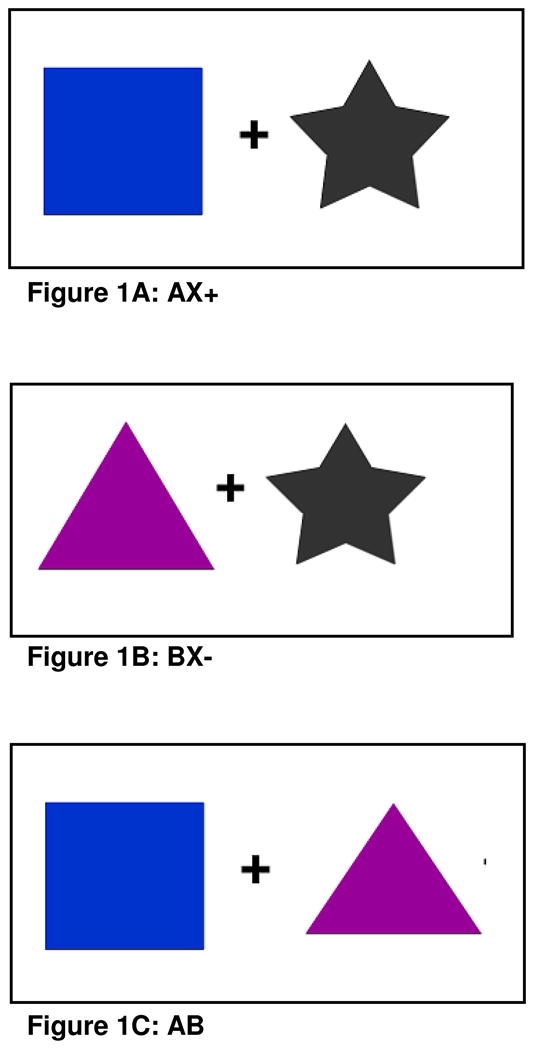
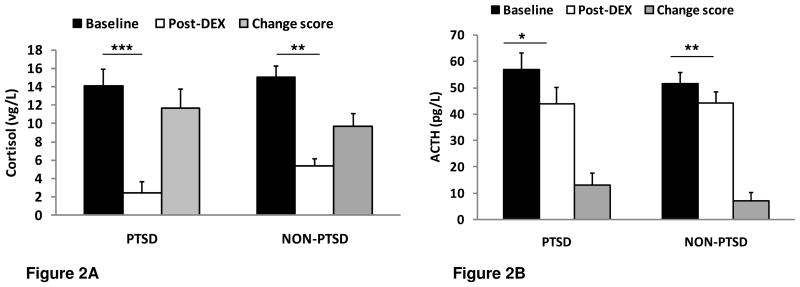
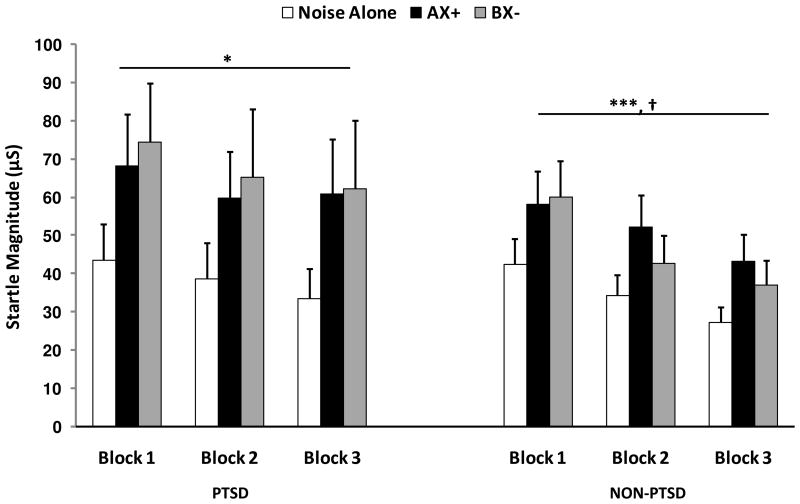
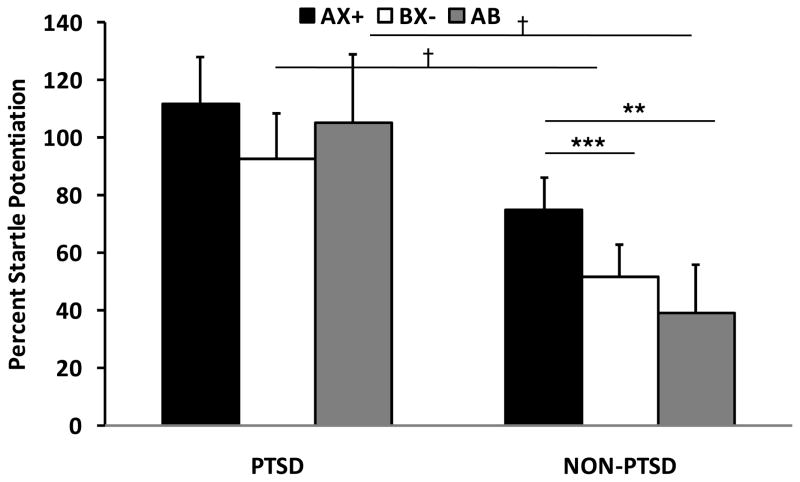
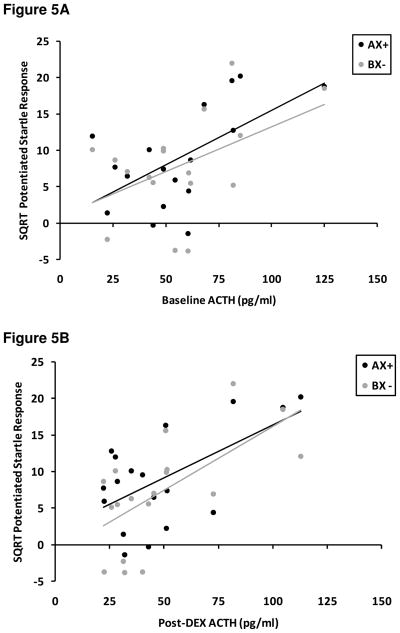
A central problem in posttraumatic stress disorder (PTSD) is the inability to suppress fear under safe conditions. We have previously shown that PTSD patients cannot inhibit conditioned fear. Another relevant finding in PTSD is the hypersensitivity of the hypothalamic-pituitary-adrenal (HPA) axis feedback. Given their common neurobiological pathways, alterations in HPA function in PTSD may be associated with impaired fear inhibition. The present study examined the relationship between HPA axis function and fear-potentiated startle and inhibition of conditioned fear in trauma-exposed individuals. We used a conditional discrimination procedure (AX+/BX-), in which one set of shapes (AX+) was paired with aversive airblasts to the throat (danger signal), and the same X shape with a different shape (BX-) were presented without airblasts (safety signal). The paradigm also included a transfer of fear inhibition test (AB). In addition to fear-potentiated startle, blood was drawn for neuroendocrine analysis and the dexamethasone suppression test (DEX) was performed; cortisol and ACTH were assessed at baseline and post-DEX. Ninety highly traumatized individuals recruited from Grady Hospital in Atlanta, GA participated in the study. The sample was divided into those who met DSM-IV criteria for PTSD (n=29) and Non-PTSD controls (n=61) using the PTSD symptom scale (PSS). Both groups showed significant reduction in cortisol and ACTH levels after DEX. Subjects with PTSD had higher fear-potentiated startle to the safety signal, BX- (F(1,88)=4.44, p<0.05) and fear inhibition trials, AB (F(1,88)=5.20, p<0.05), both indicative of less fear inhibition in the presence of B, compared to control subjects. In addition, fear-potentiated startle to AX+, BX-, and AB was positively correlated with baseline and post-DEX ACTH in PTSD subjects. These results suggest that impaired fear inhibition and associated alterations in HPA feedback may reflect amygdala hyperactivity in subjects with PTSD.
Copyright 2009 Elsevier Ltd. All rights reserved.
Figures
References
-
- Baker DB, West SA, Nicholson WE, Ekhator NN, Kasckow JW, Hill KK, Bruce AB, Orth DN, Geracioti TD. Serial CSF corticotropin-releasing hormone levels and adrenocortical activity in combat veterans with posttraumatic stress disorder. American Journal of Psychiatry. 1999;156:585–588. - PubMed
-
- Beck AT, Ward CH, Mendelsohn M, Mock J, Erbaugh J. An inventory for measuring depression. Archives of General Psychiatry. 1961;4:561–571. - PubMed
-
- Bernstein DP, Fink L. Childhood Trauma Questionnaire A retrospective self-report manual. The Psychological Corporation; San Antonio, TX: 1998.
-
- Bernstein DP, Stein JA, Newcomb MD, Walker E, Pogge D, Ahluvalia T, Stokes J, Handelsman L, Medrano M, Desmond D, Zule W. Development and validation of a brief screening version of the Childhood Trauma Questionnaire. Child Abuse & Neglect. 2003;27:169–190. - PubMed
-
- Blechert J, Michael T, Vriends N, Margraf J, Wilhelm FH. Fear conditioning in posttraumatic stress disorder: Evidence for delayed extinction of autonomic, experiential, and behavioural responses. Behaviour Research and Therapy. 2007;45:2019–2033. - PubMed
Publication types
MeSH terms
Substances
Grants and funding
- R01 MH07 1537/MH/NIMH NIH HHS/United States
- R56 MH071537/MH/NIMH NIH HHS/United States
- M01 RR00039/RR/NCRR NIH HHS/United States
- P50 MH52384/MH/NIMH NIH HHS/United States
- R01 MH071537/MH/NIMH NIH HHS/United States
- R37 MH47840/MH/NIMH NIH HHS/United States
- R01 MH078775/MH/NIMH NIH HHS/United States
- M01 RR000039/RR/NCRR NIH HHS/United States
- R21 MH076869/MH/NIMH NIH HHS/United States
- P50 MH 058922/MH/NIMH NIH HHS/United States
- U19 MH06905602/MH/NIMH NIH HHS/United States
- P50 MH058922/MH/NIMH NIH HHS/United States
- F32 MH070129/MH/NIMH NIH HHS/United States
- R01 MH070880/MH/NIMH NIH HHS/United States
- HHMI/Howard Hughes Medical Institute/United States
- R01 DA018294/DA/NIDA NIH HHS/United States
- UL1 TR000454/TR/NCATS NIH HHS/United States
- MH071537/MH/NIMH NIH HHS/United States
LinkOut - more resources
Full Text Sources
Medical
Miscellaneous
