


Inhibition of ERK1/2 and activation of liver X receptor synergistically induce macrophage ABCA1 expression and cholesterol efflux
- PMID: 20037141
- PMCID: PMC2825427
- DOI: 10.1074/jbc.M109.073601
Inhibition of ERK1/2 and activation of liver X receptor synergistically induce macrophage ABCA1 expression and cholesterol efflux
Abstract
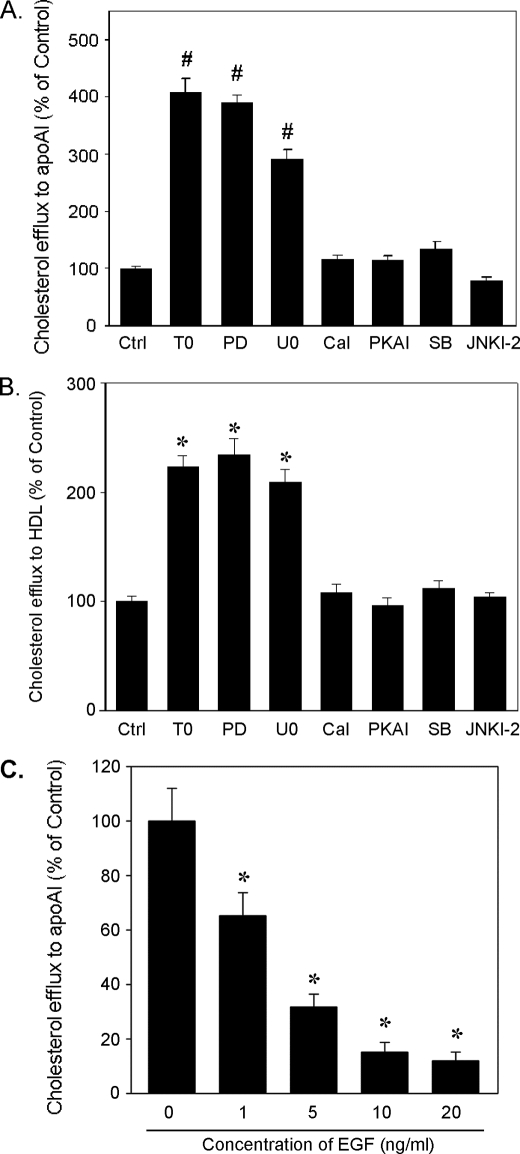
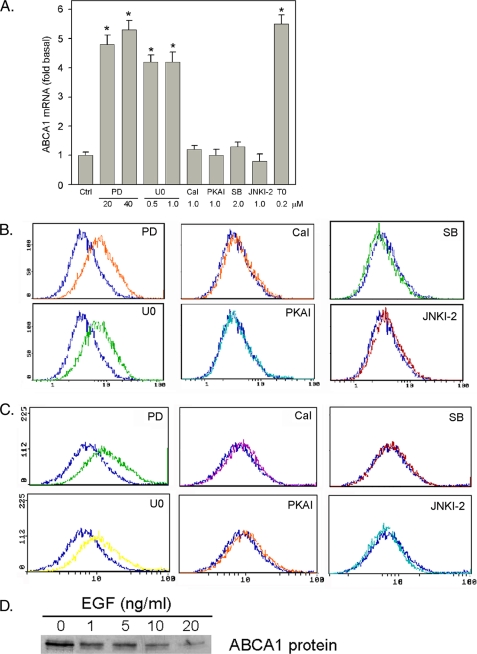
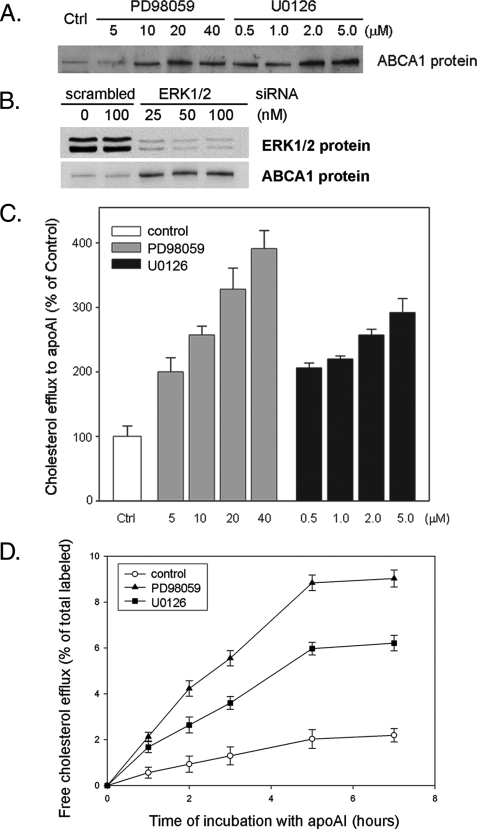
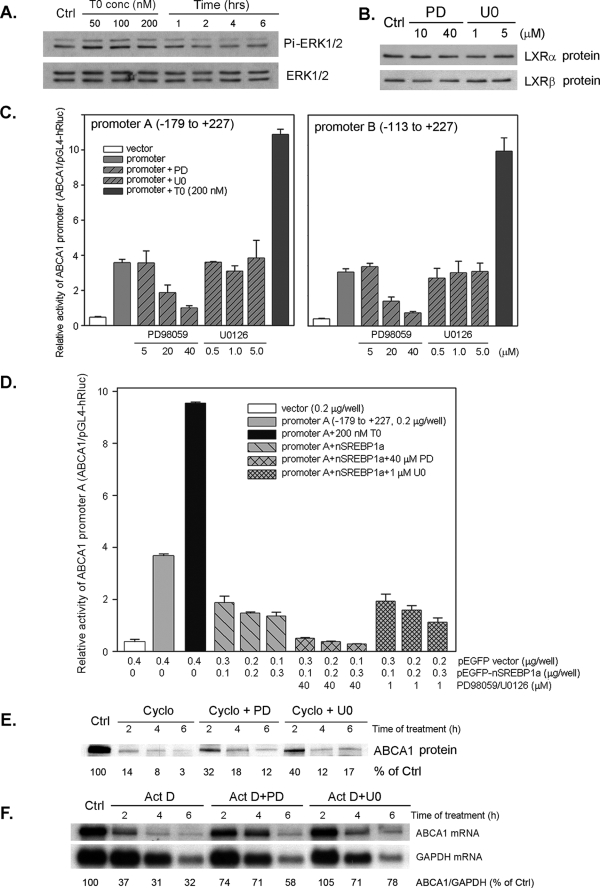
ATP-binding cassette transporter A1 (ABCA1), a molecule mediating free cholesterol efflux from peripheral tissues to apoAI and high density lipoprotein (HDL), inhibits the formation of lipid-laden macrophage/foam cells and the development of atherosclerosis. ERK1/2 are important signaling molecules regulating cellular growth and differentiation. The ERK1/2 signaling pathway is implicated in cardiac development and hypertrophy. However, the role of ERK1/2 in the development of atherosclerosis, particularly in macrophage cholesterol homeostasis, is unknown. In this study, we investigated the effects of ERK1/2 activity on macrophage ABCA1 expression and cholesterol efflux. Compared with a minor effect by inhibition of other kinases, inhibition of ERK1/2 significantly increased macrophage cholesterol efflux to apoAI and HDL. In contrast, activation of ERK1/2 reduced macrophage cholesterol efflux and ABCA1 expression. The increased cholesterol efflux by ERK1/2 inhibitors was associated with the increased ABCA1 levels and the binding of apoAI to cells. The increased ABCA1 by ERK1/2 inhibitors was due to increased ABCA1 mRNA and protein stability. The induction of ABCA1 expression and cholesterol efflux by ERK1/2 inhibitors was concentration-dependent. The mechanism study indicated that activation of liver X receptor (LXR) had little effect on ERK1/2 expression and activation. ERK1/2 inhibitors had no effect on macrophage LXRalpha/beta expression, whereas they did not influence the activation or the inhibition of the ABCA1 promoter by LXR or sterol regulatory element-binding protein (SREBP). However, inhibition of ERK1/2 and activation of LXR synergistically induced macrophage cholesterol efflux and ABCA1 expression. Our data suggest that ERK1/2 activity can play an important role in macrophage cholesterol trafficking.
Figures

References
-
- Arora S., Nicholls S. J. (2008) Drugs Today 44, 711–718 - PubMed
-
- de Villiers W. J., Smart E. J. (1999) J. Leukocyte Biol. 66, 740–746 - PubMed
-
- Suzuki H., Kurihara Y., Takeya M., Kamada N., Kataoka M., Jishage K., Ueda O., Sakaguchi H., Higashi T., Suzuki T., Takashima Y., Kawabe Y., Cynshi O., Wada Y., Honda M., Kurihara H., Aburatani H., Doi T., Matsumoto A., Azuma S., Noda T., Toyoda Y., Itakura H., Yazaki Y., Kodama T. (1997) Nature 386, 292–296 - PubMed
-
- Braun A., Trigatti B. L., Post M. J., Sato K., Simons M., Edelberg J. M., Rosenberg R. D., Schrenzel M., Krieger M. (2002) Circ. Res. 90, 270–276 - PubMed
Publication types
MeSH terms
Substances
Grants and funding
LinkOut - more resources
Full Text Sources
Other Literature Sources
Medical
Molecular Biology Databases
Miscellaneous
