


ERECTA controls low light intensity-induced differential petiole growth independent of phytochrome B and cryptochrome 2 action in Arabidopsis thaliana
- PMID: 20037477
- PMCID: PMC2881279
- DOI: 10.4161/psb.5.3.10706
ERECTA controls low light intensity-induced differential petiole growth independent of phytochrome B and cryptochrome 2 action in Arabidopsis thaliana
Abstract
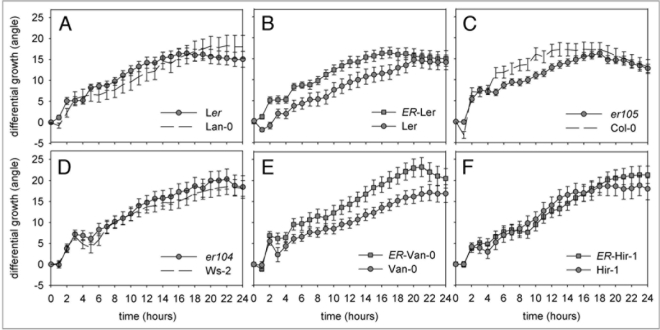
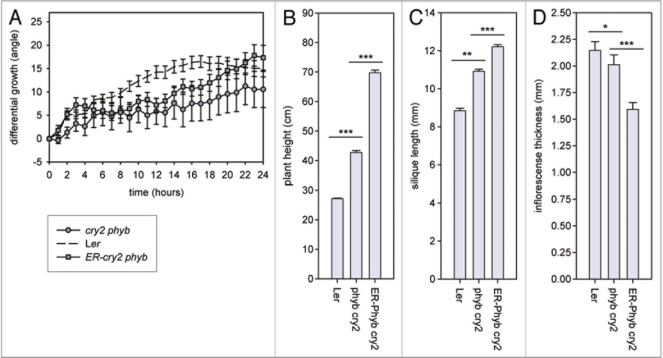
Plants can respond quickly and profoundly to changes in their environment. Several species, including Arabidopsis thaliana, are capable of differential petiole growth driven upward leaf movement (hyponastic growth) to escape from detrimental environmental conditions. Recently, we demonstrated that the leucine-rich repeat receptor-like Ser/Thr kinase gene ERECTA, explains a major effect Quantitative Trait Locus (QTL) for ethylene-induced hyponastic growth in Arabidopsis. Here, we demonstrate that ERECTA controls the hyponastic growth response to low light intensity treatment in a genetic background dependent manner. Moreover, we show that ERECTA affects low light-induced hyponastic growth independent of Phytochrome B and Cryptochrome 2 signaling, despite that these photoreceptors are positive regulators of low light-induced hyponastic growth.
Figures
Comment on
-
Ethylene-induced hyponastic growth in Arabidopsis thaliana is controlled by ERECTA.Plant J. 2010 Jan;61(1):83-95. doi: 10.1111/j.1365-313X.2009.04035.x. Epub 2009 Oct 1. Plant J. 2010. PMID: 19796369
References
-
- Millenaar FF, van Zanten M, Cox MCH, Pierik R, Voesenek LACJ, Peeters AJM. Differential petiole growth in Arabidopsis thaliana: Photocontrol and hormonal regulation. New Phytol. 2009;184:141–152. - PubMed
-
- Mullen JL, Weinig C, Hangarter RP. Shade avoidance and the regulation of leaf inclination in Arabidopsis. Plant Cell Environ. 2006;29:1099–1106. - PubMed
-
- Koini MA, Alvey L, Allen T, Tilley CA, Harberd NP, Whitelam GC, et al. High Temperature-Mediated Adaptations in Plant Architecture Require the bHLH Transcription Factor PIF4. Curr Biol. 2009;19:408–413. - PubMed
Publication types
LinkOut - more resources
Full Text Sources
Molecular Biology Databases
