. 2010 Feb;42(2):137-41.
doi: 10.1038/ng.507. Epub 2009 Dec 27.

A genome-wide perspective of genetic variation in human metabolism

Affiliations

A genome-wide perspective of genetic variation in human metabolism

Thomas Illig et al. Nat Genet. 2010 Feb.

Abstract

Serum metabolite concentrations provide a direct readout of biological processes in the human body, and they are associated with disorders such as cardiovascular and metabolic diseases. We present a genome-wide association study (GWAS) of 163 metabolic traits measured in human blood from 1,809 participants from the KORA population, with replication in 422 participants of the TwinsUK cohort. For eight out of nine replicated loci (FADS1, ELOVL2, ACADS, ACADM, ACADL, SPTLC3, ETFDH and SLC16A9), the genetic variant is located in or near genes encoding enzymes or solute carriers whose functions match the associating metabolic traits. In our study, the use of metabolite concentration ratios as proxies for enzymatic reaction rates reduced the variance and yielded robust statistical associations with P values ranging from 3 x 10(-24) to 6.5 x 10(-179). These loci explained 5.6%-36.3% of the observed variance in metabolite concentrations. For several loci, associations with clinically relevant parameters have been reported previously.


Figures
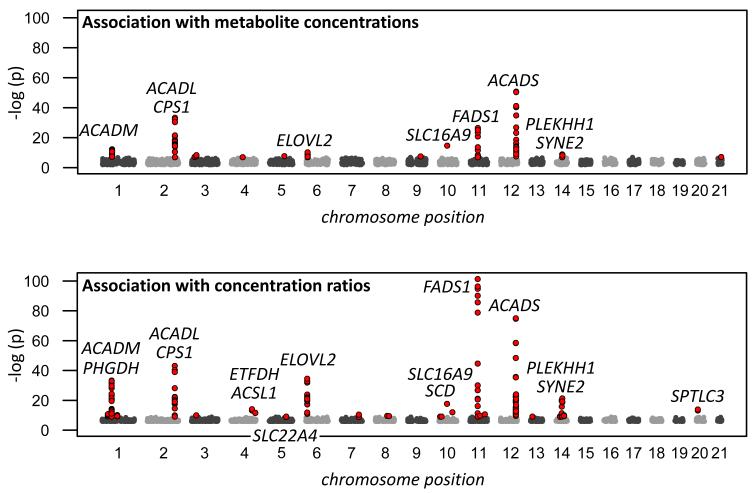
Figure 1
Figure 1
Manhattan plot of the strength of association with metabolite concentrations (top; data points with p<10−7 are plotted in red) and concentration ratios (bottom; data points with p<10−9 are plotted in red); based on association with 1029 samples (step 1 of discovery stage); for each SNP only the metabolic trait with the lowest p-value of association is shown; multiple dots thus indicate that several SNPs support the association at that locus (data provided as Supplementary Table 1).
Figure 2
Figure 2
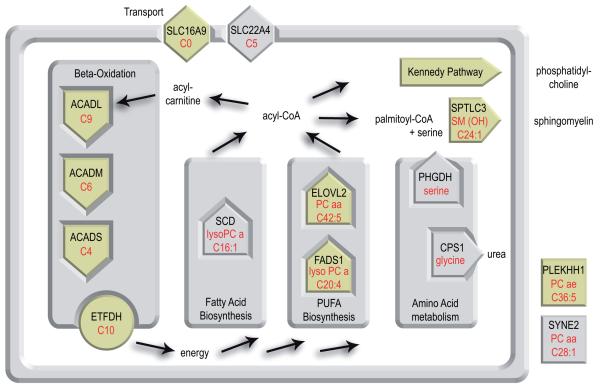
A systemic view of genetic variation in human metabolism as identified by this study. Eight of nine fully replicated genetic polymorphisms (beige) and also four of five suggestive loci (grey) are located in or near enzyme-coding genes that are central to the different processes in human lipid metabolism, that is, the beta-oxidation (ACADS, ACADM, ACADL), the polyunsaturated fatty acid biosynthesis (FADS1, ELOVL2), the fatty acid synthesis (SCD), the breakdown of fats and proteins to energy (ETFDH), and the biosynthesis of phospholipids (SPTLC3). Two SNPs are located in or near genes coding for carrier proteins (SLC22A4, SLC16A9) and two SNPs involve enzymes that are related to amino acid metabolism (PHGDH, CPS1). Only for two genetic variants does the attribution of a metabolic function remain elusive (PLEKHH1, SYNE2). For each locus the most strongly associating single metabolite is indicated in red.

Comment in

  • Inborn variation in metabolism.
    Mootha VK, Hirschhorn JN. Mootha VK, et al. Nat Genet. 2010 Feb;42(2):97-8. doi: 10.1038/ng0210-97. Nat Genet. 2010. PMID: 20104246

References

    1. Gieger C, et al. Genetics meets metabolomics: a genome-wide association study of metabolite profiles in human serum. PLoS Genet. 2008;4:e1000282. - PMC - PubMed
    1. Altmaier E, et al. Bioinformatics analysis of targeted metabolomics--uncovering old and new tales of diabetic mice under medication. Endocrinology. 2008;149:3478–89. - PubMed
    1. Kottgen A, et al. Multiple loci associated with indices of renal function and chronic kidney disease. Nat Genet. 2009 - PMC - PubMed
    1. Kathiresan S, et al. Six new loci associated with blood low-density lipoprotein cholesterol, high-density lipoprotein cholesterol or triglycerides in humans. Nat Genet. 2008;40:189–97. - PMC - PubMed
    1. Willer CJ, et al. Newly identified loci that influence lipid concentrations and risk of coronary artery disease. Nat Genet. 2008;40:161–9. - PMC - PubMed

Publication types